‘You should see what we see.’ What it’s like inside KY hospitals swamped by COVID-19.
Intensive care unit nurse Gena Lewis tried to calm a man in his early 50s with COVID-19 as he waited to be put on a ventilator, “shaking all over, saying, ‘I’m going to die, I’m going to die.’” Joy Murphy did her best to console a patient as he gasped for air, knowing she’d exhausted all options to help him breathe easier. Donita Cantrell’s team of ICU nurses did what a scared patient in his 70s asked and held his hand while he was ventilated, as he could no longer breathe on his own. He thanked them for everything they’d done “because he was afraid this might be the last time he sees them,” Cantrell said.
Dr. Yuri Villaran watched a husband and wife die of coronavirus in his ICU within two weeks of one another. Sabrina Lambert, a nurse practitioner, treated a man in his mid 20s whose coronavirus had stricken him with pulmonary embolisms in his lungs. Sean Daniels, a hospital chaplain, was barred by emergency department nurses from praying with a dying woman amid an overflow of coronavirus patients that spilled into the waiting room; the risk of exposure was too high.
These scenes from across Kentucky aren’t new, but they’re happening increasingly often among a particular group of people: the unvaccinated. As Kentucky’s hospitals scramble to treat record volumes of coronavirus patients, most are bowing under the weight, unable to serve some patients in a timely manner because they’re bumping up against chronic staffing shortages; hastily reallocating resources and canceling elective procedures; unable to accept transfer patients from other hospitals filled to capacity; watching more young people succumb to a potentially avoidable death, or teetering on the edge of the worst possible scenario: being consistently too full to provide adequate care.
Until now, it’s a reality the state has yet to contend with in the pandemic, though some have predicted it. People who are largely unvaccinated began flooding hospital beds in July. In the last eight weeks, hospital admissions from COVID-19 have skyrocketed by more than 950% — a pace that will eventually buckle the system. As Kentucky Public Health Commissioner Steven Stack said on August 10 of states like Louisiana and Alabama, whose health care systems are overrun, “we are just a couple weeks behind … the states to the south of us.”
That time has come for some hospitals, according to interviews with more than a dozen health care providers at hospitals in Ashland, Morehead, London and Lexington, each of which is operating at or beyond capacity.
In Kentucky right now, the sheer volume of COVID-19 admissions in such a short period of time, coupled with a prolonged demand on very specific resources — ventilators, ICU nurses and emergency room doctors — is only increasing the potential for substandard care, providers interviewed for this story said.
Too few beds can certainly be a limitation, but more often the struggle is too few providers to staff those beds. More than half of Kentucky’s 96 acute care hospitals are reporting critical staffing shortages, Gov. Andy Beshear said Friday.
The problem is worsened by an “exodus” of health care workers in the last 18 months. “Even though we may have a physical bed to put someone in, we might not have staff available to take care of that patient up to our normal standard of care,” Dr. Lee Dossett, a hospitalist working with COVID-19 patients at Baptist Health Lexington, said this week.
When that’s the case, something has to give and care is triaged. Typically that means nurses and physicians will take on more patients and hospitals will cancel specialty and elective procedures in order to pull those providers and resources onto units caring for COVID-19 patients.
UK HealthCare this week announced a series of resource-shifting steps it was taking to do just that, including closing portions of Albert B. Chandler Hospital and Good Samaritan Hospital to “pull nursing resources from there to the COVID units.”
The rapid reallocation of resources, which virtually all Kentucky hospitals are doing, to meet a very specific intensive need “strains the entire system,” Dossett said. “When people talk about the hospital system collapsing or being near collapsing, that’s what they’re talking about.”
‘I got no beds’
Dr. Philip Overall traced with his finger St. Claire Regional Medical Center’s line-item patient census on his computer screen Tuesday evening, looking for openings.
“This [surge unit] can hold six patients, and there’s already five in there. And the ICU can hold 14, and there’s already 13 in there,” he said. “Which means I have one critical COVID-19 bed and one critical non-COVID bed to work with all night” — a squeeze that has been “unbelievably common” over the last month.
A few minutes later, the non-COVID bed was filled.
“I got no beds,” Overall said, sighing. “Right now, if you don’t have COVID, I don’t have a bed for you upstairs.”
That meant at least two of the patients in the emergency department he leads would be “boarded,” or spend the night in the ER rather than be admitted. There simply wasn’t space.
Ten more people with coronavirus were admitted to the Morehead hospital on top of the hospital’s 25 or so non-COVID admissions before Dr. Overall arrived that evening. With a volume like that, “we get full real quick,” he said.
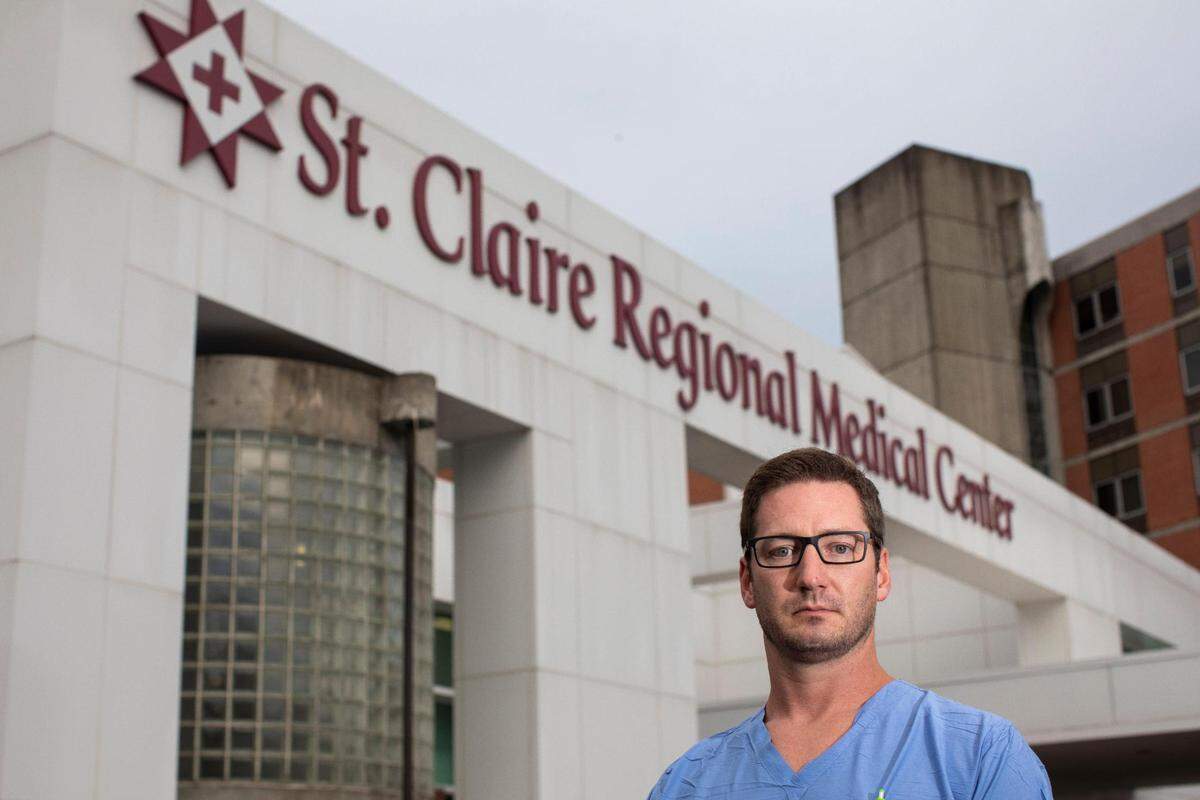
A patient’s first point of contact with a hospital is usually the emergency department, which is designed to quickly assess a patient’s needs, and if need be, admit them to receive more specialized care. But if there are no available staffed beds, it creates a logjam.
“The staffing issues we’re having leads to our emergency room backing up; we have people who are technically admitted to the hospital, but we can’t take them to a bed upstairs,” Dr. Dossett said.
When that happens, like in Dr. Overall’s case, patients are boarded in the ER while others in need of care pool in the waiting room. That night there were three waiting, including one with coronavirus-like symptoms — a manageable amount. Earlier that day at Baptist Health Lexington, the hospital was caring for 64 COVID-19 patients, 10 were in the ICU, and seven were delayed in the ER waiting to be admitted to a bed, Dr. Dossett said.
Other hospitals are facing untenable patient loads, like King’s Daughters Hospital in Ashland. “By 4 p.m. today, they had 78 people waiting to be seen,” one of Dr. Overall’s nurses told him incredulously.
“That’s real bad news,” he said.
It’s not uncommon for regional hospitals like St. Claire to accept patient transfers from other smaller hospitals or to transfer their own patients to larger hospitals, such as UK HealthCare. But the sheer deluge of patients at hospitals statewide has radically constricted the ability of larger hospitals to accept transfers, which exacerbates the risk of compromised care.
Later Tuesday evening, a doctor from a hospital west of Jacksonville, Florida, called the Morehead ED desperate to find an ICU bed for one of their COVID-positive patients.
“They couldn’t find ICU COVID beds in the entire southeast. That hospital is 742 miles from Morehead,” Overall said, shaking his head. “That gave me chills.”
‘Like it was all in vain’
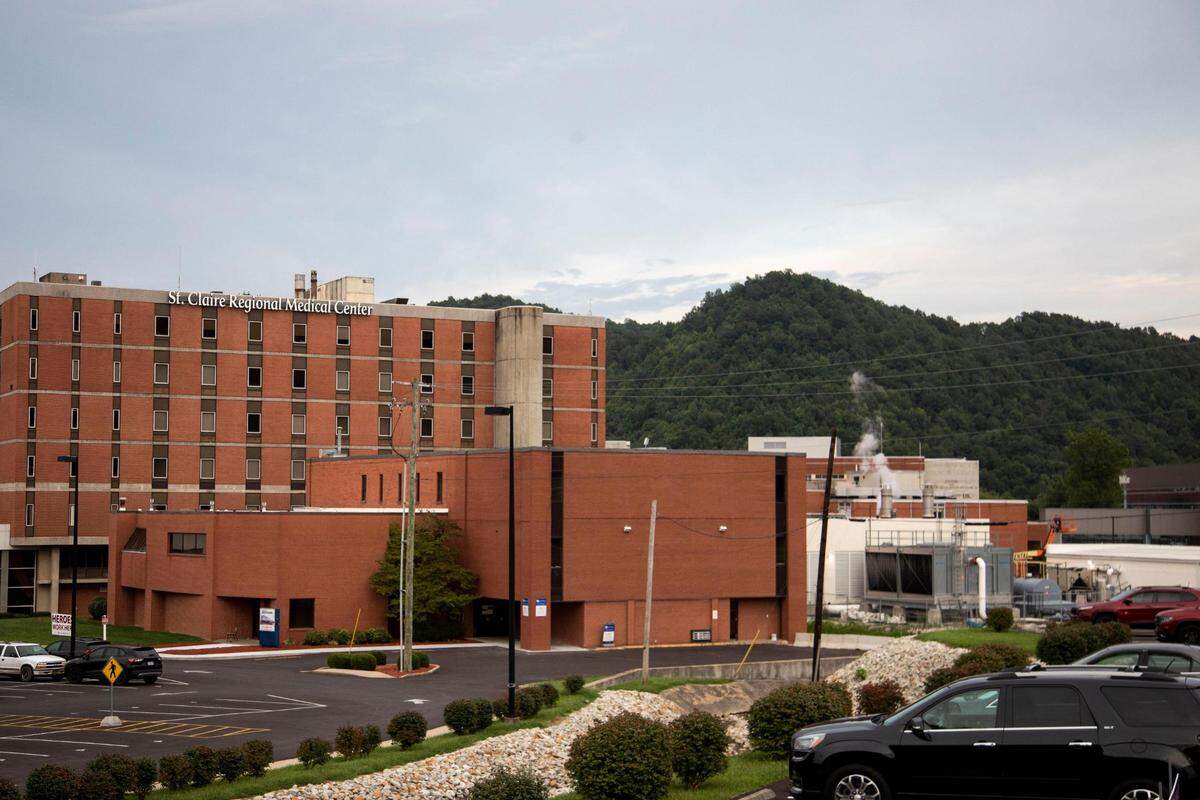
Coronavirus patients are quite literally overflowing, forcing St. Claire to retrofit two additional surge units to house them. The hospital has adequate staffing for 77 beds; on Tuesday evening there were 92 patients, including 29 with COVID-19. Many of those patients are in their 50s and 60s. A 36-year-old had been admitted for 11 days. A 54-year-old had been in the hospital for 17 days. A 55-year-old had been there for 26 days.
That’s the thing with coronavirus patients — since they are increasingly younger and sicker, people’s length of stay in the hospital tends to be longer.
“In order to free up beds to admit to, we’ve got to get people out of the hospital, too,” Dr. Overall said. “These COVID patients stay for a long time.”
Caring for a patient sick with COVID-19, especially one in an ICU, requires more direct staff support; patients have to be closely monitored around the clock, especially if they’re reliant on a ventilator to breathe. Since the virus preys on people’s respiratory systems, which affects their blood-oxygen level, many require supplemental oxygen. In addition, a patient may need to be proned — a last-ditch intensive process that involves turning the patient face down on their stomach and letting gravity increase blood flow and expand their lungs.
This process helps, but it requires near-constant attention from a provider. With ICU nurses in short supply, it limits the number of patients they can care for at once.
“How can we provide all the care that all these patients need if we don’t have enough people to do it with?” said Dr. Yuri Villaran, an intensivist at Baptist Health Lexington.
Providers are exhausted from treating patients who are sicker and dying younger. And while all health care personnel interviewed for this story are deeply sympathetic to their patients, some can’t stave off frustration at the throngs of people continuing to suffer and die from what’s now largely a preventable disease.
“I vacillate back and forth: I’m angry at times, but it doesn’t affect the way I care for patients,” said Joy Murphy, an ICU nurse who works with COVID-19 patients at Baptist Lexington. The anger, she said, arises from seeing people from their 30s to 60s, largely unvaccinated, become so intensely sick.
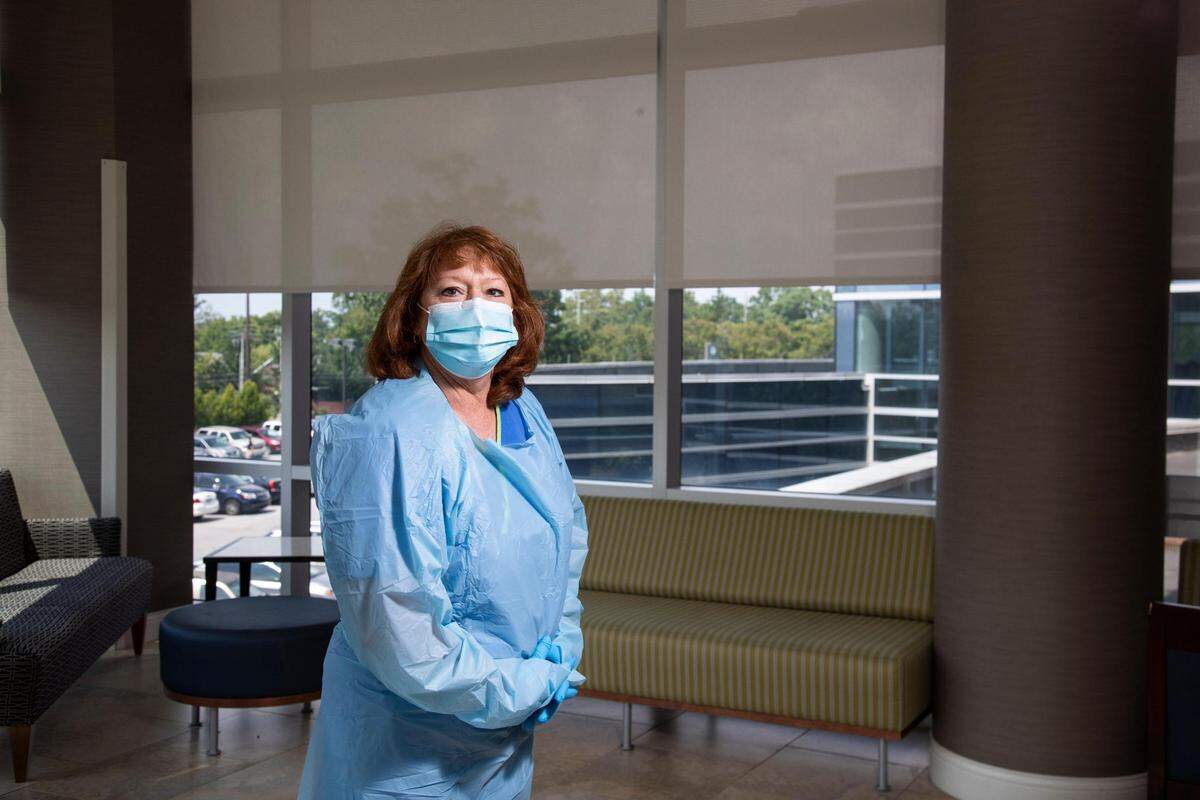
“The thing that’s harrowing for me is to see somebody gasp for breath and to know that I’ve already done everything I possibly could for them. I’ve already given them as much oxygen as I can give them. At that point in time, all I can do is just be there with them. That’s every day here. I’m tired of seeing people die,” she said. “I wish I could carry a sign around that says, ‘You should see what we see.’”
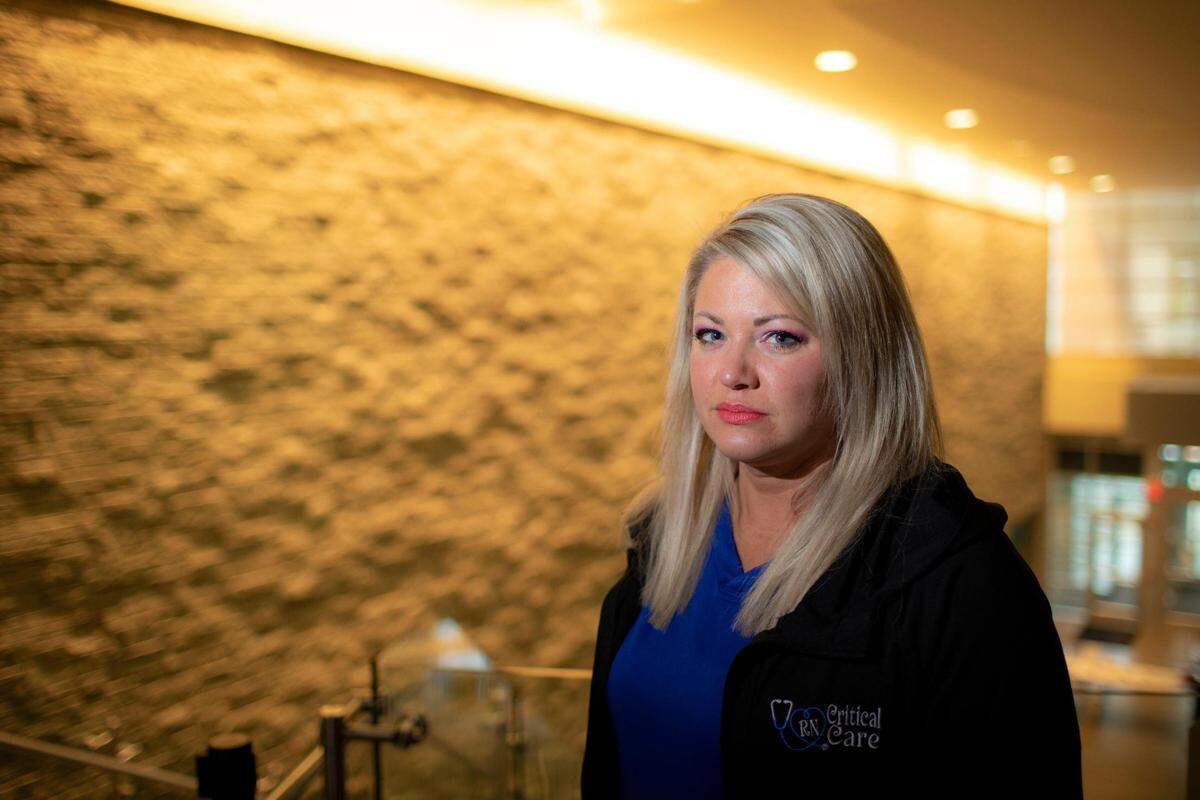
Gena Lewis, an ICU nurse treating coronavirus patients at CHI Saint Joseph in London, said it’s devastating to treat so many young sick patients, knowing many won’t live.
“They come down here sick as a dog and you know in the back of your mind that they’re probably not going to live. So then you just have to kinda suck that up and try to be positive and say, ‘We’re going to work hard, we’re going to pray for you,’ and you know good and well probably they’re not going to make it,” she said. “50-years-old, 30-years-old with kids at home. Five-year-olds. And that just relates to you as a nurse because you got kids at home, too. The emotional part of it tears your guts out.”
And then there’s the fatigue and burnout.
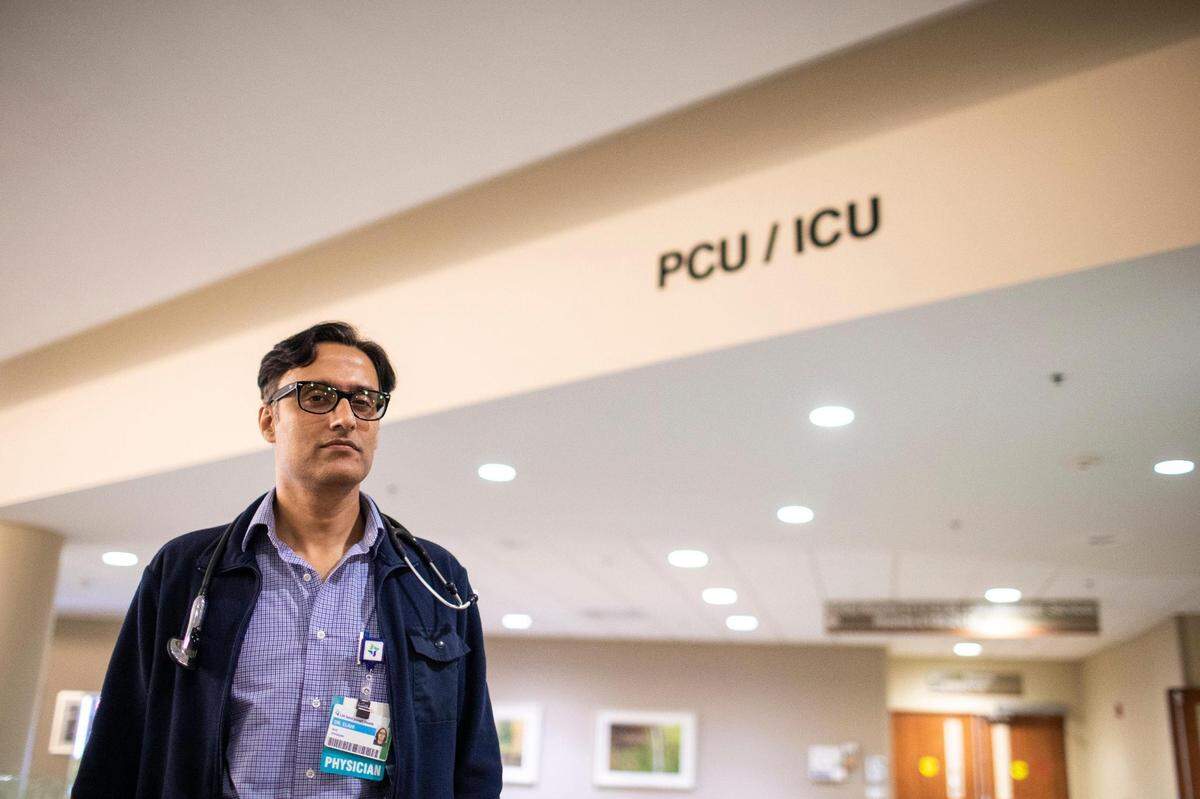
“Personally, I’m just sad,” said Dr. Asim Elahi, a hospitalist working alongside Lewis in London. “It comes to a point when you try to get to that point where you don’t really want to work and you’re just tired.”
Elahi, 45 and a runner, caught the virus last year and was in bed for three weeks, out of work for six. He and his family, like many, took aggressive measures to protect themselves and those around them, like wearing masks in public and spending minimal time indoors with others.
Now, “it’s like all that was in vain. Whatever we did for a year, it’s all going down the drain.”
‘I will not let her suffer’
In a small room a few floors above Overall’s ER at St. Claire, seven family members sat in chairs against a wall, crying, holding hands, emotionally bracing for what Dr. John Sanders was about to say.
“I can only imagine how bad this sounds, and I’m so sorry,” he said. “I just don’t think she’s going to make it. And I’m afraid at this point that we’re prolonging her suffering. I recommend that we stop life support and keep her comfortable.”
At the news, one of the patient’s adult children shook and sobbed through her mask, holding the hands of the sisters on either side of her.
“She won’t suffer at all?” another daughter asked.
“I will not let her suffer, I give you my word on that,” he said tenderly.
Sanders was referring to a 67-year-old woman in the hospital’s intensive care unit — this family’s mother, daughter, sister. She’d become gravely sick with COVID-19 since she was admitted almost two weeks ago. One of four patients on a ventilator on this floor, she could no longer breathe on her own and her vital signs were plummeting.
Next, Dr. Sanders said, only two could go in and say goodbye at a time. Each would have to don full personal protective equipment — a gown, gloves, glasses, a hair net, and an N95 — to go into her room. The other family members who had gathered downstairs were unfortunately not allowed in; the hospital had already reached its visitor limit. Like virtually all hospitals in Kentucky, very few, if any visitors were allowed inside to avoid further exposing others to the virus.
Pair by pair, they would say their goodbyes. “Can she hear us?” one of the patient’s sons asked.
“My advice is you should talk to her like she can hear you,” Dr. Sanders said.
The patient they were grieving wasn’t vaccinated, along with 72% of the other hospitalized patients in this Eastern Kentucky hospital. None of the four patients on ventilators were immunized.
“Here’s the thing about the COVID,” Dr. Sanders said. “First off, please, please, please get immunized.”
Some of the family said they had been. Others hadn’t.
For patients who arrive sick with COVID-19 at the hospital, vaccination cannot, at that point, help them. As Medical Director of hospice and palliative care medicine, Dr. Sanders knows this, which is why he makes a point to urge families of patients to get vaccinated.
“I don’t want to be rude and insensitive, but I also feel like it’s my duty from a public health standpoint,” he said beforehand. “This might be my opportunity to make a little dent in it.”
An ICU nurse helped each of them put on the requisite gear and escorted them into the patient’s room, where she lay motionless on her back with breathing tubes down her throat, the machines keeping her alive humming lowly. In just a moment, nurses would remove the breathing tubes, leaving her to breathe on her own until she couldn’t anymore. Two of the family members would wait until that moment, so they could be with her as she took her last breath.
Staff extubated her. Her breaths were shallow and infrequent, her stomach heaving gently to inhale. Her children touched her arms and her forehead, gently brushing her hair, sobbing into their masks.
Her breathing became even more sporadic until, finally, it stopped.
Dr. Sanders, in full PPE, lifted his stethoscope from around his neck and listened to her chest for a heartbeat.
“She’s gone,” he said gently.
One of her daughters wailed.
“You were such a good mom. I’m going to miss you so much,” she said as she pressed her forehead against her mom’s. “I love you. You can go home now.”
This story was originally published August 27, 2021 at 2:40 PM.