Beshear encourages booster doses amid signs of waning immunity among the vaccinated
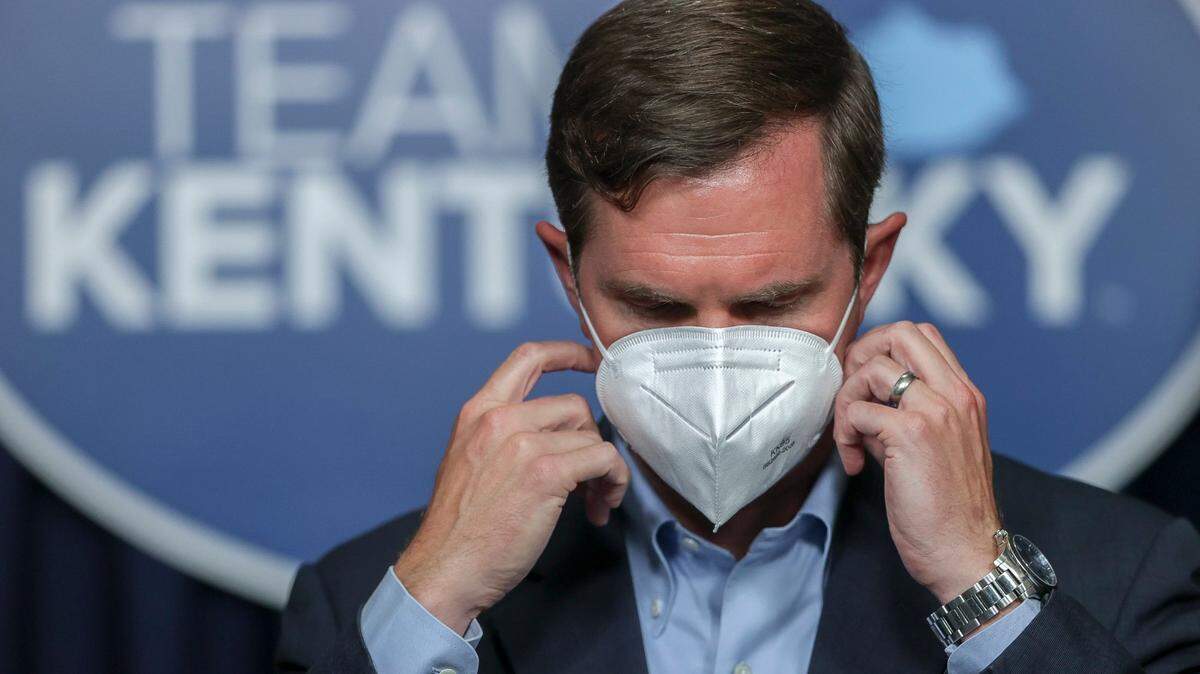
While Kentucky has clocked six consecutive weeks of declining COVID-19 cases and seven straight weeks of a declining positivity rate, more vaccinated residents are testing positive, which Gov. Andy Beshear on Monday said signals a need for people to get their booster dose.
Though a vast majority of those testing positive and getting sick enough to be hospitalized are unvaccinated, the increasing number of fully inoculated breakthrough cases shows how immunity wanes over time, Beshear said in a news conference.
Between March and May of this year, for instance, only 5% of Kentucky’s new coronavirus cases were among fully vaccinated individuals. But through the summer and early fall surge, which was driven by the more contagious Delta variant, that amount swelled to 16%. Similarly, from March to September, 92% of all people hospitalized with the virus were unvaccinated. But factoring in people hospitalized in October, that rate dipped to 84%.
“When you look at this growth, the only natural explanation is that the immunity does lessen a little over time,” Beshear said. But that’s to be expected: “This isn’t bad news; the vaccines work, this just means you need a booster.”
In other plea to convince younger Kentuckians to get the jab, Beshear reiterated that the Delta variant is killing more younger people than previous strains. Pre-Delta, from March to May, 2% of all deaths from COVID-19 were among people ages 30 to 49. That amount escalated to 13% from June to October.
“If you’re in that age group, a lot of people are now dying of COVID,” Beshear said. “You need to get your vaccine, and then if you qualify, you need to get your booster.”
On Saturday and Sunday, Kentucky reported 1,652 new coronavirus cases and 22 deaths, including a 34-year-old woman in Madison County, a 35-year-old woman in Anderson County and a 42-year-old man in Breckenridge County. On Monday, the state logged 568 new cases and another 26 new deaths, including a 24-year-old man in Bullitt County and a 35-year-old woman in Jefferson County.
Prevalence of the virus otherwise continues to recede across the commonwealth, but Beshear did note two blips his office is monitoring. The statewide positivity rate, for example, has been in relative free fall for almost two months. But that rate rose slightly from 4.98% on Halloween to 5.03% on Monday, which has only happened one other time in the last month, Beshear said. Similarly, the number of new cases continues to drop week over week, but Monday’s case total (568) was higher than the daily increase on Monday, October 25 (544).
It’s too early to tell if that is “more than just a daily blip,” Beshear said, but it could portend that Kentucky is “moving toward a plateau, as opposed to a significant downward slope.”
Though the statewide positivity rate is roughly 5% for the first time since early July, only a little over half of Kentuckians are fully vaccinated: 57% have received at least one dose, but closer to 51% are fully vaccinated — the 17th lowest rate nationwide, according to Centers for Disease Control and Prevention data. The highest rates of vaccination are clustered in the state’s more densely populated urban centers, leaving much of rural Kentucky still susceptible to high levels of community transmission. In more than 25 counties, 40% or fewer residents are vaccinated, according to the state health department.
The availability of vaccines to younger children will help make a dent in the commonwealth’s vaccination rate. On Friday, the U.S. Food and Drug Administration authorized the Pfizer-BioNTech vaccine for emergency use in children ages 5 to 11. Shots could become available to children this week if the CDC grants its separate approval. When the green light is given, parents can visit kycovid19.ky.gov to find sites administering the Pfizer vaccine.
Though fewer counties are experiencing severe levels of community transmission, because a majority of teenagers and no children are yet vaccinated, “it is too early to lift universal masking at our schools,” Beshear said.
Only children and teenagers ages 12 and older are currently eligible for a vaccine. Nearly 60% of those eligible Kentuckians have gotten at least a first dose, and younger residents continue to account for the lowest rates. Roughly 42% of teenagers between 12 and 15 and 46% of 16- and 17-year-olds have gotten at least one dose, compared to 65% of 40- to 49-year-olds and 91% of 65- to 74-year-olds.
This story was originally published November 1, 2021 at 5:21 PM.