‘We’re creating addicts.’ How Kentucky doctors plan to slash opioid use at hospitals.
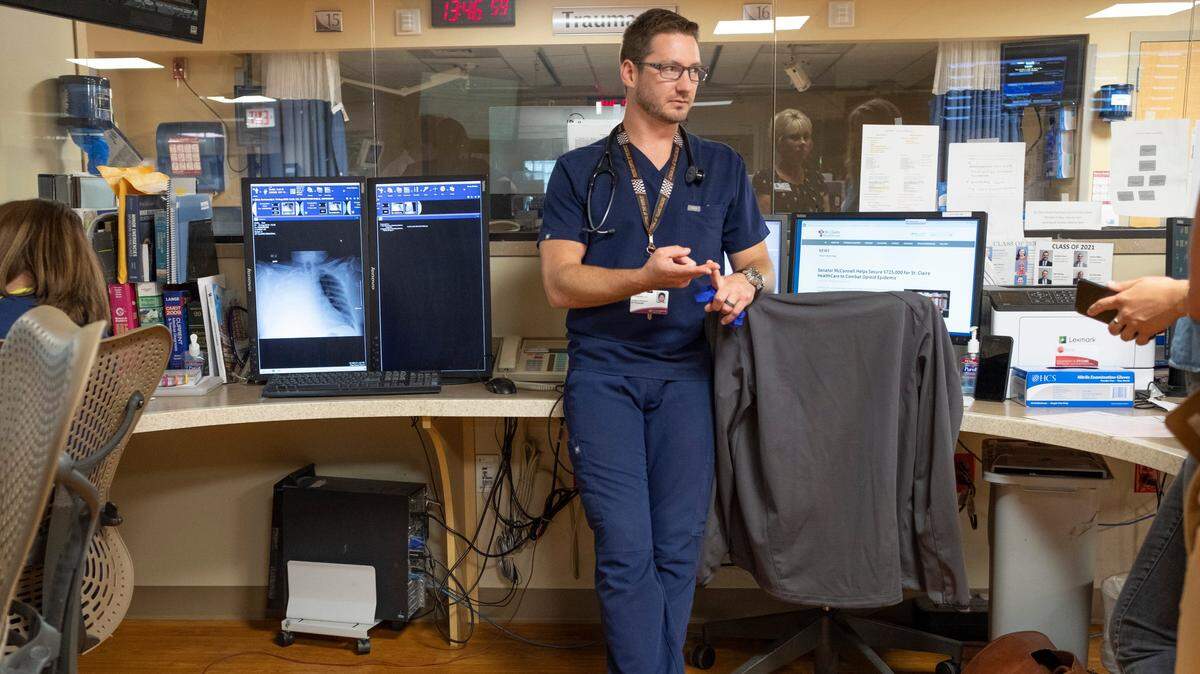
On a recent Saturday night in the emergency room at St. Claire Hospital in Morehead, Dr. Philip Overall faced a familiar dilemma.
It was just after 10:30 p.m., and a woman in her 50s with a spate of chronic illnesses had just arrived with debilitating abdominal pain.
Overall pulled open the curtain to the patient’s temporary room to find her sitting hunched on her bed, clutching her left side through her hospital gown. The sharpness of her pain, which had throbbed for several hours, kept her from lying down or breathing normally, and she had started to sweat, she told Overall, “‘cuz I’m hurting so bad.”
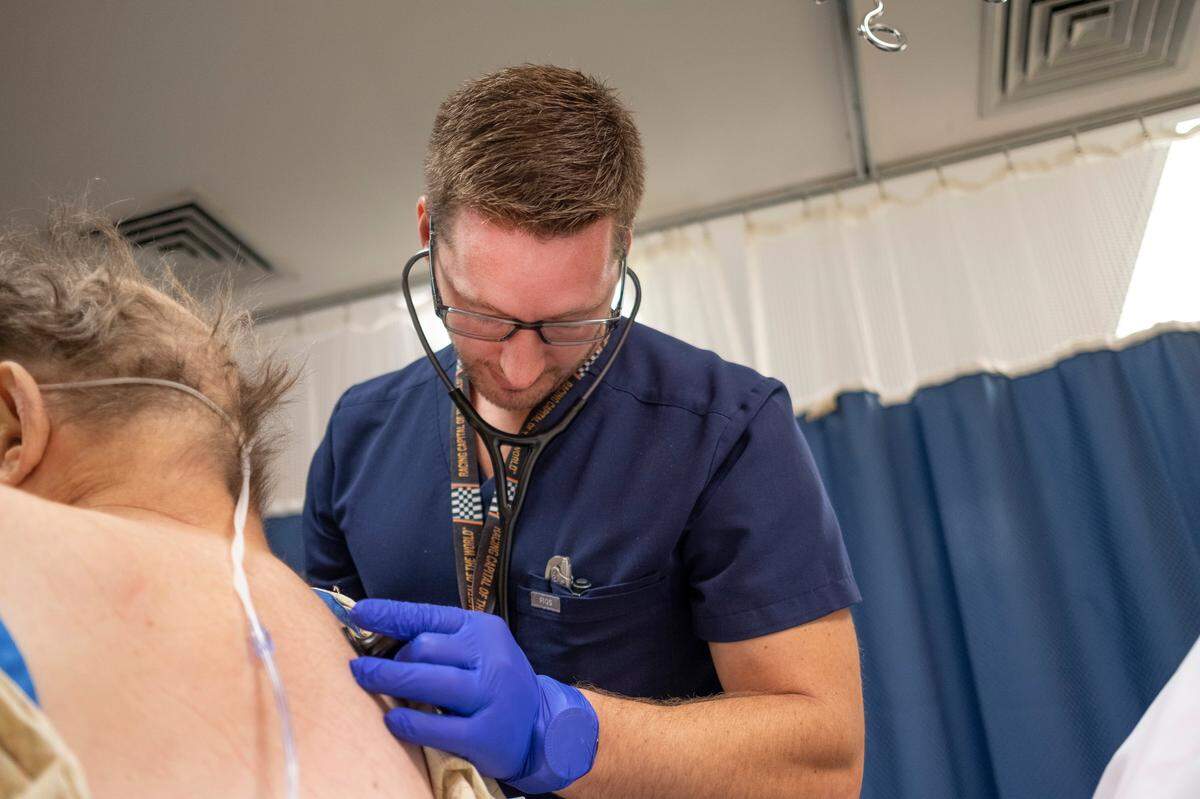
The 36-year-old ER medical director asked her to lay back, and she winced and her limbs twitched as he gently pressed on her abdomen — the first of several routine tests and scans that would be conducted to determine the root of her pain. Other than a slightly elevated heart rate, her vitals were normal.
Her list of ailments is extensive, as is her daily list of prescriptions: epilepsy, Hepatitis C, high blood pressure, diabetes, heart attack survivor, and at least one medication to manage each. She tells Overall she’s undergone past surgeries to remove her appendix and gallbladder, and had multiple Caesarean sections for her children.
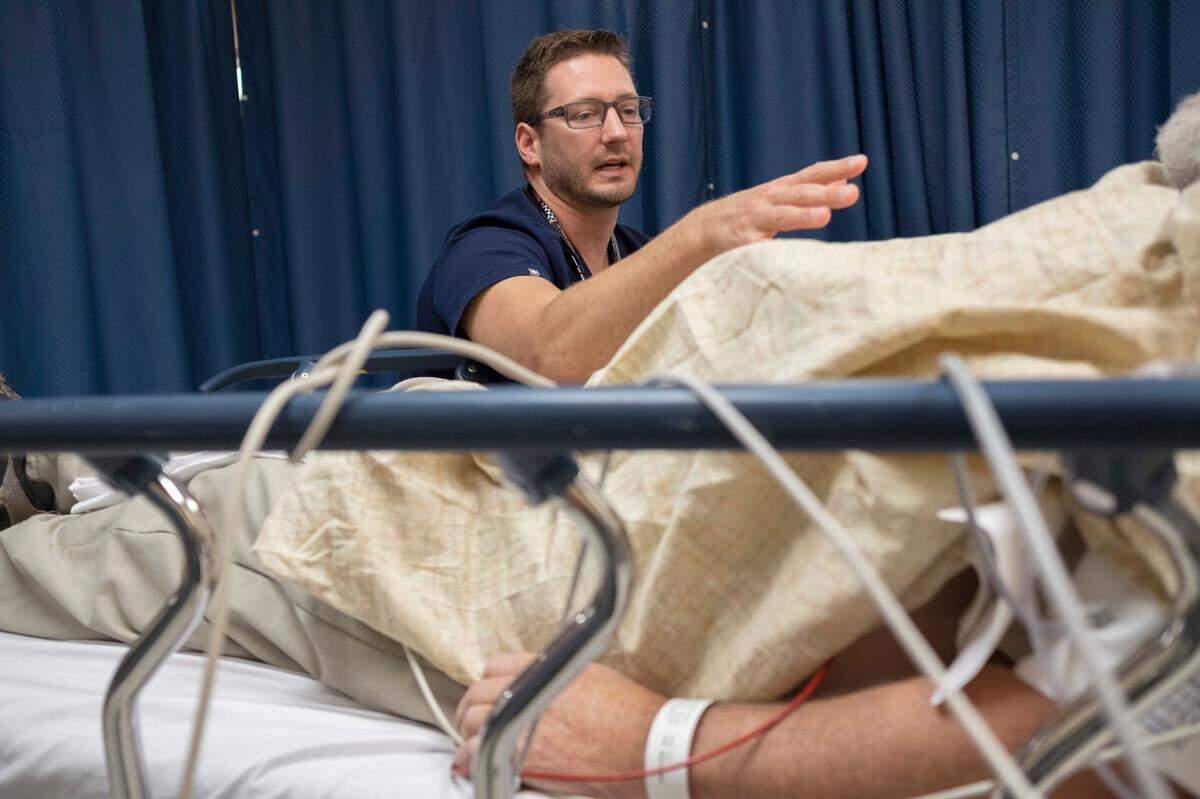
She also has a history of opioid abuse, though her last drug screening was clean, Overall sees a few minutes later as he’s combing through her medical records on his computer. Complicating matters, she said she’s allergic to Ibuprofen, Tylenol, and a handful of low-grade opioids, including morphine.
This means if Overall wants to treat her pain immediately, one of his only choices is Dilaudid — a highly addictive opioid typically reserved for cancer patients.
Giving her this drug would likely knock her pain out completely, but it also risks inflaming her addiction. Even if she hadn’t been in recovery, prescribing such a strong opioid always carries with it the risk of future abuse, Overall said.
But opting not to treat her pain with traditional promptness meant she would continue to sit in anguish at least until her labs returned and he could better understand why she was hurting, or until she was admitted to the hospital.
“She may be in pain, but am I going to throw Dilaudid at her for something that I don’t even know what it is, when she’s got a history of opioid abuse?” Overall wondered aloud. “Is this medicine really necessary? Right now, I don’t think it is,” he decided.
In other words, does providing relief with opioids outweigh the known risk of exposure? It’s a question doctors in hospitals across Kentucky are asking themselves, in some cases for the first time, as part of a new statewide initiative to combat the deadly addiction crisis by uniformly slashing opioid prescription rates.
A few years ago, Overall said he would’ve treated her pain “reflexively,” without a second thought. “Now, I withhold those narcotics unless I deem them immediately appropriate.”
This cautious stewarding of prescription opioids has been a common practice among several doctors at the Eastern Kentucky hospital since 2016, when the state’s fatal overdose rate was at its peak.
In Overall’s ER, where acute pain is the most common reason patients visit, the internal shift meant no longer using opioids as a “first line therapy for pain control,” he said, reading from his department policy.
Instead, staff are urged to “maximize” alternatives, like ice, heat, and over-the-counter painkillers such as acetaminophen, Ibuprofen, muscle relaxers, and other non-steroidal anti-inflammatory drugs (NSAIDs). “Strongly discourage” treating more comparably minor ailments with opioids, the policy directs, including headaches, simple sprains, contusions, fibromyalgia, osteoarthritis, and, in the case of Overall’s female patient, “non-specific abdominal pain.”
If opioids are necessary, “prescribe the lowest effective dose and quantity,” or a dose that lasts no longer than three days. In those cases, each patient must first be searched in the eKASPER system — a statewide controlled prescription monitoring database. It gives a provider details of a patient’s history, including the type and frequency of past prescriptions. Refills aren’t allowed.
In Overall’s ER, where about 30,000 patients visit each year, upwards of 14 percent of those discharged in 2016 left with opioids, according to hospital data. The national rate around that time was closer to 17 percent, according to a study from the American College of Emergency Physicians.
Statewide in 2017, Kentucky providers prescribed 87 opioids for every 100 people — the seventh highest rate in the country, according to the Centers for Disease Control and Prevention. That same year, the Kentucky General Assembly passed House Bill 333, which placed a three-day limit on opioid prescriptions for acute pain.
Overall’s policies went even further, making opioids a last resort in nearly all circumstances. In 2017, a year after changes were instituted, the rate of patients leaving his ER with an opioid dropped by more than two thirds, to under 4 percent, where it has hovered since. Of the 2,413 patients who visited the ER in July, only 82 — about 3 percent — left with a prescription.
Now, roughly a decade after Kentucky was first choked by a devastating opioid abuse epidemic that roiled the nation and stacked death tolls higher than the Vietnam War, positive results like St. Claire’s are motivating a small cohort of UK HealthCare doctors to achieve something historic: slash high-risk prescription opioid rates at virtually all of Kentucky’s 125 hospitals by at least half.
‘Your pain will not be zero’
“What’s really, really important, and I can’t stress this enough, is resetting the expectation with our patients,” Dr. Phillip Chang, UK HealthCare’s chief medical officer, told a small group of health care providers in a basement room of the Hazard Appalachian Regional Healthcare Medical Center in mid October.
“‘Listen, your pain will not be zero,’” he pretended to tell a patient. “‘Our goal is to get your pain level to be tolerable so you can participate in physical therapy.’”
Having this conversation with patients and relying on less addictive treatment options in lieu of opioids is likely to take more time, “but believe it or not, the patients responded better to it, because we actually talked to them about their pain,” he told the 35 or so health care officials. Most had traveled from across the region to be here to learn about Chang’s brainchild, the Kentucky Statewide Opioid Stewardship program, first unveiled this summer.
The program’s goals are simple but the lift sounds heavy: systematically alter prescribing practices in order to dramatically cut prescription rates. Rely, instead, on evidence-based practices, which have evolved beyond defaulting to opioids. When opioids are necessary, dispense them in minimal doses, educate patients on safe usage and connect those who need it with addiction treatment options.
This includes keeping short- and long-term opioid prescribing, especially for those patients with abuse histories, to a minimum, and otherwise keeping as many patients “opioid naive” as possible,” said Dr. Doug Oyler, a trauma pharmacist and director of the Office of Opioid Safety at UK.
“What we’re trying to achieve is nothing short of a cultural change,” Chang, 46, said by phone in early October. “If you think about how you want to deliver this message to everybody and really change the culture of how Kentuckians view opioids and pain management, it has to be through the hospital systems.”
The need to stifle traditional opioid prescribing practices isn’t new, but, prior to now, there’s been no coordinated push to do so in Kentucky. For those who’ve tried, there weren’t other models to copy. Progress has mostly been a result of independent gumption on the part of providers, like Chang and Overall, to try something locally untested.
What Chang and a handful of mostly Central Kentucky doctors have done is formalize the opioid stewardship philosophy into an actionable plan for others, one that the Kentucky Hospital Association and the Cabinet for Health and Family Services have endorsed as part of the Kentucky Opioid Response Effort, or KORE.
For its statewide scale and applicability across hospital departments, KY SOS is the first of its kind in the country, Chang said. Other states have pioneered their own prescription reduction efforts, but most are limited in scope. Colorado’s 2017 prescribing and treatment guidelines, for example, focuses only on emergency departments.
Backing is already near unanimous, even though the program is still fledgling. All but nine of the state’s 125 hospitals have signed on, and that includes all critical access and acute care hospitals, according to the Kentucky Hospital Association’s tally.
Each participating hospital is collecting prescription data to turn over to KY SOS as early as January. From there, Chang and his team will analyze the data to come up with some appropriate reduction benchmarks hospitals should aim for.
Chang said in Hazard, “We want to help you showcase to your community what you’re doing to help with this crisis.”
‘We’re creating addicts’
Like so many other doctors, Chang’s inspiration for better stewardship can be traced back to a revelatory moment.
In 2013, while he was chief of trauma and critical care at UK, a male patient in his 20s kept visiting Chang’s clinic for a few weeks after being treated for a trauma injury. Each time he visited he complained of pain, and each time Chang refilled his opioid prescription.
When he came back for a third refill, Chang hesitated. Only then did he pull the patient’s KASPER report, and what he found was troubling. In just four weeks, he and a few other area doctors had prescribed this patient more than 1,000 pills.
Chang was floored. “I had this epiphany: we’re prescribing too much,” he said in Hazard. “We’re creating addicts. Seventy-five percent of addiction stemmed from health care. We are responsible.”
But the coordinated shift for Chang and his team took a few years. It finally started around the same time as St. Claire in the summer of 2016. Between then and the summer of 2018, they cut the number of patients receiving higher-risk, or long-acting opioid doses per day by nearly 60 percent across all UK HealthCare departments. Annually, they avoided filling 1,300 opioid prescriptions, meaning patients were discharged with a quarter of a million fewer pills than previous years, Chang said.
In the midst of these results, Chang started to poll others about opioid-free surgeries. To his surprise, some surgeons were keen to try. Now, almost two years later, UK’s endocrine surgical team performs its procedures without opioids 98 percent of the time. In terms of reductions, “it’s our most successful group,” Chang said.
But broadly at UK HealthCare, the largest health system in the state, consensus still is that opioids are relied upon too much. An in-house survey that polled more than 360 inpatient physicians, physician assistants, nurse practitioners and pharmacists found that 62 percent said opioids are “used too commonly.”
The same goes for Baptist Health Lexington, where emergency physician Dr. Ryan Stanton has spearheaded the integration of more opioid alternatives into his patient care, but the rest of the hospital has been slow to follow.
He views the change as practical: since opioids are rarely given to patients discharged from his ER, he wants his treatment to mimic their self-care.
“If the first thing you do is give someone a big ol’ slug of Dilaudid, and now they’re snoring, two hours later they’re going to be in pain again because [they] cannot recreate that,” he told the Hazard group. “I want to treat them in the emergency department and know that what I treat them with … they can continue at home.”
“Don’t fall for the easy button,” he urged. “Zero pain is an unrealistic expectation that helped fuel the opioid epidemic.”
‘This we’re responsible for’
Prior to 2016 at St. Claire, like most places, opioids were dispensed mechanically, almost as fail safe. Doctors were taught that pain was the fifth vital sign: if a patient had it, it was their job to eliminate it.
At the time, roughly 7 million Americans were abusing prescription opioids — about 37 percent of whom got their painkillers from a doctor or pharmacist, and more than half got them from a friend or relative with a prescription, according to federal data. Close to 80 percent of patients who received a prescription after an elective surgery had some amount left over.
Years later, it came to light that drug manufacturers between 2006 and 2012 flooded Kentucky doctors and pharmacists with nearly 2 billion prescription opioids, more than almost any other state in the country.
“There was a taper sheet you would just sign: 120 Percocet for a rib fracture, for example. Even after surgery with no pain,” said Dr. Jacob Perry, a general surgeon at St. Claire and one of the doctors who has since reduced his department’s opioid output.
“We were on the frontlines of overprescribing,” Perry, 39, said.
It was around this time that he performed an emergency laparoscopic surgery to remove a patient’s gallbladder — an invasive procedure that pretty much guaranteed an opioid prescription to deal with post-operation pain.
Instead of taking the painkillers his patient had been given, she managed her pain with Advil, and two days later, she returned to work.
Perry recalled being flummoxed, and then determined: if all she needed was an over-the-counter pain pill, could others manage their pain the same way?
He started asking some of his patients during follow-up visits: of the opioids he had prescribed them, “how many did you take?”
“The vast majority were like, 1, 2, 3, maybe four,” he said.
So, without announcing it, he began lowering some of his prescription doses, from 30 to 20. He worried patients would notice and complain, but “that never really materialized,” partly, he thinks, because he made sure to explain to patients the level of pain they should expect.
“10 years ago, I never would’ve been like, ‘Here’s what’s going to happen after surgery: you’re going to be sore. That will improve,’” he said.
Today, Perry prescribes his patients no more than 10 pills and rarely allows refills. But he shrugs off the notion that it should be made into a big deal. “All it took was us deciding to do it,” he said.
Chang, who was a mentor of Perry’s when both worked in trauma surgery at UK, said, “people ask why we’re not after meth or cocaine. Because three out of four heroin users started with prescription opioids, meaning something we wrote. This is the only addiction crisis that started with hospitals and physicians,” he said. “This is the only thing we caused. This we’re responsible for.”
Even so, it’s not a new problem. Fatal opioid overdoses have been on the rise in the commonwealth since 2004, as have overdoses involving prescription opioids, despite a drop between 2012 and 2015, data from the National Institute of Health show.
“What took so long is it was ingrained in our training,” Chang said. “It was ingrained in our systems of monitoring,” all of which were exacerbated by opioid manufacturers’ “very effective marketing machines.”
“I’m just glad we’re the generation to recognize it and start doing something about it,” he said.
This story was originally published November 8, 2019 at 9:45 AM.