Rate of KY babies born opioid-exposed among highest in U.S. UK team seeks better treatment
Health care providers know ingesting opioids while pregnant can cause lasting, sometimes irreversible harm to a fetus. Researchers at the University of Kentucky are hoping to pinpoint exactly why, in hopes of developing a treatment plan to minimize those outcomes.
A team at the University of Kentucky was recently awarded a $3 million grant through the National Institute on Drug Abuse — a branch of the National Institutes of Health — to specifically study the fetal neurological impact of opioid exposure, beginning with the transfer of opioids through the placenta.
Kentucky has long outpaced the national rate of babies born with Neonatal Abstinence Syndrome, or NAS — a syndrome developed from mothers ingesting substances such as opioids while pregnant that causes an infant to experience withdrawals from after birth.
Fetuses exposed to opioids, specifically, risk developing Neonatal Opioid Withdrawal Syndrome, or NOWS. After birth, physical symptoms of this syndrome in infants can resemble withdrawal responses in adults, including fever, tremors, vomiting and seizures.
Heavy opioid use while pregnant can spur a variety of neurological impairments in a child, such as cognitive, motor, social and emotional abilities. Neonatal Abstinence Syndrome also can lead to low infant birth rate and increased risk of Sudden Infant Death Syndrome, or SIDS.
The rate of babies born with the syndrome in Kentucky decreased between 2019 and 2020 (the last year data is available) from 20.9 per 1,000 live births to 19.4 per 1,000 live births — a total of 993 babies were born with it that year.
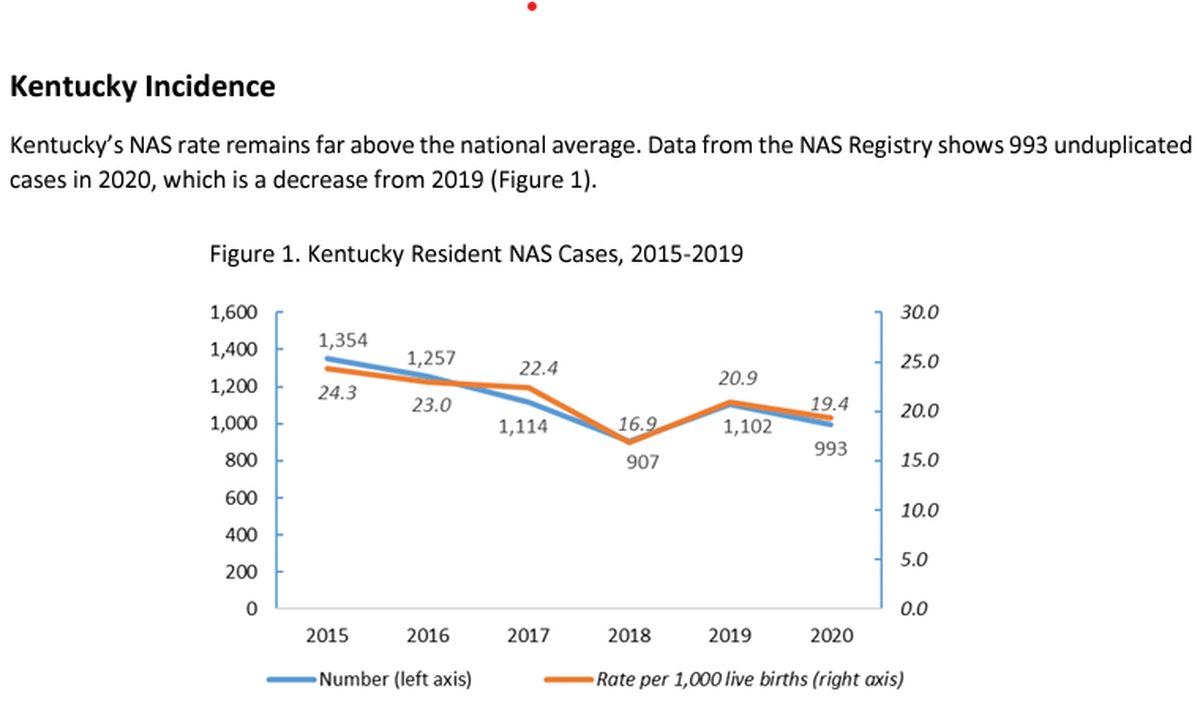
But the commonwealth’s rate was still more than double the national average that year, which was 6 for every 1,000 live births, according to the Centers for Disease Control and Prevention, and the third-highest in the country.
In parts of Eastern Kentucky, that rate soared in 2020 to more than 77 of every 1,000 babies born, according to the 2021 Neonatal Abstinence Syndrome in Kentucky Annual Report. Statewide, the number of babies born with the syndrome in rural counties is more than twice the rate of urban counties. Of the roughly 1,000 babies born with it in 2020, half had to be treated with medication.
“We’ve known for a long time there are consequences to perinatal opioid exposure, but why that’s happening is something we don’t fully understand,” said Dr. Ilhem Messaoudi, chair of UK’s Department of Microbiology, Immunology and Molecular Genetics and principal investigator for the study.
“The goal of our study is to really try and understand the molecular basis of why we see neurodevelopmental delays,” she added.
It’s known, for example, that maternal opioid use disorder can increase inflammation in a baby’s brain and alter microglia, “cells that are like the housekeepers of the brain,” which can disrupt the nervous system, Messaoudi said. But the step-by-step process of how and why opioid exposure causes that inflammation is less known.
“There are gaps in our knowledge,” Messaoudi said. “What we’re trying to do is break down all the different steps where these adverse outcomes could be happening and the molecular basis for them, so we can really try to come up with interventions and therapeutics.”
In 2013, the Kentucky General Assembly designated Neonatal Abstinence Syndrome a reportable disease, and a year later, mandated a statewide reporting registry to chart its prevalence.
Since the state began collecting data and publishing it in annual reports, the two most common drugs children have been reportedly born exposed to are buprenorphine, found in Suboxone and used by doctors for medication-assisted treatment for opioid addiction, and heroin.
But the use of fentanyl and amphetamines, including methamphetamine, has increased since 2017. Prevalence of fentanyl more than doubled from 2018 to 2020, from being present in 4% of babies born with the syndrome to nearly 10%.
Meth use while pregnant increased from 23% in 2017 to upwards of 35% in 2020.
Suboxone remains the most common substance in babies born with the medical condition. Though its use during pregnancy as a prescribed medication to treat opioid use disorder can adversely impact a fetus, taking it “as part of supervised (treatment) is preferable to untreated opioid use disorder during pregnancy,” Kentucky’s Maternal Mortality Review panel wrote in its 2021 annual report.
In 2020, upwards of 64% of all cases of NAS were in part due to buprenorphine exposure in utero, according to that report. More than half of those women who took Suboxone while pregnant were enrolled in a supervised treatment plan for opioid use.
Taking Suboxone for this purpose, even while pregnant, is preferable to not being enrolled in treatment, said Dr. John O’Brien, chief of UK HealthCare’s Division of Maternal Fetal Medicine and researcher on the study and member of the Maternal Mortality Review panel.
“You’re not avoiding risks in all circumstances. It would be ideal to be able to mitigate all risks, but there’s a greater risk with lack of treatment (for pregnant people living with opioid addiction) than there is with avoiding treatment,” O’Brien said. “Abstinence from therapeutic interventions,” like Suboxone, is “associated with far greater harms to both moms and babies.”
The three-year study, “POPI: Placenta, Opioids and Perinatal Implications” will seek to enroll at least 100 pregnant pregnant women from UK HealthCare’s Perinatal Assistance and Treatment program (PATHways), designed to help pregnant and postpartum patients living with substance use disorders.
In addition to collecting a series of samples while a fetus is in utero, researchers will track postnatal neurobehavioral outcomes when participating children are three-, six- and 12-months old.
This story was originally published December 7, 2023 at 8:09 AM.