

UK HealthCare building boom: What does a $4.4 billion expansion mean for Kentuckians?
UK HealthCare is in the midst of an expansion project that will cost over $4.4 billion, add nine new buildings to its arsenal and bring more healthcare access to Kentuckians.
Announced as part of a strategic refresh in April 2023, Co-Executive Vice President of Health Affairs Eric Monday said the new projects will help UK HealthCare achieve its goal of meeting every Kentuckian’s healthcare needs so they don’t have to travel out of state for top-notch medical care.
“The No. 1 purpose of the institution is take care of the commonwealth,” Monday said. “In the worst of times, we want to be the place that can provide that care.”
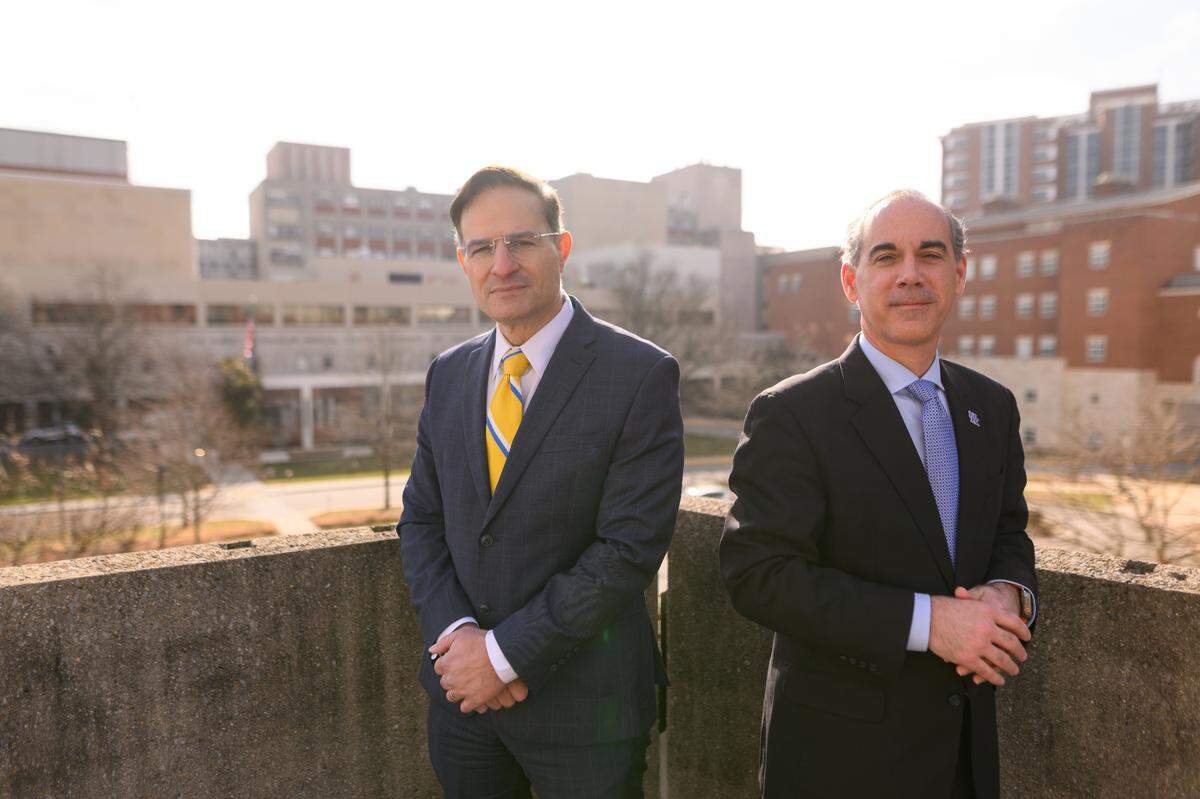
In total, the expansion projects will add almost 500 in-patient beds to the UK HealthCare system in less than 10 years, with most of that care focused in Central Kentucky.
Andrew Ibrahim, a health policy researcher at the University of Michigan with a focus on hospital expansion and consolidation, said that’s a large undertaking on a quick-turn timeline. He called it “fast in an impressive way, not in a bad way.”
“If they’re building that much all at one time, it means they have the money to do it. They must have pretty good understanding that there’s that much demand and those buildings will fill up,” he said.
Expanding Chandler, UK’s largest hospital
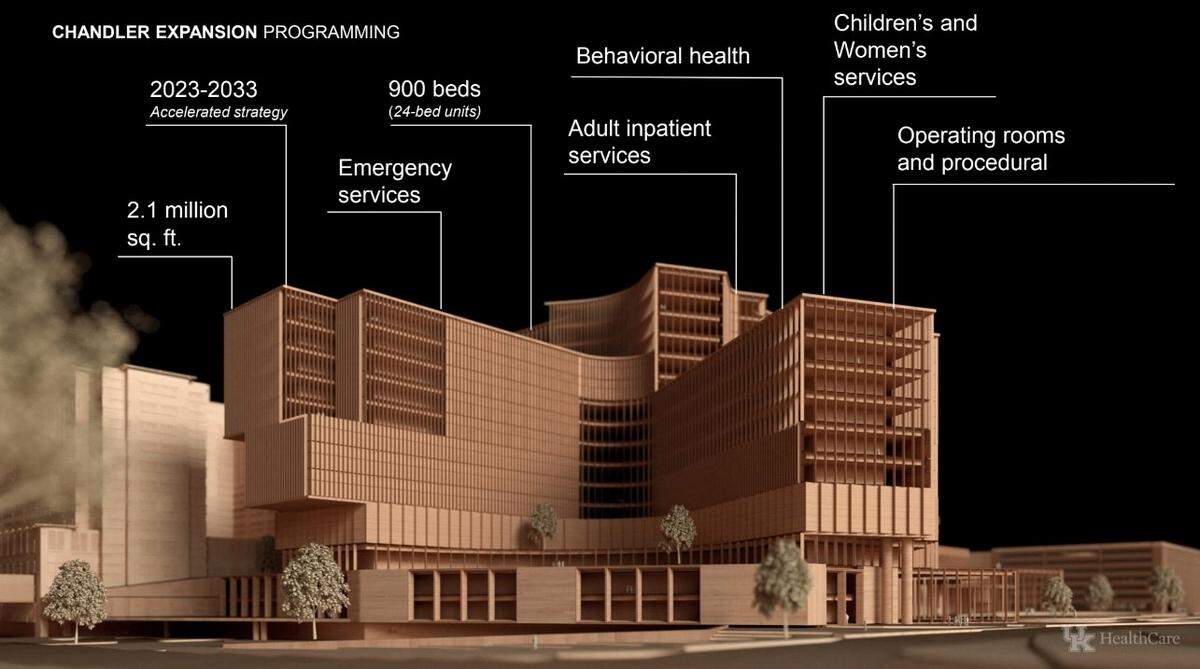
The biggest and most expensive change coming to UK HealthCare’s campus is a 900-bed expansion of the main hospital, Albert B. Chandler Hospital.
UK HealthCare will spend a projected $3.3 billion to build the 2.1 million-square-foot facility on the health system’s main campus in Lexington.
“We have to build capacity. We’re at 1,100 beds today; how do we move to 1,400? That’s the plan that’s in front of us,” Monday said.
The logistics of the expansion are being evaluated to make the most cost-effective move because construction prices could jump by 10% every year the project is prolonged, Monday said.
“One of the key areas of opportunity is just basically time, value and money.,” he said.
Construction is to begin in 2027. The first round of patients will be in the expansion in 2029, with the hospital fully operational by 2033. Currently, UK is in the design phase of the Chandler expansion.
“The buildings are an incredibly important strategy that help you optimize your performance as a growing health system,” Ibrahim said.
“One thing that’s particularly important about these large healthcare projects now is they have gotten so complex. Building a hospital in the modern era is very complicated. There’s a lot of rules and regulations.”
Close to 50% of UK HealthCare’s discharges are transfers from other hospitals across the state. Last year, UK had to deny 4,000 transfer requests. Though that’s 2,000 less denials than the year before, it’s still too many, officials said.
The Chandler expansion will help UK HealthCare accept more transfer requests.
“UK partners to try to ensure that that care can be provided locally if at all possible. But if it can’t, then the expectation is that UK should provide that care and no one should leave the commonwealth,” said Mark Birdwhistell, UK’s senior vice-president for health and public policy.
“It is our obligation to be sure that we can provide care as close to home as possible. Community first, but if not in the community then at UK HealthCare.”

UK HealthCare will move out of the original Chandler footprint, which has 405 beds. The timeline for that move hasn’t been nailed down.
“We would look at a domino understanding of what’s necessary in that space. Ideally, we cannot provide patient care in original Chandler because it’s not supportive for that environment,” Birdwhistell said.
“Down the road there may be additional building site opportunities, but initially we would use that to support other elements.”
UK’s other Lexington hospital, Good Samaritan Hospital, will cease operations in 2029. Monday said employees of the 221-bed hospital will not be fired, just moved to other UK HealthCare locations. He said there are no concrete plans for how Good Samaritan will be used once the Chandler expansion is open.
Birdwhistell said people who live close to Good Samaritan hospital often use its emergency room for primary care needs. That’s why it’s important UK opens an outpatient clinic before Good Sam quits operating.
UK’s four new outpatient centers
In May, UK opened the first of four new outpatient service buildings in Central Kentucky. Chief strategy and growth officer Rob Edwards said these additions will be “traditional physician offices” focused on primary care.
Fayette County and Franklin County are two of only 13 counties in Kentucky, which has 120 counties, not considered a health professional shortage area, according to the Rural Health Information Hub. Three of the four new clinics will be in those counties.
To justify opening a new clinic or constructing a new building, Ibrahim said there has to be a critical mass of patients available in the proposed area.
“Some of the tension in where the facilities get put is also understanding how complex the service is and how much volume there is,” he said.
“For more complex services, you probably do need to keep the buildings more central to keep the volume up.”
Monday said the decision of where to lease space was “informed by” the need to increase access for UK employees. Over 30,000 people are covered by UK’s health plan, he said. The new outpatient buildings are in ZIP codes where many UK HealthCare professionals live.
The first site opened May 20 in the Hamburg area of Lexington, with 12 exam rooms. Another site will open in Franklin County at Frankfort Regional Medical Center later this year, and will have 12 or 13 exam rooms.
The final two outpatient buildings will open in 2025, but design and planning are still underway. One building will be in Richmond, and one will go in an “underserved area of Fayette County,” at 330 Newtown Pike.
The leased space in Richmond needs “significant construction” before it can be utilized as an outpatient clinic space. UK will spend $3.5 million in construction cost.
For the ambulatory sites in Richmond, Hamburg and Frankfort, UK will spend up to $520,000 per year to lease the spaces. UK has not released the projected cost fo rent the space on Newtown Pike.
Though the locations were chosen to make access easier for UK employees, the four outpatient buildings are open to the general population.
Birdwhistell said the buildings will also help serve the medicaid population of central Kentucky.
“In the medicaid population, transportation is one of the key deterrents of getting early access to care. Having that clinic located so that it’s close to bus routes or in walking distance is one of the objectives,” he said.
“Having access where people can get primary care close to home is the objective.”
Expanding emergency care in Ashland
UK King’s Daughters is getting a new emergency room.
Expected to open in Spring of 2025, the Ashland hospital’s new building will combine emergency services and the imaging department to provide faster care to acute patients. The new building will also become the front entrance of the hospital.
The current emergency room opened in 1995 and had the capacity to care for about 40,000 patients per year. Last year, the ER had more than 78,000 visits.
“We’ve just outgrown the one we have now,” Director of Integrated Communications Tom Dearing said. “If we’re going to keep helping the other people in our region, we need a bigger, better emergency department. We broke ground on this in Fall 2022 and I’ve been working on it ever since. It’ll let us provide things a little bit faster, a little more efficiently and with enough room.”
The new ER will have 75 exam rooms — the current has 43 — and accounts for future expansion, with a shell floor in the basement. Shell floors are built during the initial phases of construction to make it easier and quicker for later growth.
The current ER is 20,912 square feet, and the new construction will be 210,000 square feet. That includes a new emergency room, radiology department and front entrance of the hospital. The construction is projected to cost $160 million, with construction expected to finish in mid-October.
Dearing said the building could support up to four additional floors in the future, if needed. The hospital hasn’t decided what will become of the old ER space.
Along with seeing more patients, the expansion will open up more jobs at King’s Daughters, which currently has about 5,500 employees.
“We’ve been seeing not only the increase in patients, but also in acuity. Sicker patients are coming our way,” Dearing said. “We’ll need more people when the expanded ER opens.”
UK’s largest academic building
Kentucky is one of the most physician-poor states in the country, according to the Association of American Medical Colleges. In terms of total doctors, Kentucky will be 2,926 physicians short by 2030, according to a report by the Cicero Institute, a policy research organization.
Specifically looking at primary care physicians, Kentucky ranks 44th for the number of active primary care physicians in the US. To maintain the current access rate, Kentucky will need an additional 624 primary care physicians by 2030.
That’s a 24% increase in the primary physician population.
“We have some counties without a single physician. As the flagship medical school for the commonwealth, we would like to be able to help with that,” College of Medicine Dean Chipper Griffith said.
UK will spend $380 million to construct a new health education building to increase the medical school’s capacity and train the future doctors of Kentucky. That money is coming from UK’s academic budget, not the UK HealthCare budget. At 550,000 square feet, it will be the largest academic building in UK’s history.

“Every year at the end of the admission cycle we have hundreds of qualified applications that we don’t have room for. Some go to Louisville, some go the high velocity path, but some give up. That’s a shame in a physician-poor state,” Griffith said.
The new building, currently in the final stages of design and set to open on UK’s Lexington Campus in 2026, will increase the medical school’s class size from 201 per year to 270 per year across all four campuses. That means an additional 276 students will be in training by 2030.
Along with the college of medicine, the health education building will be home to the college of public health and some health science and nursing programs.
The new space will double enrollment in the College of Nursing, bringing in an additional 350 students per year. The College of Health Science will see a 30% increase with the addition of 460 students, and the College of Public Health will see a 30% increase with an additional 350 students.
Griffith said having multiple health disciplines under one roof will increase collaborative learning and prepare students to work together in a professional setting.
“We have all these experts in such a comprehensive academic health system. How do you bring them all together at the table? We call it a transdisciplinary approach,” Co-Executive Vice-President for Health Affairs Robert DiPaola said.
Bringing care to Eastern Kentucky
St. Claire HealthCare, a hospital based in Morehead, officially became a part of UK HealthCare July 1. That acquisition is the second hospital system UK HealthCare has ever acquired, following the addition of King’s Daughters in Ashland in December 2022.
The hospital was acquired through a member substitution agreement, foregoing a monetary purchase. Member substitutions are often used to transfer ownership of non-profit organizations, like hospitals. Instead of an outright purchase, leaders from the acquiring organization take over positions on the governing board.
With the addition of St. Claire HealthCare, UK brings in 139 more beds focused on serving the Eastern Kentucky population.
“Since the passage of the Affordable Care Act in 2010, the rate of hospital mergers or acquisitions has doubled. There are about two transactions every week where a health system is acquiring another hospital,” Ibrahim said.
“Now more than 70 or 80% of hospitals belong to some kind of larger health system and that’s becoming more the norm.”
He said the payment penalties and incentives introduced with the passage of the Affordable Care Act made it hard for independent community hospitals, like St. Claire, to stay afloat on their own. One penalty could be detrimental, but smaller hospitals don’t always have the resources to achieve the incentives.
St. Claire President and CEO Don Lloyd said even though the medicine is the same, the circumstances of healthcare are very different between rural and metropolitan areas. He said his hospital’s new partnership with UK will help train more physicians to practice in under-served parts of Kentucky.
“For us as a health system, it brings an opportunity for us to ensure that we can carry on our mission of not only providing clinical care but also educating the next generations of healthcare providers and really addressing some of those social determinants through the various programming that we envision,” Lloyd said.
UK, St. Claire and Morehead State University already partner for the Rural Physician Leadership Program, which offer incentives to medical school graduates to be doctors in physician-poor areas of the state. Lloyd said UK has shown commitment to address the workforce shortage, and he looks forward to furthering that progress through the partnership.
“If a patient can stay closer to home and get their care, their outcomes are better,” Monday said.
Building Markey Cancer Center a new home
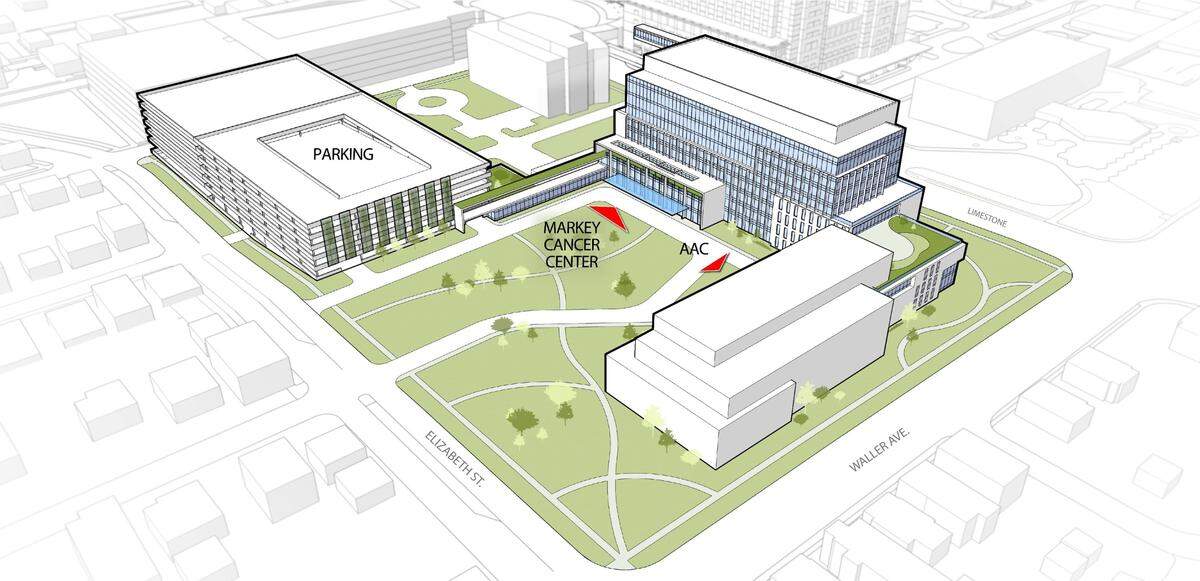
Besides increasing the number of health professionals in the state, another way to improve access to healthcare is to improve operational efficiencies. That’s the main goals of the new Markey Cancer Center building, which broke ground April 25.
The new UK Cancer and Advanced Ambulatory Building, located in Lexington next to Shriners Children’s Hospital, will consolidate all of Markey’s offerings to help lower the average patient length of stay.
“We’re gonna take all of that cancer care that’s in like six buildings, bring it into one and provide more capacity,” Monday said. “That’s not just for Lexington, that is for the entire commonwealth.”
As the only National Cancer Institute designated Comprehensive Cancer Center in Kentucky, Markey had 93,349 patient visits in 2023. Markey Cancer Center Director Mark Evers said about 50% of patients come from Central Appalachia, where high rates of poverty, obesity and smoking contribute to elevated cancer rates.
“We have some of the highest rates of lung and colorectal cancer in the country in that specific area,” he said. “We’re the only academic cancer center that’s caring for those patients. Many of our programs are really geared towards the cancers with the highest incidents in that region.”
The new building, which will give Markey an additional 70,000-square-feet of space, will increase capacity because of the larger footprint and quicker patient turn-around.
The building and adjacent parking garage is projected to cost $885 million and will open for patients in 2027.
Opening a behavioral health emergency room
Along with the physical health needs of patients, UK is addressing access to mental health care.
UK HealthCare opened an outpatient mental health treatment unit at Eastern State Hospital in Lexington on July 30.
Eastern State Chief Administrative Officer Lindsey Jasinski said the new Emergency Psychiatric Assessment Treatment and Healing (EmPATH) unit functions much like a behavioral health emergency room, and will help decompress already overrun traditional emergency departments.
“Many people are showing up in the emergency room with psychiatric needs that need to be addressed,” Birdwhistell said. “That need can be addressed in a less acute setting by mental health professionals — to get them back on track with medications and referred to mental health counselors in the most appropriate time, in the most appropriate setting.”
Eastern State Hospital is owned by the state but managed by UK HealthCare. The EmPATH unit is fully owned and operated by UK HealthCare through leased space on Eastern State’s campus.
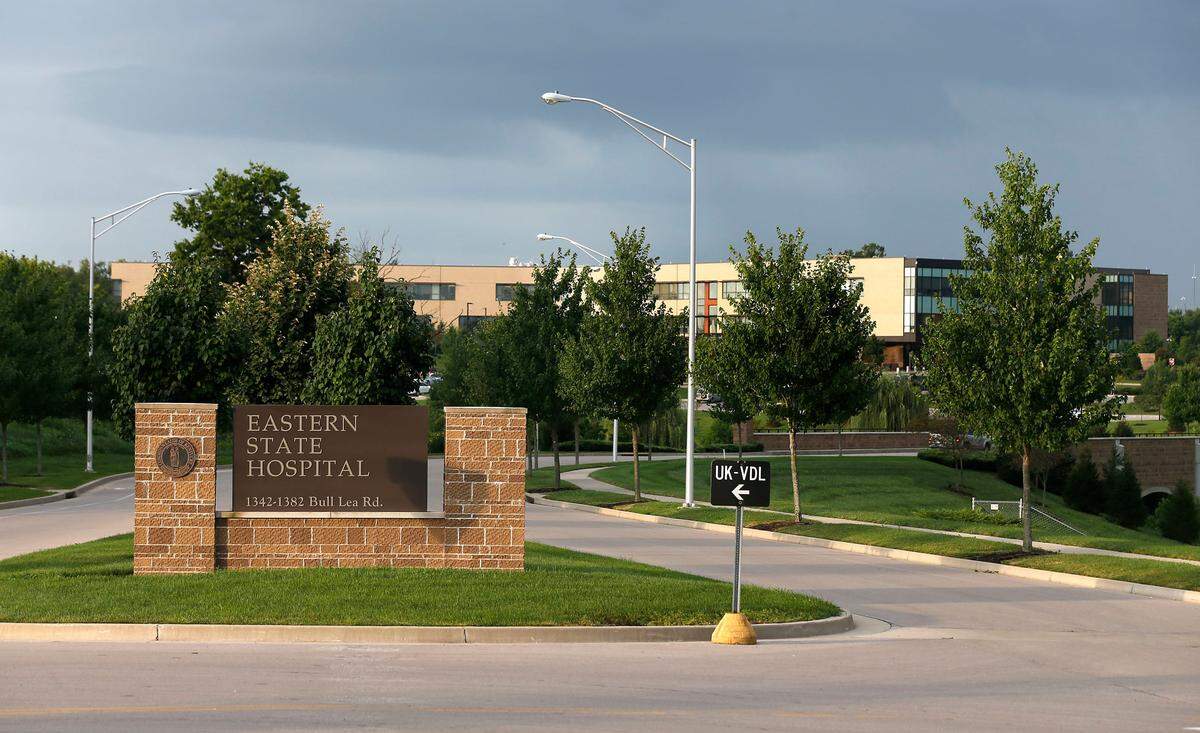
The project cost approximately $1.26 million to get off the ground, according to Eastern State Community Engagement Director Vikki Franklin. UK HealthCare will also pay Eastern State up to $310,000 per year for the leased space.
“We have seen significant growth in need for crisis services post-pandemic over the past several years. This is a great model for being able to provide really collaborative trauma informed care that’s better for our patients,” Jasinski said.
The unit has a 12-patient capacity.
Much like a traditional emergency room, patients can bring themselves to the new mental health crisis unit or be brought in by first responders. Anyone can take advantage of the new service, unless the patient is under 18 or medically unstable.
This story was originally published July 25, 2024 at 7:00 AM.