
KY doctors increased rates of lung cancer screening. Now they’re teaching other states
Other states are looking to Kentucky to learn how they can increase lung cancer screening rates — and, in turn, reduce mortality.
Kentucky’s expertise dates back to 2015, when the University of Kentucky Markey Cancer Center launched the Quality Implementation of Lung Cancer Screening, or QUILS, program. The move came since Kentucky is the state with the highest rate of lung cancer in the U.S.
Something had to change.
The QUILS System scores different aspects of lung cancer screening programs, like communication effectiveness and patient retention, to isolate ways the program could be improved. Once the shortcomings are identified, the programs are trained to better address their patient populations needs.
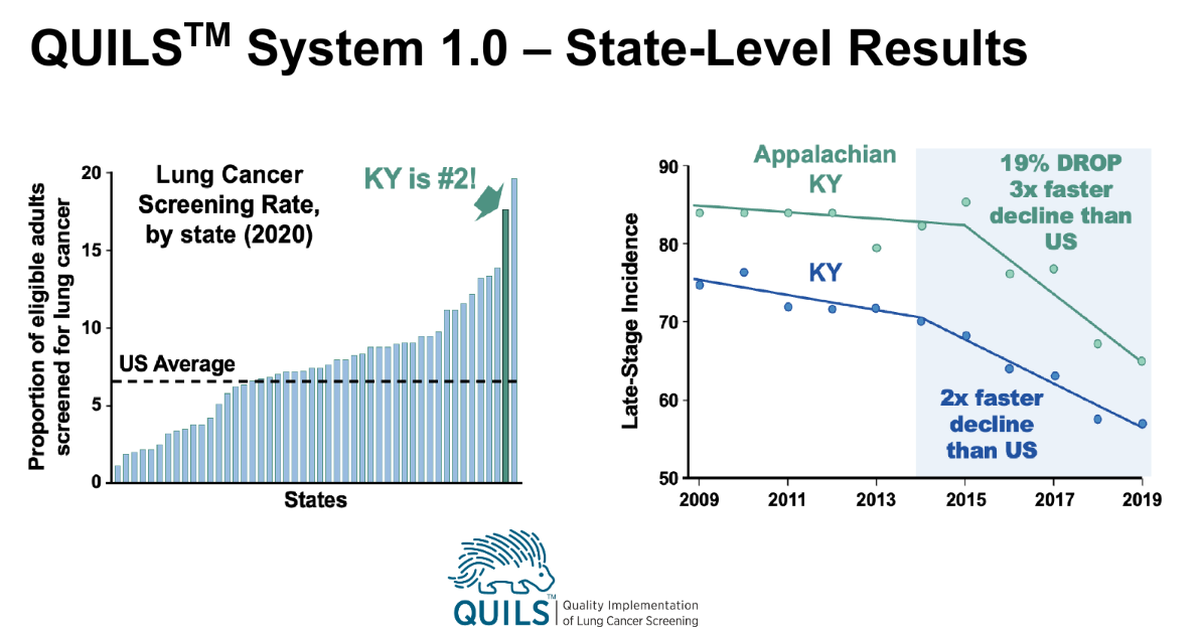
By targeting specific, under-performing aspects of lung cancer programs and establishing a standard of care, QUILS increased lung cancer screening rates in Kentucky by almost 10% between 2015 and 2020.
“We often were receiving patients just a fraction too late,” said Dr. Timothy Mullett, thoracic surgeon at Markey Cancer Center and primary investigator with the QUILS program.
“In the past, only 10-15% of patients would have an early enough stage of cancer that we could wind up operating.”
Lung cancer screening does not change the likelihood of developing cancer, but it does help catch the disease before it’s progressed too far to treat. With the help of the QUILS program, Kentucky saw a 10% decline in late-stage lung cancer diagnoses.
“QUILS is a system that we’ve put together to measure the effectiveness of lung cancer screening in a particular program and try and enhance that program to be more equitable across the population that a facility may serve,” Mullett said.
Mullett, Jamie Studts and Jennifer Knight pioneered the program, which saw success at each of the 10 locations where it launched in 2015.
Hoping to replicate the success seen in Kentucky, the program recently secured a $6.8 million grant from the Bristol Myers Squibb foundation, which helped launch QUILS nine years ago, to expand to Mississippi and Nevada.
The Nevada Cancer Coalition and the Mississippi Lung Cancer Round Table will find screening locations in their respective states to participate in the program. Screening at those sites will begin next fall.
The team at Markey will still be the primary investigators, and all data will be reported to them.
“Far too many Americans, especially people in vulnerable communities, face barriers to accessing lung cancer screening,” said Catharine Grimes, president of the Bristol Myers Squibb Foundation.
“By empowering local health care providers and educating communities about early detection, the QUILS program has brought hope to and transformed health outcomes in high-risk communities in Kentucky. Now, the (Bristol Myers Squibb) Foundation is proud to support this program’s expansion into Mississippi and Nevada, where the need is just as great.”
With a separate grant, the program will expand to 16 more sites in the commonwealth, but there is no specific timeline yet for the expansion.
Kentucky Public Health Commissioner Dr. Steven Stack said it’s a great pride for Kentucky to be pushing forward change, but there’s still a lot of work to be done regarding lung cancer treatment.
He encouraged Kentuckians to never start smoking — the leading cause of lung cancer.
“I’m very excited about the possibilities that we can find ways to screen more and catch cancer in the lung earlier, and then treat it more effectively,” Stack said. “I would be remiss if I didn’t remind us that our state has the fourth-highest cigarette smoking rate among adults.”
Who should be screened for lung cancer?
Kentucky has the highest rate of lung cancer diagnosis and mortality in the nation.
Mullett said it is widely known that more frequent screening leads to earlier detection, which gives patients a better prognosis.
That’s not what the QUILS system wanted to prove.
“We weren’t trying to prove whether lung cancer screening worked. We already knew that it worked. We needed to make it work better,” he said.
“We needed to make lung cancer screening a reality, and begin to weave it into our clinical practice.”
The scan takes less than a minute. Eligible populations — people 50-80 years old who have smoked an average of one pack per day for 20 years — should be screened for lung cancer once per year with a low-dose CT scan.
Mullet said if you’re approaching 50 years old and you’ve used tobacco in the past, talk to your doctor about lung cancer screening, because the nuances around eligibility are hard to discern.
This story was originally published December 2, 2024 at 4:30 AM.