
Losing billions in Medicaid funding could force 35 rural KY hospitals to close
Proposed health care funding cuts and Congress’ plan to slash Medicaid could place already financially struggling rural hospitals at risk of closure.
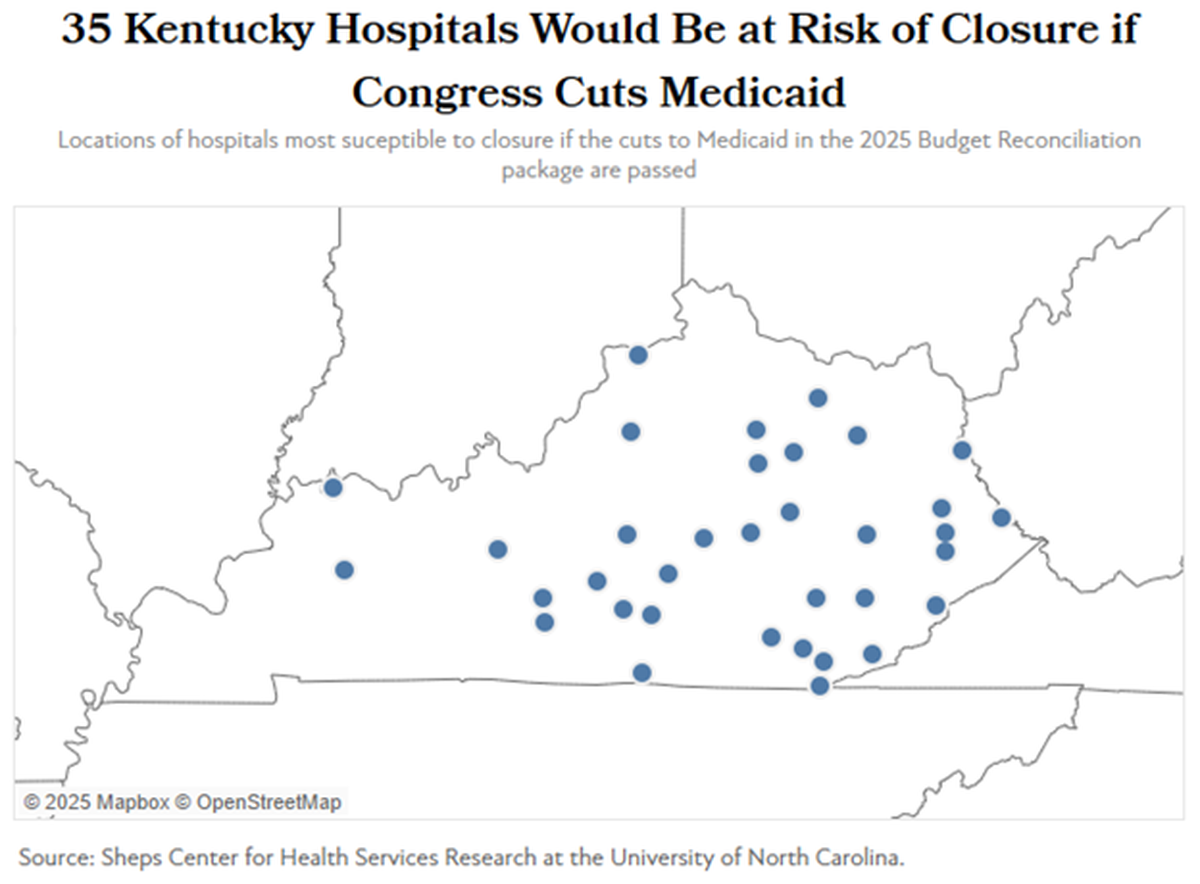
Kentucky stands to lose up to $28 billion in federal dollars it uses to insure those seeking medical care and prop up rural health care providers that employ thousands. The proposed cuts could put 35 rural hospitals in Kentucky at risk of closure, more than any other state in the country, according to a new estimate.
“Substantial cuts to Medicaid or Medicare payments could increase the number of unprofitable rural hospitals and elevate their risk of financial distress,” said researchers from the Sheps Center for Health Service Research at the University of North Carolina in a report.
“In response, hospitals may be forced to reduce service lines, convert to a different type of health care facility, or close altogether.”
Generally, most hospitals run on thin margins and struggle financially to stay operational. Because of rising labor and supply costs, regulatory complexities, the need to consistently improve and update facilities, and a reliance on Medicaid and other insurance reimbursements for care, hospitals typically make small profits and run with little to no difference between revenue and expenses.
Rural hospitals, nonprofit hospitals and those with patients covered by Medicaid are more vulnerable to closure, cutting back on care to save money, and have even thinner margins than other health care facilities.
The UNC report identified the country’s top 10% of hospitals receiving payments from Medicaid and those that finished the past three years with negative margins. In total, there are 338 hospitals at risk of closure.
If Congress cuts Medicaid, for every 10 hospitals that could shutter, at least one would be in Kentucky, the report says.
Hospitals use Medicaid dollars — those given from a joint federal and state program meant to cover the cost of health care to people with limited income and resources — for standard and supplemental payments for services they provide. When hospitals rely on revenue streams from patients using Medicaid and that source of payment goes away, that’s when the facility may start to experience financial strain.
Nearly 1.5 million Kentuckians are enrolled in Medicaid, almost 30% of the state’s population, according to KFF, the nonprofit health policy research organization.
The Kentucky Center for Economic Policy estimated 346,000 Kentuckians would lose coverage after the U.S. House of Representatives passed plans to reduce Medicaid spending. Nationally, 16 million will become uninsured, according to estimates from the Congressional Budget Office.
That kind of pressure on operations could mean health care providers implement cost-saving practices, such as reducing services, cutting staff and investing less in facility improvements. Patients’ access could be reduced and they may face longer wait times, all while the hospital begins to absorb uncompensated care costs.
Regardless of how Kentuckians are insured, the potential impact to rural hospitals would make getting care even more difficult for everyone. The closure of rural health care centers would funnel those needing care into urban areas where city hospitals could become crowded and out-of-town patients could see higher price tags on care.
A Pew Research Center survey already shows Kentucky is in a region with the second-longest drive times to local hospitals, and people who live in rural areas drive 63% longer for care than those who live in urban areas.
Analysis from the Kentucky Center for Economic Policy also indicates employment in rural hospitals could take a hit if facilities begin to close. Over 90,000 Kentuckians worked in hospitals in 2024, according to the U.S. Bureau of Labor Statistics, earning an average annual wage of just over $70,000, about $10,000 more than the average Kentuckian.
The Herald-Leader has previously reported rural Kentucky women would “bear the brunt” of the impact if Congress slashes Medicaid. But the bill is not easy to pass, said longtime Kentucky Sen. Mitch McConnell at the end of May.
The “Big, Beautiful Bill” backed by President Donald Trump awaits further consideration in the Senate. It extends tax cuts that benefit the wealthy while limiting spending for Medicaid and the Supplemental Nutrition Assistance Program, among others.
The following is a list of Kentucky’s health care providers identified in the report as most at risk of closure:
- Whitesburg ARH Hospital.
- Highlands ARH Regional Medical Center.
- UofL Health — Shelbyville Hospital.
- T.J. Samson Community Hospital.
- St. Claire Regional Medical Center (UK St. Claire).
- Middlesboro ARH Hospital.
- Spring View Hospital.
- Advent Health Manchester.
- Bourbon Community Hospital.
- Harlan ARH Hospital.
- Deaconess Henderson Hospital.
- CHI Saint Joseph Health — Saint Joseph Mount Sterling.
- Tug Valley ARH Regional Medical Center.
- Owensboro Health Twin Lakes Medical Center.
- Baptist Health Corbin.
- Clark Regional Medical Center.
- Baptist Health Deaconess Madisonville.
- The Medical Center at Albany.
- Three Rivers Medical Center.
- Kentucky River Medical Center.
- TJ Health Columbia.
- Pineville Community Health Center.
- Mercy Health — Marcum and Wallace Memorial Hospital.
- ARH Our Lady of the Way Hospital.
- Casey County Hospital.
- Carroll County Memorial Hospital.
- The Medical Center at Caverna.
- Ephraim McDowell Fort Logan Hospital.
- Mary Breckenridge ARH Hospital.
- Jane Todd Crawford Hospital.
- Barbourville ARH Hospital.
- CHI Saint Joseph Health — Saint Joseph Berea.
- Russell County Hospital District.
- McDowell ARH Hospital.
- Fleming County Hospital.
This story was originally published June 18, 2025 at 4:30 AM.
.JPG)