
Nursing care designation doesn't define quality hospital service, UK says
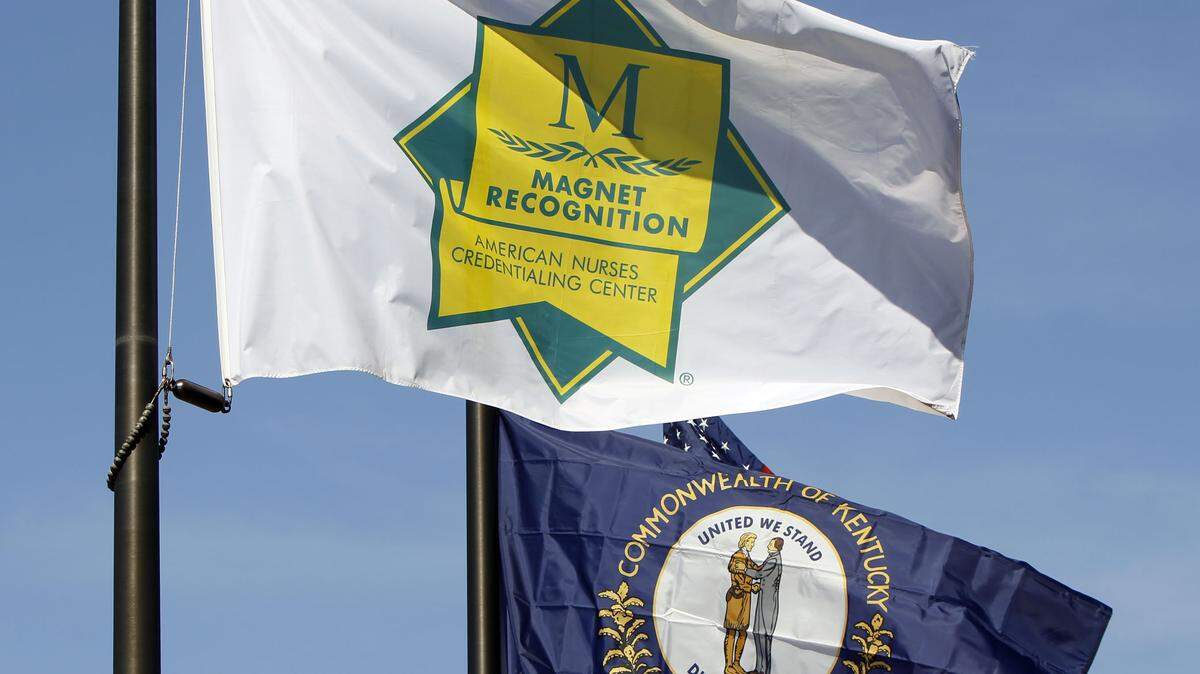
Magnet hospital status was "the ultimate benchmark to measure the quality of care" for the University of Kentucky until it failed to get renewal of the designation.
A hospital official questioned its importance last week. "It is a recognition from a professional society," said Dr. Richard Lofgren, chief clinical officer for UKHealthcare. "You can get recognition from a whole lot of professional societies."
Lofgren pointed out that many top health facilities have never sought Magnet status, a measure of high-quality nursing care.
But other area hospital officials say the designation means so much to them that they make meeting the expensive and time-consuming application process part of the job responsibilities of employees.
"It's huge," said Sammie Mosier, chief nursing officer at Frankfort Regional Medical Center, which received the designation this year. She said Frankfort Regional has been working for seven years to meet the requirements of the Magnet Recognition Program.
Even UK Chandler Medical Center and Kentucky Children's Hospital, which had held the designation since 2001, touted that the hospitals were some of the first in the country to secure the honor and referred to Magnet status on its Web site as the "highest honor a hospital can receive for its nursing services."
A Feb. 15 letter to UK from the American Nurses Credentialing Center, which awards the honor, outlined areas where the hospital fell short in the renewal application. The letter cited low scores in patient and nursing satisfaction and "nursing sensitive indicators," which measure quality of care by looking at such problems as the number of patients who get pressure ulcers or the number of patients who fall.
A summary of the review that caused UK to lose the designation said that "the structure for supporting a culture of patient safety was not evident" and that nurses fell short on "friendliness/courtesy," "promptness /response to call," "nurses' attitude toward requests" and "attention to special/personal needs."
Lofgren and Colleen Swartz, chief nurse executive, said it's not that the hospital is providing inferior patient care. Swartz said the hospital got across-the-board high marks on the two-year review provided by the center. Applications are renewed every four years.
Swartz blamed a change in the renewal process guidelines for UK's failure. When it became clear that key measurements would be different, there was discussion about whether it was prudent to apply for renewal, Lofgren said.
Other organizations apparently coped with the changes. Central Baptist reapplied this year under the new guidelines, and its Magnet status was renewed, said spokeswoman Ruth Ann Childers. Frankfort Regional Medical Center applied for the first time and succeeded.
Officials from those hospitals say applying for Magnet status is a significant investment of staff time and energy.
Mosier said Frankfort Regional spent about $380,000 last year on education and incentive programs that support the application. It is an investment, she said, because Magnet hospitals have a record of low employee turnover. Recruiting and training a surgical nurse can cost about $55,000, she said.
"If you are not replacing them you are going to have to invest in the ones that you have," she said.
Mosier and Childers said each of their hospitals has a staff person who spends about half their time making sure the Magnet status application is on track. Central Baptist is so proud of its Magnet status it flies the official "Magnet hospital" flag near the main entrance.
Although UK has held the Magnet status for 10 years, and reapplied successfully in 2005, Lofgren said he couldn't estimate the cost of applying aside from the $60,000 to $70,000 in application fees. He also couldn't estimate the amount of staff time committed to it, which includes an extensive site visit and employee interviews. UK does not have a person dedicated to the application, Lofgren said.
Because of the loss of Magnet status, the hospital is required to eliminate the mention of the designation from all Web sites, brochures, advertising or banners. Ann Smith, chief administrative officer, said reference to Magnet status has mostly been in digital form and can be purged easily and inexpensively.
In the end, Lofgren said, any money that was spent on the renewal was well spent because it allowed the hospital to get an honest, third-party appraisal of its nursing operation.
Patient care is important to the hospital, Lofgren said, and is improving as evidenced by recent scores on a standardized national survey conducted by the Hospital Consumer Assessment of Healthcare Providers and Systems. The survey showed that in February 2010, 74 percent of patients said they would recommend the hospital. In February 2011, the number went up to 88 percent.
During the past few years, the hospital actually has increased its focus on nursing, Lofgren said. It hired Swartz as chief nurse executive in January 2008 and created the Office of Service Excellence in October 2009.
"We are headed in the right direction," he said.
Lofgren pointed out that the hospital deals with patients in its trauma and critical care units who are often very sick, scared and far from home. That alone makes getting good patient satisfaction scores difficult, Smith said.
Although nurses were surprised and disappointed about losing Magnet status, it has acted as an incentive to improve, Swartz said.
"They've viewed it as sort of a call to action."
This story was originally published March 7, 2011 at 12:00 AM with the headline "Nursing care designation doesn't define quality hospital service, UK says."