
1951 point-rigging scandal brought ‘the death penalty’ to UK’s basketball team
Editor’s Note: As Lexington celebrates the 250th anniversary of its founding, the Herald-Leader and kentucky.com each day throughout 2025 will share interesting facts about our hometown. Compiled by Liz Carey, all are notable moments in the city’s history — some funny, some sad, others heartbreaking or celebratory, and some just downright strange.
In 1951, the University of Kentucky men’s basketball program was coming into its own.
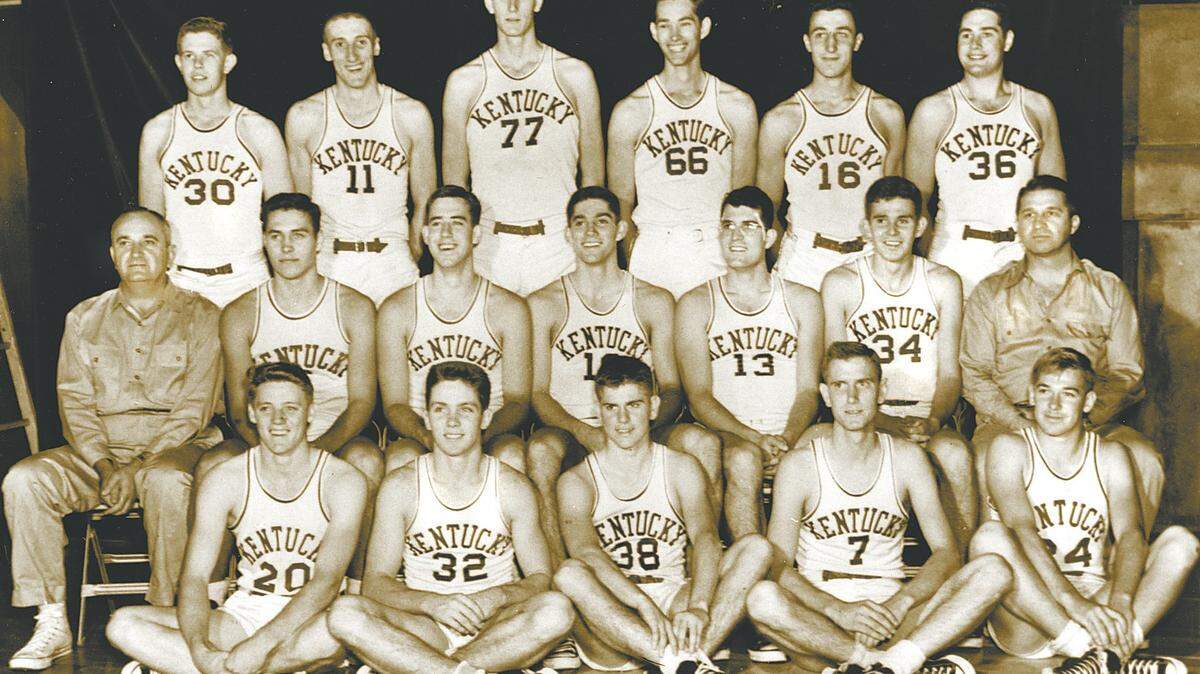
In the two years before, the team had won back-to-back NCAA Championships under coach Adolph Rupp. Rupp had come to the school as a high school basketball coach, remaking and building the program toward success.
In 1948, he led the team to a record of 36 and 3, with all three losses being away games. In the final game of the NCAA Championship, the Wildcats beat the Baylor Bears.
After the game, the team went to the Olympic Trials where they played to send players to the Olympics in London. The starting five players on the Wildcat team were the only team to win both an NCAA title and an Olympic Gold medal, earning them the nickname “The Fab Five” — Ralph Beard, Alex Groza, Wallace “Wah Wah” Jones, Cliff Barker and Kenny Rollins.
The next season was filled with high expectations, with most of the Fab Five returning — UK went on to beat Oklahoma A&M in the championship, making them one of only two schools at the time to have won back-to-back championships.
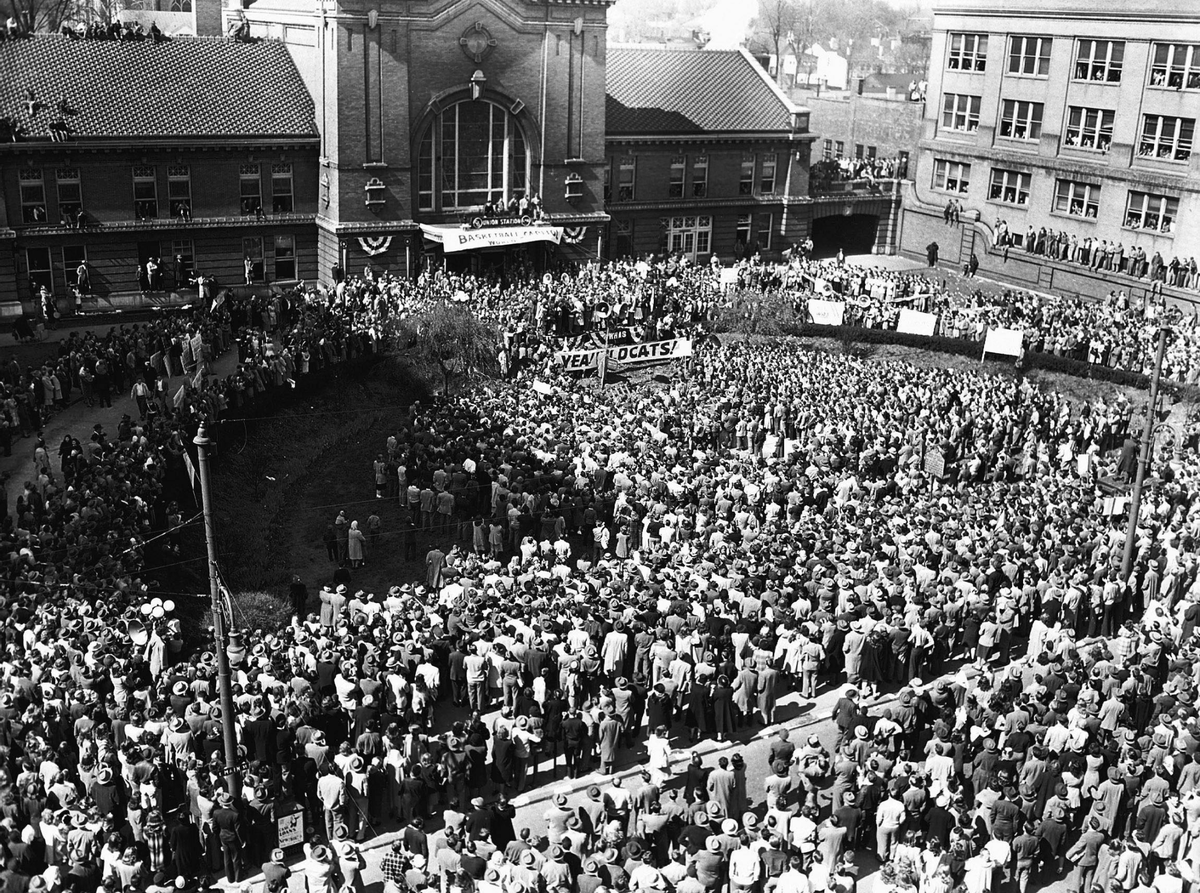
In 1950, and the team hoped to carry their success into a new decade. But they missed out on making it to the NCAA tournament, heading to the National Invitational Tournament instead and losing by more than 30 points to the City College of New York Beavers.
The next year, the team seemed to be picking up steam again. Kentucky defeated four top 10 teams and was ranking in the top five most of the season, until Vanderbilt knocked them out of the SEC finals. Still, the Wildcats went on to the NCAA finals and beat Kansas State for the championship.
But in New York, trouble was brewing.
Players across teams tried rigging games
In Jan. 1951, two basketball players from Manhattan University, Henry Poppe and Jack Byrnes, and three bookmakers were arrested on charges of bribery and conspiracy. All three were accused of engaging in an illegal attempt to influence the outcome of games.
Poppe and Byrnes were found guilty of working with bookmaker Cornelious Kelleher to ensure Manhattan lost certain games within a certain point spread, in exchange for $50 a week and $3,000 for each losing game, and $2,000 for going over the point margin on other games.
Poppe had tried to recruit Manhattan junior center Junius Kellogg, but he refused.
Instead, Kellogg reported the offer to his coach Ken Norton, who in turn informed Manhattan College’s president, who encouraged Kellogg to go to the police. At the police’s direction, Kellogg went undercover, pretending to accept Poppe’s offer.
Kellogg was instructed to fix the game against DePaul University and win by less than the 10-point spread. Manhattan won by three. On the basis of Kellogg’s testimony, Poppe was arrested and implicated Byrnes and the others. Sports editor Max Kase of the Journal-American gave NY District Attorney Frank Hogan a tip about the arrests, then later broke the story about the college basketball point shaving on Jan. 18.
Within a month, three CCNY players had been arrested in Penn Station. In February and March, players from Long Island University and Bradley were arrested.
In October, the scandal hit UK. Hogan had arrested UK players Ralph Beard, Alex Groza and Dale Barnstable and charged them in connection to accepting $500 bribes to shave points in games, including a NIT game against Loyola of Chicago in Madison Square Garden in 1949.
Groza and Beard had been on two NCAA championship teams, as well as on the 1948 Olympic gold medal team.
Officials said the point shaving started with Beard’s friendship with former UK football player Nick Englisis. Englisis left the football team in 1946 and in late 1948, Englisis approached Beard, Groza and Barnstable about potentially point shaving during an upcoming season.
The three players agreed to the arrangement and shaved points in several games. During the NCAA tournament, the three were supposed to win over Villanova by over the point spread, but they weren’t able to. The loss caused Englisis to lose all of his money, and ended the point-shaving deals for the three players.
Prior to their arrest, Rupp had claimed his team was untouchable: “They couldn’t reach my boys with a ten-foot pole,” he said.
UK suspended for 1952-53 season
But he was wrong. Groza, Beard and Barnstable were given suspended sentences, placed on indefinite probation and barred from all sports for three years. The NBA also suspended the trio.
A NCAA investigation found that UK had committed several rule violations, including giving illegal spending money to players and allowing some ineligible athletes to compete. As a result, the SEC voted to ban Kentucky from competing for a year, and requested that teams not schedule with Kentucky.
As a result, UK was forced to cancel the entire 1952-1953 basketball season.
The NCAA punishment eventually came to be known as “the death penalty.” Walter Byers, the first executive director of the NCAA said the punishment was a program killer.
“In effect, it was the Association’s first death penalty, though its enforcement was binding only through constitutional language that required members to compete against only those schools that were compliant with NCAA rules. Despite fears that it would resist, Kentucky accepted the penalty and, in turn, gave the NCAA credibility to enforce its rules,” the NCAA said.
After the ban, the Wildcats came back to a perfect season, winning 25 of 25 games — Rupp’s only undefeated season. The team was awarded the 1954 Helms National Championship. However, the NCAA ruled three of Rupp’s players ineligible for post season play, so Rupp decided to skip the 1954 NCAA Tournament in protest.
It would be another four years before the team won its next championship. The “Fiddlin’ Five,” so called because Rupp said they played around and made too many mistakes, still holds the record for the most losses of UK’s championship teams. The team would improve throughout the tournament, eventually winning the title over the University of Seattle in 1958.
Have a question or story idea related to Lexington’s 250-year history? Let us know at 250LexKy@gmail.com.