
How Man o’ War Boulevard connected 17 miles of Lexington in 1988
Editor’s Note: As Lexington celebrates the 250th anniversary of its founding, the Herald-Leader and kentucky.com each day throughout 2025 will share interesting facts about our hometown. Compiled by Liz Carey, all are notable moments in the city’s history — some funny, some sad, others heartbreaking or celebratory, and some just downright strange.
Man o’ War Boulevard, a 17-mile stretch of road circling south Lexington, was completed nearly 40 years ago.
Taking more than 10 years to complete, the road was finally finished on Nov. 30, 1988, and connects Versailles Road with US 60.
Plans for a southern bypass of Lexington started in the 1930s, according to Lexington Herald-Leader archives. It wouldn’t be until 1973, however, that construction began.
In 1974, the road was renamed from Tiverton Way to Man o’ War Boulevard. The first stretch of road ran from Richmond Road to Palumbo Drive and opened in 1975. Four years later, it was expanded to Alumni Drive (then Mount Tabor Road) and Armstrong Mill Road. By 1983, it encompassed the area between Tates Creek Road and Nicholasville Road.
In 1986, the road had grown into a four-lane highway running from Harrodsburg Road to Armstrong Mill Road. The next section of the road — from Armstrong Mill Road to I-75 — would be the most expensive. Widening the section from Armstrong Mill to Palumbo to four-lanes cost about $3.3 million, while the section to I-75 was estimated to cost more than $8 million.
Construction on the road to I-75 began in August 1986 and completed two years later. In all, the project cost more than $45 million.
When it opened in 1988, the speed limit on the road was 50 miles per hour and had few traffic lights. But as Lexington’s suburban areas began to grow, so did the number of traffic lights, and the speed limit dropped to 45 miles per hour for most of the road.
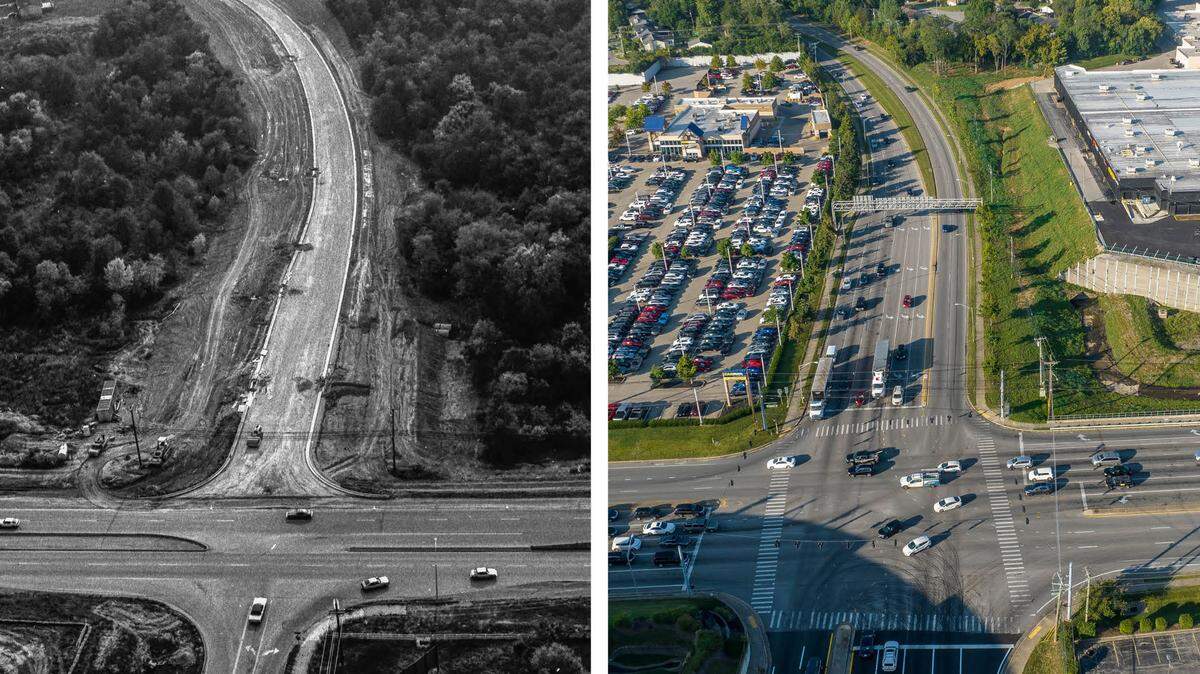
The road has gotten plenty of criticism since its completion.
Many Lexington residents complain about the number of traffic lights, the high curbs along the road and the lack of breakdown lanes for stalled or wrecked vehicles. In 2007, former Mayor Scotty Baesler, who oversaw most of the road’s construction during his term in office, said the criticism was either unfair or based on misconceptions.
The road was never designed to be a freeway, but as an urban arterial road, he said.
“We never planned it to have any overpasses. It would have been better to have some pull-off areas, but that wasn’t the highest priority at the time,” he told the Lexington Herald-Leader in an interview at the time. “The priority was to get four lanes around Lexington and get traffic out of the subdivisions. People can talk about Man o’ War now, but I’d hate to see the traffic we’d have on Tates Creek Road today if we hadn’t built it. To me, Man o’ War is one of the most significant things we did in the 1980s to benefit the entire community.”
Today, the road is estimated to see between 30,000 and 48,000 vehicles per day, according to the Kentucky Department of Transportation.
Have a question or story idea related to Lexington’s 250-year history? Let us know at 250LexKy@gmail.com.