Motorcycle club members visit Lexington to share ‘legacy of Buffalo Soldiers’
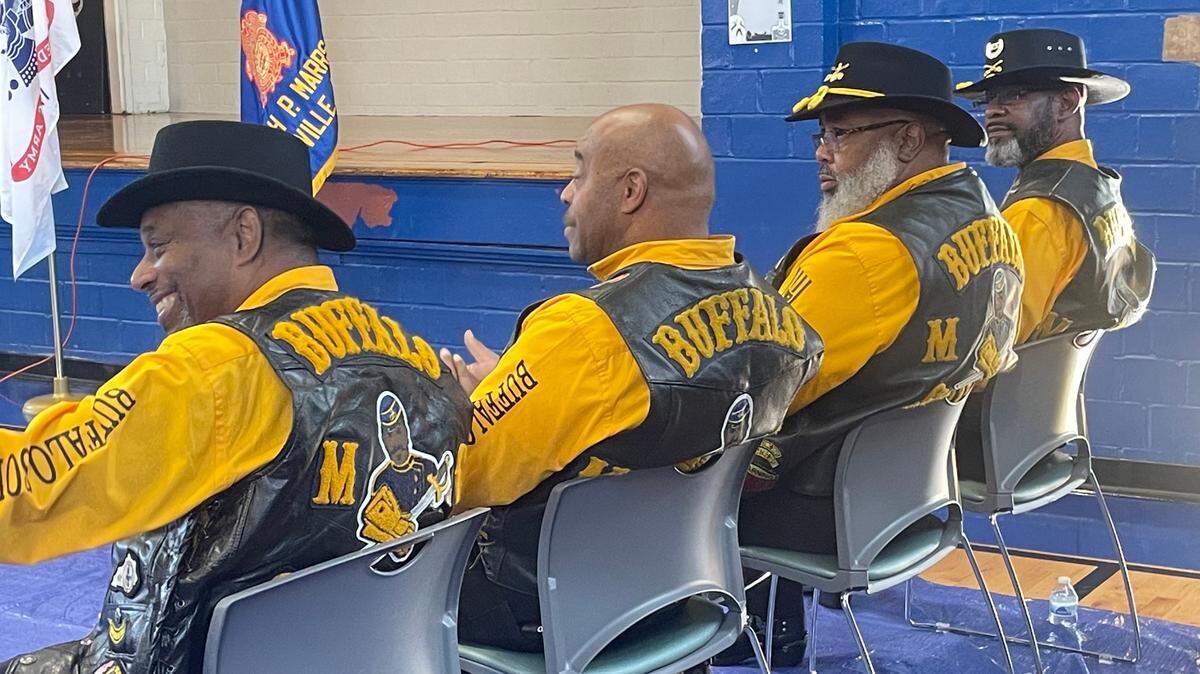
Members of the National Association of Buffalo Soldiers & Troopers Motorcycle Club rode into Lexington on their “iron horses” to share history and honor Buffalo Soldiers ahead of Veterans Day.
Several members of the motorcycle club spoke at the Charles Young Community Center in Lexington on Sunday afternoon by invitation of cemetery historian and event organizer Dr. Yvonne Giles.
The men rode their bikes from Louisville and Georgetown to speak. Giles opened the program with the history of African Americans in the United States military service, and discussed the African Cemetery No. 2 milestone, near the community center.
Charles Young, the center’s namesake and a Buffalo Soldier, served in the 9th Cavalry at western posts between 1889 and 1907 and rose to the rank of captain, Giles said. He was the first African American superintendent of the National Park Service.
In 1866, Congress established six all-Black regiments (later consolidated to four) to help rebuild the country after the Civil War and to fight on the Western frontier during the Plains Wars. It was from one of these regiments, the 10th Cavalry, that the nickname Buffalo Soldier was born, according to the National Park Service. The nickname soon became synonymous with all African American regiments formed in 1866.
Members of the Louisville NABSTMC including President Jerry Ledbetter, Bernard Love Sr., LeRoy Smith and Ricky Campbell spoke about women involved in the wars, and soldiers’ involvement in the Spanish American War, World War I and World War II to an audience of nearly 40 attendees.
“Anytime anyone wants to know the history, especially why the motorcycle club and the Buffalo Soldiers are mixed, we are happy to give a brief presentation of that,” said Ledbetter. “We represent the legacy of the Buffalo Soldiers.”
The motorcycle club’s objective is to educate those that are unfamiliar with the sacrifices and hardships that the Buffalo Soldiers of the 9th and 10th U.S. Cavalries had to endure.
“This is just the tip of the iceberg — the tip of the iceberg — of stories of Black men and women who have had to confront just unbelievable discrimination and mistreatment. But yet, they served. They fought. They joined. They finished their careers,” Giles said.
Ricky Campbell spoke about soldier Cathay Williams, a Black woman who enlisted in the U.S. Army under the pseudonym William Cathay, passing herself as a man. At the time, women were not allowed to serve in the military other than working as launderers, nurses or cooks.
“She wanted to be a soldier, and she tried her best,” Campbell said. “So what she did in 1866 — she put on men’s clothing, she went down to the recruiter, and she signed a three-year contract. But the thing was, she said, ‘Cathay Williams isn’t going to work.’ So she changed her name to William Cathay and she signed that contract. Back then they didn’t do body physicals, so she was able to get in.”
In 1867, Williams came down with smallpox, and was going to a dispensary and got through the sickness. The next year, the smallpox came back and she returned to the dispensary, where they unveiled her body and discovered she was a woman.
She was given a medical discharge. She was denied a pension from the military because she had falsified legal documents. Williams died shortly thereafter. Her exact date of death is unknown.
Member LeRoy Smith, or Smitty, spoke about the 6888th Central Postal Directory Battalion, nicknamed “Six Triple Eight.” This was the first all-Black, all-female postal service.
The Women’s Army Corps (WAC) of the U.S. Army was created by a law signed by President Franklin D. Roosevelt on July 1, 1943. The WAC was converted from the Women’s Army Auxiliary Corps which had been created in 1942 but did not have official military status, according to the U.S. Army of Military History.
In 1944, despite slow recruitment of volunteers, a battalion of 817 (later 824) enlisted personnel and 31 officers, all African-American women drawn from the WAC, the Army Service Forces, and the Army Air Forces, formed the Six Triple Eight.
“They crawled under logs wearing gas masks and jumped over trenches,” according to a Washington Post article from February 2009. The women learned to identify enemy aircraft, ships and weapons; to climb ropes; to board and evacuate ships; and to do long marches with rucksacks.
“During World War II there was 7,500 men named Robert Smith. (The women) got all the mail to the right people,” Smith said.
“A lot of things happened that we only recognize the men for,” Smith said. “For the last 15 years, there has been a campaign to honor these women here.” In February 2022, President Joe Biden awarded them all the Congressional Medal of Honor.
“It’s a lot more than the men who are pulling the triggers. It’s a lot of support that goes into here and again, the morale,” Smith said.