
‘Willing to listen.’ FCPS considers industrial revenue bond for more Lexington housing
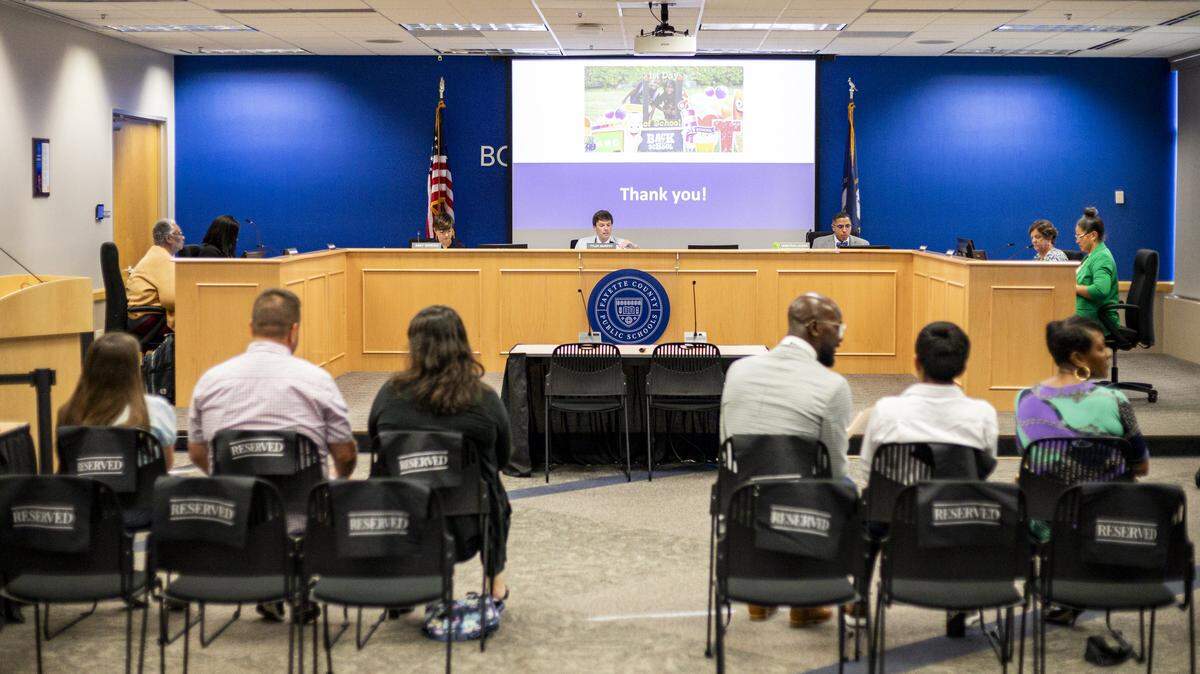
Fayette County’s school board is considering whether it should participate in industrial revenue bonds to provide tax-exempt financing for local development projects, including new housing.
Chief of Staff Tracy Bruno at Monday’s school board meeting asked whether board members would be willing to participate in industrial revenue bonds with developers in Fayette County. Board members said they were willing to listen, but said any decision would have to benefit the community as a whole.
Industrial revenue bonds are tax-exempt financing to support the expansion or construction of industrial manufacturing facilities, but more recently have also been used for affordable housing, which can be in short supply. Discussion at Monday’s board meeting focused on using these bonds for a new development that would include housing.
In an email to families and others Monday night, district officials confirmed that industrial revenue bonds “now encompass affordable housing in Lexington,” and gave more detail on the topic.
“For example, there's a plan to build retail businesses and apartments on a vacant lot downtown, and the developer needs start-up money via bond sales,” the district said. “FCPS would eventually collect much more in tax revenue from a mixed-use development.”
Lexington-Fayette Urban County Government has developed a framework for developers to remodel or construct more affordable housing. Bruno said that through these industrial revenue bonds, a developer could get lower interest rates through a pilot for property tax abatements — payments in lieu of taxes, Bruno said.
City officials brought together Fayette County Public Schools, the Lexington Public Library and Lextran, all taxing entities, which would negotiate with developers when they propose an industrial revenue bond.
In a Jan. 28 email to school board members, Superintendent Demetrus Liggins shared information about a potential development proposal he and his team recently discussed with Lextran, the Lexington Public Library, and representatives of the project.
“I would appreciate your input as we continue to discuss this potential request,” he said.
Midland Avenue development could benefit from these bonds
The proposal would be for a mixed-use development at the corner of Midland Avenue and Winchester Road, he said. The project would replace a currently blighted property with two five-story buildings that include apartments and ground-level retail space. The apartments are intended to serve working adults earning between 80% and 120% of the area medium income.
Liggins told school board members the developer is considering requesting a 10-year property tax abatement through the industrial revenue bond. The structure would allow for 100% abatements on the increased value of the property for the first seven years, folllowed by a 75% abatement on value increases for years 8-10. After year 10, the property would be fully taxed.
The current property value for that lot is $3.7 million, the district said. It’s estimated that it will be worth $45 million after completion, with annual growth projected at 2%.
If FCPS agreed to issue an industrial revenue bond and got the potential payment-in-lieu-of-taxes (PILOT), the district is projected to get $589,496 over the 10-year abatement period. Without the industrial revenue bond abatement, FCPS would get $3.93 million over that same 10 years. Either way, FCPS would get the full tax revenue for the property going forward after the 10-year period.
“At this stage, no action is being requested. I’m sharing this information to ensure transparency and to seek your thoughts, questions, or concerns about the potential proposal, particularly as it relates to the financial impacts on FCPS and broader community considerations, so that my team and I will have some perspective of board members when discussing this idea with other taxing partners,” Liggins said.
Susan Straub, Mayor Linda Gorton’s spokesperson, said the city got together with the largest taxing districts — the city, Fayette County Public Schools, the Public Library and LexTran — and devised a process for PILOT agreements.
Those are agreements on tax breaks that must be approved by the city’s Economic Development Investment Board. The group set a limit on PILOT agreements of 10 years for workforce housing projects, and 15 years for affordable housing projects. In order to qualify for the tax breaks, developers must have signed PILOT agreements from the city and all three tax entities before being considered by the Economic Development Investment Board.
The developers for this project on Midland Avenue could pursue this type of PILOT agreement, Straub said, but they have not come back yet to the Economic Development Investment Board with signed agreements from all of the taxing districts.
“We have to all agree — it doesn’t have to be the same structure — all three taxing entities have to agree to negotiations with a developer before the IRB can move ahead,” Bruno said.
Twenty percent of the housing would have to be dedicated to affordable housing.
“I want to emphasize that negotiations are ongoing, and this was only the first proposal from the developer,” Bruno told the Herald-Leader Wednesday morning.
Two other industrial revenue bond proposals have also recently come before Fayette County Public Schools officials — a solar farm, and a revitalization project for an existing downtown building.
Those were not discussed in detail at Monday’s meeting, and nothing has been agreed to by the district.
In a Jan. 21 email to Bruno, developers of the Midland Station development project proposed a 10-year PILOT schedule. “The proposed PILOT schedule reflects the shorter term (10 years) available under the city’s new policy versus the 30-year term we initially requested in mid-2024,” said Andrew Ganahl, managing partner of AND Real Estate LLC.
Vice Chair Amy Green made a proposal that would allow the district to give up less money. Green’s proposal was to use the same formula for FCPS that was used to calculate an industrial revenue bond for the state.
“I need to know about the position we want to take into negotiations,” Bruno said.
Concerns from FCPS board members
Board member Amanda Ferguson asked why there wasn’t a specific proposal about the industrial revenue bond on the board’s meeting agenda so the public could see it. Board members received the email about it, but Liggins said the proposal wasn’t final.
“Given our financial shortages I don’t know if we can afford to do specific proposals and defer the payment,” Ferguson said, adding she understood the district also wanted to be a good community partner.
Budget issues for FCPS have been a focal point for the district the past several months, with leaders acknowledging a $16 million budget shortfall and significant problems in the district’s contingency fund. Prior to Monday’s school board meeting, a report was released showing Liggins had violated multiple board policies by failing to properly manage the district’s finances.
Board member Penny Christian asked if similar situations had been successful for other comparable districts of FCPS’ size and questioned how affordable the housing would be.
“I will not be a party to gentrification,” she said.
Board member Monica Mundy also suggested that the information be shared with the public, and said school board members should at least entertain the idea.
Board chair Tyler Murphy raised the possibility of securing an independent assessment of the property’s value and whether it would feature multifamily housing for FCPS students. Bruno said some housing could be set aside for FCPS employees.
Superintendent Demetrus Liggins said district officials need consensus from the board to ensure good-faith negotiations, noting that final decisions lie with the board. Board members were hesitant to commit without more specifics, such as the range of apartment rent.
“We're willing to listen, but it has to benefit the community as a whole,” said Green.
Straub said in 2021, Fayette County Public Schools reached a PILOT agreement with the developers of the Manchester Hotel.
This story was originally published February 11, 2026 at 11:46 AM.