Why did it take so long for Lexington to have election results in the 2026 primary?
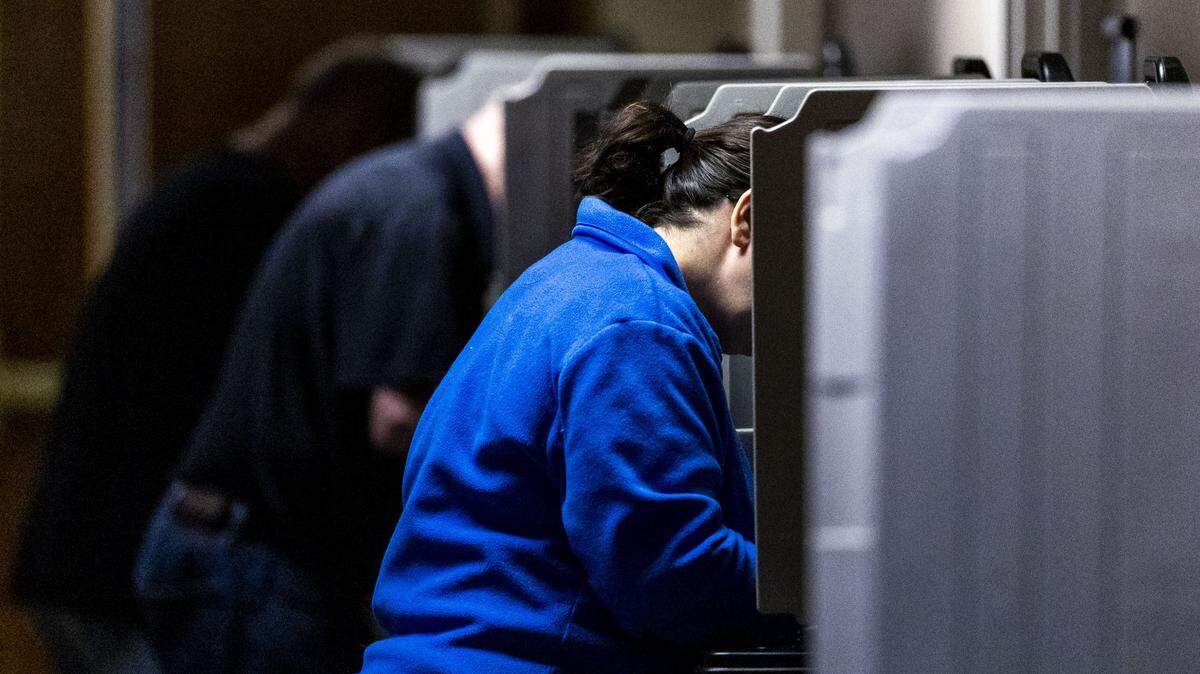
It was just after 9 p.m. when election results from Fayette County hit the Kentucky Secretary of State’s website — more than three hours after polls closed in the county.
Several races, including the 6th Congressional District, a few state house races and all local offices, were waiting on those results to be able to declare a winner.
The wait time frustrated several election watchers.
“All of Kentucky is waiting on Fayette County (Lexington) to report literally ANY votes,” Louisville Public Media reporter Joe Sonka wrote on Bluesky at 8:56 p.m. “They are usually one of the first counties to report totals.”
Fayette County Clerk Susan Lamb told the Herald-Leader the May 19 primary presented several challenges for her office. The delay came from three precincts that had technical difficulties closing down the ballot-scanning machines, she said.
“We probably could have reported an hour earlier had we not had that delay,” she said.
When the polls close and all voters have cast their ballots, election officers at each site have to shut down the scanning machines, print a tally-tape with the voting results of that specific precinct to hang up on site and then extract a “v-drive” out of the scanners to deliver to the clerk’s office. The v-drive has all of the results from ballots cast into that scanner. The scanners are left at the polling location to be picked up later.
Workers at two separate precincts had technical difficulties with the scanners as they were trying to shut them down. Staff from the clerk’s office had to drive to those precincts, pick up the full scanner machines and bring them back to Lamb’s office to resolve the machines’ issues.
A third precinct closed down its polling location and brought equipment back to the clerk’s office as usual. But election staff discovered those poll workers had not properly shut down the scanning machine and did not have the v-drive with them.
Those workers had to go the back to the polling location. But the building was locked, so staff had to wait for property owners to come back to the building, unlock it and let election staff in to shut down the scanning machine — and then they had to return the clerk’s office with the v-drive in hand.
“It’s a really well-oiled machine,” Lamb said of her team’s election operations, “but what happens that I can’t control is when we have an ‘oopsie’ with a poll worker.”
What the county clerk does to make election day happen
Lamb, who has been in office since February 2023, has a large operation to oversee. There are 122 voting locations her office has to staff. Six of those are voting centers, housed at each Lexington Public Library branch, where any Fayette County voter can cast a ballot. The others are locations for the city’s 286 precincts, several of which share a voting location.
To fully staff those sites, Lamb needs 995 election officers. All election officers volunteer to serve at polling locations and receive a $250 stipend for their work on election day. Officers who serve throughout early voting get a $470 stipend.
Lamb said she was short 57 election officers Tuesday. Most of those workers called out on Monday, and the rest either called out Tuesday morning or did not show up to their polling site at all.
Typically, the clerk’s office has a list of alternates to call as backup support for situations like Tuesday’s. But Lamb had to use all of those alternates just to fill vacancies that were popping up even before early voting began.
“We didn’t have any alternates, so we were punting, and we were having to double up positions. I mean, it was stressful,” she said.
Lamb says it’s always a struggle to find enough workers for election day, but Tuesday’s problems were “extreme.”
There must be an equal number of Democrats and Republicans serving as election officers. Two officers from each party are paired for each task, whether that is signing in voters at voting sites or printing off ballots. Maintaining that balance is also a major challenge, Lamb said.
Additionally, the phone lines at the clerk’s office were busier than they had been in previous elections.
“There was a lot of issues with campaign signs being set out in major quantity, and we were having to deal with electioneering (complaints and violations),” she said.
State and local laws prohibit candidates from placing campaign signs within 100 feet of polling locations, public rights of way or on any property where they do not have permission from the property owner to place the signs.
Lamb fears the widespread campaign sign violations could have intimidated both voters and election officers.
“To my knowledge, we didn’t have anybody that didn’t show up or decided not to because they were fearful, but I mean, there was a lot of intimidation going on at these polling places with all the election signs, and I’m sure that plays a part in it.”
Staff in the office also received five calls during from early voting through Tuesday from people who showed up to vote and learned they had been removed from the voting rolls.
Lamb said all of those people were affected by 2024’s House Bill 44, which requires voters to be removed from state voter rolls if they are excused from jury duty for not being a U.S. citizen.
Those summoned for jury duty fill out a paper form where they must mark a box if they are not a U.S. citizen. Lamb said she was told three of the five people removed from the rolls were removed because of “clerical error” regarding how those forms were processed.
“Anytime a voter is disenfranchised, it’s not acceptable to me,” she said, “because I don’t want anybody ever to be denied their right to vote.”
Lamb would like to see the law amended to require the State Board of Elections, which oversees the statewide voter rolls, to retain a digital copy of those juror forms for some period of time so that errors leading to voters being erroneously removed from rolls can be more quickly resolved.
Lamb said that on the whole, she’s happy with how the May primary was handled.
“At the end of the night, we uploaded the election results, and I was very proud. We did it, and we had every v-drive accounted for. And once they were populated, everything was 100% done.”
How could local elections change in the future?
Lamb said she is considering moving away from voting precincts and adding more voting centers, like the ones at local libraries, which serve as sites open to any Lexington voter regardless of where they live.
Voter turnout across the six voting centers, from early voting through election day, was up 145% from the 2024 primary elections.
“Clearly, our libraries have shown us this year during this election, that people love to go to our libraries, and we’re so fortunate to have such a great partnership with them,” she said.
The move could also bring immense cost savings for taxpayers. It only takes 73 workers to fully staff the six current voting centers, compared to 922 people needed to staff precincts.
Her office is also required to pre-print ballots for voting precincts, meaning the high number of unused ballots eventually are shredded. At voting centers, she is allowed to print ballots on demand.
Lamb is still running the numbers, but she believes the six voting centers alone could handle the turnout of a typical Lexington primary election.
Still, since primary turnout this year was remarkably higher than usual at 25.7%, she hopes to add more voting centers in the future.
“To take away the precincts is not a favorable thing to people,” Lamb conceded. “But I think the vote center concept is going to have to be a stronger conversation, and I think that it’s going to have to be the way that we’re going to have to look at things going forward. But you got to show the money, because otherwise people won’t like the change.”