
‘The burden I live with.’ Two KY families haunted by a lynching meet 120 years later.
Note: The following article is based on a segment of the July 30, 2020, edition of the weekly WEKU (88.9) program, Eastern Standard hosted by Tom Martin. The segment and full-length audio of the conversation that is central to this account are available on-demand on esweku.org.
Some say the civil unrest triggered by the police killings of George Floyd and Breonna Taylor has given rise to a national reckoning with racism and possibly to a healing of our country’s long-festering racial wounds.
At the heart of this process is communication - talking with and listening to each other - an airing of grievance passed down from one generation to the next, a growth in enlightenment and understanding, and a newfound courage to engage in awkward, uncomfortable conversations.
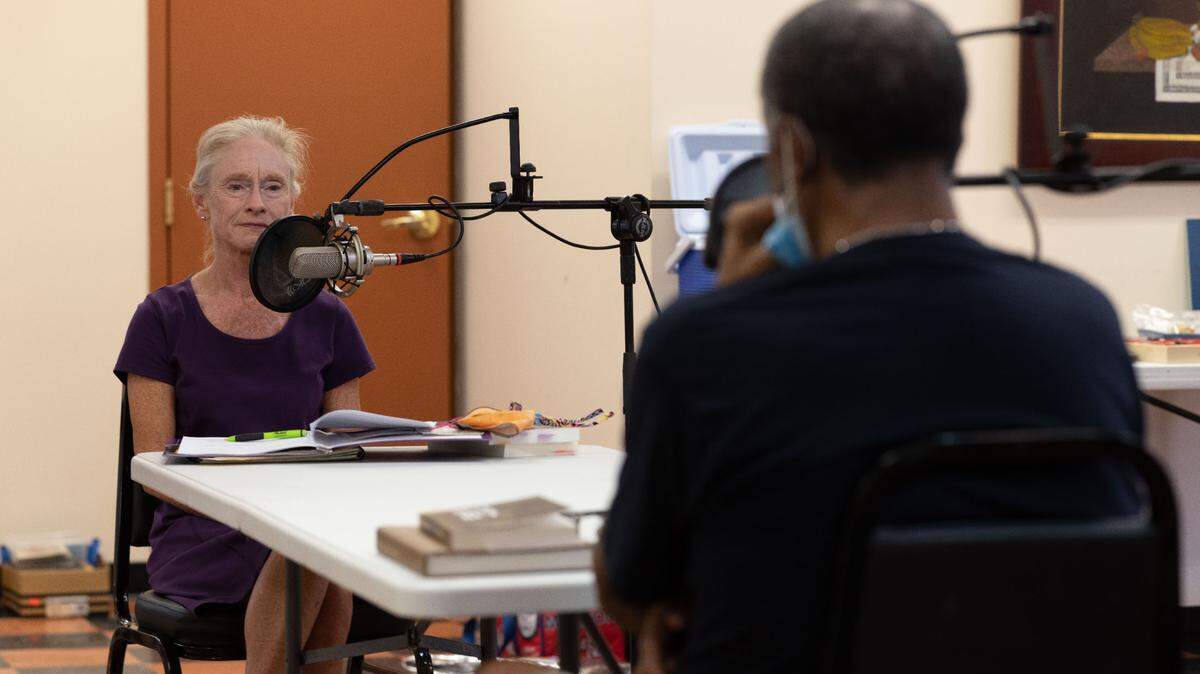
It took 120 years, but on a recent mid-July afternoon just such a conversation took place between two people, a white woman and a black man, seated facing each other, socially distanced, in the basement of the Hopewell Museum in Paris, Kentucky. Eastern Standard producing engineer Neil Kesterson and I were invited to observe and record the discussion.
“The first thing I want to say is how sorry I am that my family had anything to do with a loss of your family member for absolutely no reason, whatsoever” said Sallie Showalter, great granddaughter of Mary Lake Board, a white woman allegedly assaulted in Paris in December of 1900 by George Carter, an African American man and great uncle of Jim Bannister.
“I just want to thank you for coming to the front with this,” Bannister said. “This means so much to me and my family.”
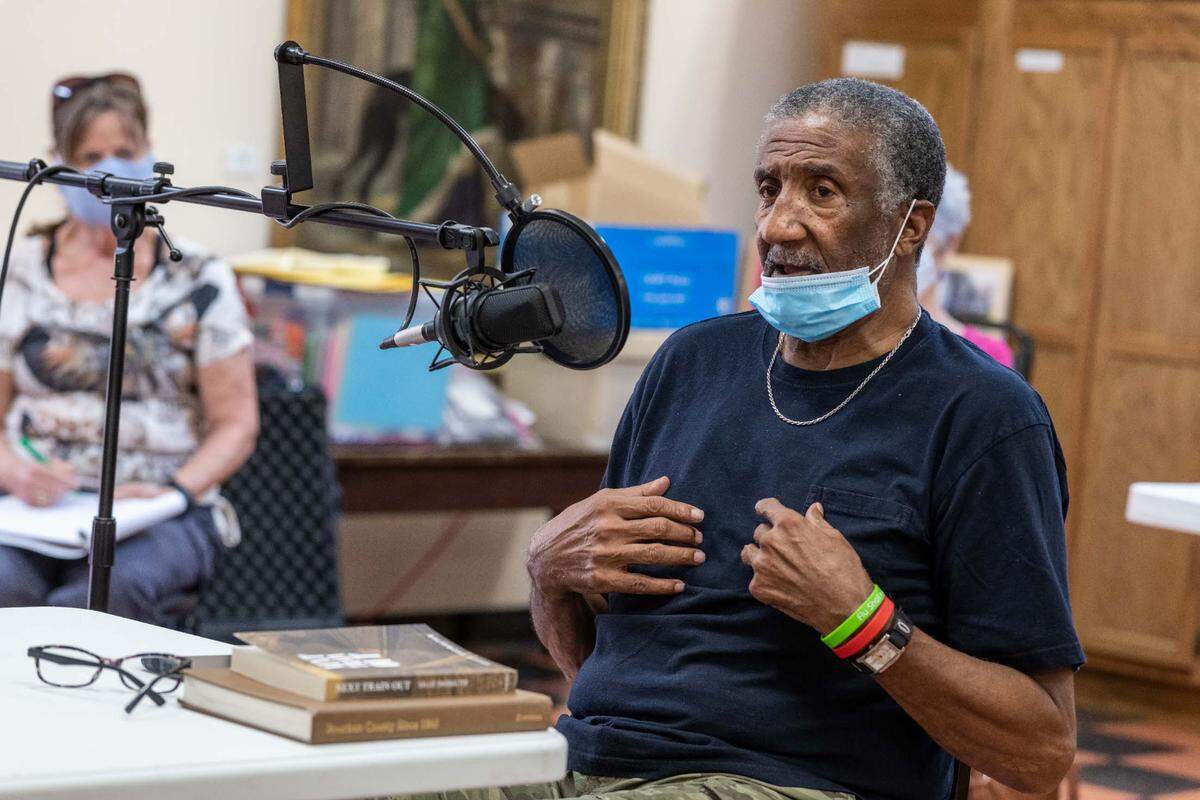
Bannister was referring to one among the scores of extra-judicial mob lynchings of African Americans that took place in Kentucky during the Jim Crow era. In some cases, entire families were hanged by mobs.
Showalter, a central Kentucky author, explained that while conducting research for a book about her family, with the help of an investigative reporter friend, she discovered a story that unnerved her. No one had mentioned it. An alleged attempted robbery of Showalter’s great-grandmother in December of 1900 led to the lynching of Mr. Bannister’s great uncle in February of 1901.
“He had uncovered the whole story about George Carter who had been accused of assaulting my great grandmother. It appears from various newspaper reports that the assault could have been an attempted purse-snatching,” said Showalter.
Born in 1941, Bannister, as a young boy, rarely heard mention of the lynching of his great uncle.
“The people in those times were intimidated not to mention what had gone on before,” he said.
But his family’s perspective of what happened in the winter of 1901 did eventually begin to emerge. Jim Bannister was then 10 years old.
“My grandmother said ‘sit down, I have something to explain to you,’” he began. “She told me ‘well, they lynched my brother.’”
Accounts differ in details concerning what happened on that chilly winter evening in 1901. Time has its way with memory. We have as a record only the newspaper accounts of the era - newspapers owned and operated by the local white establishment.
The February 8, 1901, edition of The Bourbon News reported that a George Carter had been brought before an “examining trial” on a charge of attempting to assault his sister-in-law. Mr. Carter was ordered jailed, pending trial.
The newspaper account noted that a rumor was circulating that it was Carter who also had assaulted Showalter’s great-grandmother inside the wooden covered bridge over 2nd Street in December and that despite the absence of any evidence to support this accusation, he probably would be lynched.

Between the publication of the Feb. 8 article that rumored the upcoming lynching, and the actual act on the following Sunday night, Mrs. Board evidently was shown a photo of Mr. Carter and confirmed that he was the attacker. And her young son, Sallie’s grandfather, who had witnessed the assault, was taken to the jail to identify Mr. Carter in person.
“They asked my grandfather at eight years old to go to the jail and point his finger at him,” Showalter said. “It’s possible that he recognized Carter and thought it was the same gentleman. It’s possible that he didn’t recognize him but just decided to do what the adults around him expected of him. Or, it’s possible that he knew absolutely that it was not the same man as the one who had assaulted his mother, but there were these people waiting expectantly for him to say it was. So, that’s the burden that I live with.”
Even though Mrs. Board and her son identified Carter as the attacker, the physical description of Mrs. Board’s assailant that had been reported a few months earlier - “burly,” weighing “200 pounds” - does not match that of a thin and wiry George Carter.
Was George Carter hanged because he was jailed for a crime the public thought was similar to what had happened to Mrs. Board? Or was he just a convenient and innocent target of vengeance?
According to a subsequent article in the Bourbon News, on the evening of Sunday, February 10, 1901, a mob of 50 men overpowered the county jailer, took George Carter from his cell, marched him along Main Street and hanged him not once, but twice after the rope broke during the first attempt, from the arch of an iron gate that once stood in front of the Bourbon County Courthouse. The gate has since been relocated and now serves as the entrance to a garden adjacent to Duncan Tavern Historic Center in Paris.
While this account differs from what Bannister had been told by his grandmother, photographs of George Carter’s lifeless body hanging from that gate leave no doubt about his fate. Little is known about what became of his wife and two daughters, ages 2 and 7 months.
“So the question will forever be: was this gentleman the same person?” Showalter said.
Bannister attempted many times over the years to gain more information from friends and relatives. “Nobody knew about it. I’m talking about older people. And if something outrageous like that happens in the community, everybody knows. But there was intimidation back then coming from somewhere, and they wouldn’t talk.”
This event occurred in 1901. It’s now 2020. Why talk about it now? Why “dredge up the past?”
“We haven’t had these conversations, so we haven’t corrected this problem,” said Showalter. “And still, day in and day out, Black folks are accused of things they haven’t done or they lose their lives over some minor infraction. We have to talk about it. We have to.”
“If we don’t, it’ll be like 1901. A century and two decades ago, and it’s happening again,” Bannister agreed.
Showalter challenged the community of Paris to “have an honest conversation about this history and in some way recognize formally that your (Bannister’s) great uncle lost his life, that there was another gentleman here who lost his life in a similar incident in 1889, and that there may be additional ones.”
“It’s like that song,” said Bannister. “Marvin Gaye has a song that’s 50 years old. He says: ‘What’s Goin’ On?’ And it’s still the same way, and we don’t know yet.”
You can listen to an audio version of this article, as well as the entire conversation between Sallie Showalter and Jim Bannister online at esweku.org. You can listen to Eastern Standard on 88.9 WEKU at 11 a.m. and 8 p.m. Thursdays and 6 p.m. Sundays.
This story was originally published July 30, 2020 at 7:36 AM.