Lexington protesters want more police oversight, accountability. Can they get it?
Many disciplinary actions can be removed from Lexington police officers’ files within 24 months.
All disciplinary matters are handled internally by police with no outside review or oversight.
Only after the disciplinary action is finalized —typically after it has been approved by the Lexington-Fayette Urban County Council — is the name of the police officer or what that officer did released. And sometimes the information released is limited.
That needs to change, say many organizers of local protests decrying police brutality sparked by the recent police-involved deaths of George Floyd in Minneapolis and Breonna Taylor in Louisville. Both were black and unarmed.
And Lexington has the opportunity to make those changes soon.
The collective bargaining agreement with the Fraternal Order of Police Bluegrass Lodge 4 is set to expire June 30. That collective bargaining agreement and state law outline police disciplinary procedures. Negotiations on a new agreement have not yet started due to social distancing requirements in place to stop the spread of the coronavirus.
Sarah Williams, a local activist, has pushed the city to make changes to police disciplinary procedures for more than a year, prompted in part by an incident at Fayette Mall in February 2019 involving Lexington police chaplain Donovan Stewart. Stewart has been accused of repeatedly punching a teen while the teen was restrained on the floor. The boy’s family has filed a federal lawsuit against the officer and the city of Lexington.
Stewart has not been disciplined.
Lexington police have said that in situations involving court proceedings, the court case must be resolved before a formal internal review begins.
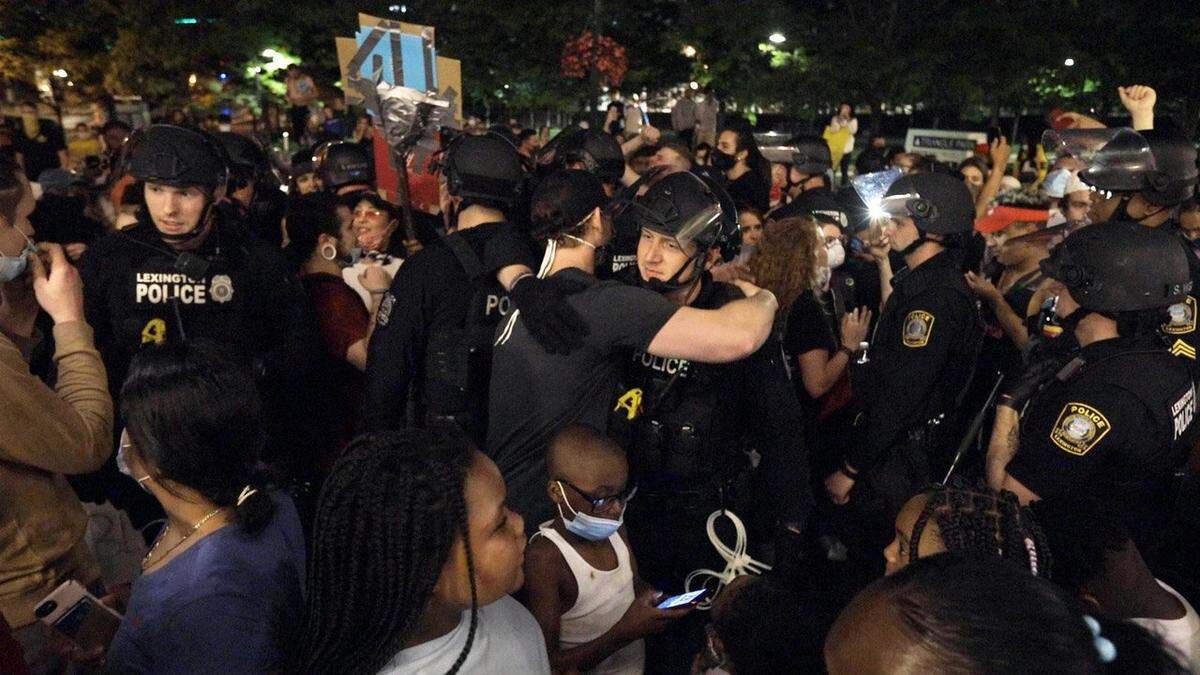
Williams, who has helped lead many of the protests over the past five days, reminded protesters at various protests that the collective bargaining agreement was soon set to expire. She urged those gathered to encourage Mayor Linda Gorton and the Lexington council to make changes to the collective bargaining agreement that would ensure more accountability. Williams has also pushed for changes in state law to increase police accountability.
Williams and other community activists have asked the city to consider a host of changes some of which include the following.
- Eliminate language in the collective bargaining agreement that allows police to remove coaching and counseling forms — which are a form of written reprimand — after 12 months from their files. Oral warnings are removed from officers’ records 12 months from the date of the entry. Written reprimands and suspensions are removed two years after the incident occurred, according to the contract.
- Create a citizens review or oversight board.
- Stop disqualifying misconduct complaints submitted more than 30 days after an incident.
- Stop delaying officer interviews by up to 48 hours after an alleged misconduct.
Gorton said Tuesday during a council meeting that the city is open to looking at a citizen review board for police disciplinary matters, but cautioned state law would have to be changed to make that happen. Louisville has a citizen review board.
“Unlike Louisville, current state law does not provide for a citizen review board for Lexington, and its council (legislative body) is the hearing body. This is also set forth in the collective bargaining agreement,” said Susan Straub, a spokeswoman for the city of Lexington.
“A change in the state law to mirror the process in Louisville, and negotiation with the lodge, would likely be required in order for a disciplinary citizen review board to be part of the contract in Lexington,” Straub said.
State laws affect some changes protesters want
Lt. Jonathan Bastian, president of the FOP Bluegrass Lodge 4, said the police department has worked hard over multiple nights of protests to ensure everyone’s safety.
“Lexington FOP members did so proudly because we also stand against police brutality. Lexington’s protests proceeded peacefully and with minimal damage..”
Bastian said the FOP understands and has heard of some of the changes protesters want to the collective bargaining agreement. But not all the changes that protesters want are controlled by that agreement.
“The disciplinary system is somewhat complex, as it represents interdependent layers of state and local laws interwoven within” the collective bargaining agreements, Bastian said.
For example, one of the protesters’ requests is to remove a provision that gives officers 48 hours before they are interviewed about an allegation.
That’s a provision that’s in state law, not the collective bargaining agreement.
Also in state law is a prohibition on police departments or cities making statements about any officer under internal investigation.
“When a police officer has been charged with a violation of departmental rules or regulations, no public statements shall be made concerning the alleged violation by any person or persons of the local unit of government or the police officer so charged, until final disposition of the charges,” the law reads.
Even after formal disciplinary proceedings are finalized, finding out what an officer did wrong is not easy. In Lexington, police disciplinary records are only released through Open Records Act requests.
And those records sometimes provide limited information.
Recently, the Lexington Herald-Leader requested all records related to the six-month unpaid suspension of Lexington officer Bryton Turley for behaving inappropriately and unprofessionally, which was approved by the council on May 7. Those records said on April 11, a citizen had reported a police officer acted inappropriately on April 10. On April 11, Turley was interviewed and admitted “he behaved inappropriately and unprofessionally. Officer Turley states this took place while at work and in uniform.”
Police did not provide additional details to the Herald-Leader about the nature of Turley’s inappropriate behavior.
The police department publishes the number of complaints, informal complaints and internal complaints that its public integrity unit receives on its web site and in its annual report. It provides information about the nature of those complaints. The resolutions for formal complaints for 2018 and the first six months of 2019 are available on the web site. The names of the officers involved in those formal complaints are not published.
The information is also not updated frequently. The data currently available online is only up to date until November 2019.
In 2018, the last full year of data available, the most common complaint, by far, was failure to activate body-worn cameras with 367 different reports. Louisville police involved in the deadly shooting of restaurant owner David McAtee early Monday had not turned on their body-worn cameras, which prompted Mayor Greg Fischer to immediately fire the police chief.
Negotiations with police are confidential
Bastian and Gorton were silent on the issues in the collective bargaining agreement that community activists have said are problematic, including the removal of many disciplinary actions from officers’ files after 12 or 24 months and disqualifying complaints filed more than 30 days after an incident.
Both sides said they couldn’t comment because negotiations are confidential.
Bastian said the collective bargaining agreement is designed to prevent bad behavior but it also guarantees officers due process rights when they are accused of misconduct.
“The current disciplinary system is designed to correct poor behavior and prevent misconduct, provide basic procedural rights to officers accused of misconduct, while ensuring accountability to the public. Ensuring due process to our members is not avoiding accountability,” Bastian said.
But Bastian said the FOP understands that Lexington police still has a lot of work to do.
“The FOP recognizes members of our community, especially people of color, believe police have failed their communities,” Bastian said. “Our membership works daily to improve our relationships in the community and to demonstrate Lexington police officers are different. We strive to improve ourselves and our agency daily.”
Several council members said during a Tuesday council work session they supported looking at protesters’ suggestions. But the council has no seat at the bargaining table with the FOP. That’s the role of the administration. The council votes on the contract but cannot make changes to it after it’s been negotiated.
Councilman Chuck Ellinger Jr. asked during a Tuesday council work session how the council could raise the concerns that activists and community members want addressed in the collective bargaining agreement.
David Barberie, a lawyer for the city, said those concerns can be communicated with Gorton and the administration.
Councilman Mark Swanson, who attended Sunday’s protest, urged Gorton and the city to take the concerns seriously and act promptly. Swanson said people don’t want to see another task force or a committee.
Councilman Bill Farmer Jr. agreed. People are angry because they have not been heard or seen, he said.
“I am open to looking at those changes,” Farmer said of the protesters’ requests. “We have to find a path forward and it has to be forward.”
This story was originally published June 3, 2020 at 12:16 PM.