Here’s what you need to know about 4 contested Lexington council races, 8 candidates
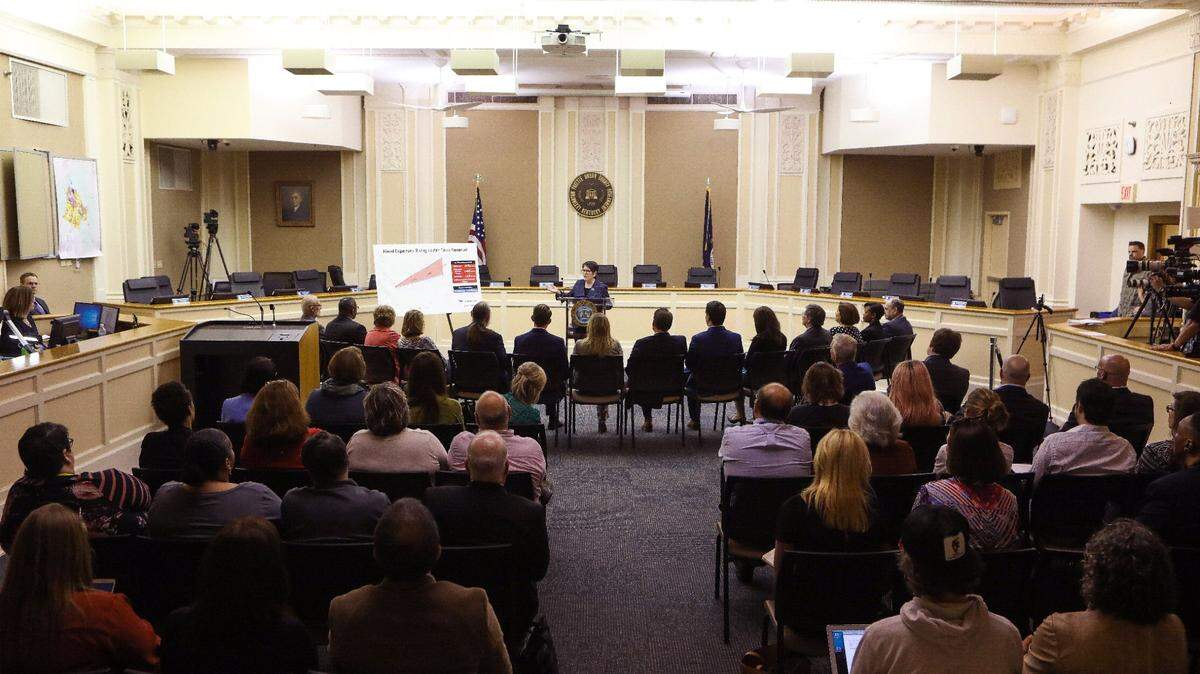
Come January, the 15-member Lexington-Fayette Urban County Council will have at least two new faces.
There are four contested council races for the Nov. 3 general election. Two are open seats.
In the 3rd Council District, which includes much of downtown and neighborhoods around the University of Kentucky, political newcomers Hannah LeGris and Jessica Mohler are facing off for the seat once occupied by the late Councilman Jake Gibbs. Gibbs, who had previously said he wouldn’t seek re-election, died unexpectedly in early March.
Longtime Councilwoman Jennifer Mossotti announced late last year that she would not seek re-election in the 9th Council District, which includes neighborhoods in the Reynolds Road corridor in South Lexington. In her first race, Whitney Elliott Baxter faces Willy Fogle, a former councilman and aide to a councilman.
Two veteran council members will try to keep their seats on Nov. 3.
Councilman Bill Farmer Jr., who represents the 5th Council District, is running against Liz Sheehan in a rematch of the 2018 general election. Farmer won that race for the district that includes much of the Chevy Chase area and extends to Idle Hour.
Councilman Fred Brown, who represents the 8th Council District, is facing Christian Motley. Brown successfully challenged the number of voter signatures on Motley’s 2018 candidacy papers for that race, and Motley was not allowed to run that year. The 8th Council District includes neighborhoods around the Tates Creek school campus.
Council district races are nonpartisan. Council members serve for two years. In 2020, council members made $33,627.51 a year.
For a map of council district boundaries, go to Lexington’s MapIT program at maps.lexingtonky.gov/mapit.
Lexington 3rd Council District
Mohler, 38, edged out LeGris, 34, to get the most votes in the four-candidate primary in May. Mohler received 26 more votes than LeGris.
Campaign finance data filed Oct. 6 with the Kentucky Registry of Election Finance shows LeGris has raised $10,640, slightly more than Mohler’s total general election campaign haul of $9,339.56.
Less than a month before the election, Mohler has more money left — $5,091. LeGris has $4,454, campaign finance reports show.
LeGris said the diversity of her work background gives her the edge and makes her the better candidate. A career counselor at the University of Kentucky, LeGris has also worked in the nonprofit sector with various organizations.
“I am running for Third District Council because I am invested in making Lexington more inclusive, economically resilient and keeping our residents safe and supported,” LeGris said.
Mohler, director of marketing and communications for the Carnegie Center for Literacy & Learning, said she’s served as an assistant press attache for the Embassy of Croatia, was an aide to Rep. Kelly Flood, D-Lexington, and has extensive experience working with nonprofits, business and the arts community. She also knows what it’s like to live in Lexington on a limited income.
“I’ve seen firsthand the gaps in government and social services and have forged creative partnerships to create solutions,” Mohler said. “As a former freelance writer, restaurant server and barista, I’ve experienced the struggles of low-income work and finding affordable housing.”
Jessica Mohler vs. Hannah LeGris: Key issues
Both say affordable housing is a key issue in the 3rd District and all of Lexington. Both say they support fully funding the affordable housing fund., which gives grants or loans to developers to build or refurbish affordable housing units.
The candidates back keeping the current urban service boundary, which limits growth. They agree that planning that encourages multi-modal transportation, not just cars, is important in the 3rd District and throughout Lexington.
Mohler said she supports banning no-knock warrants. Mayor Linda Gorton issued a temporary moratorium on no-knock warrants after Louisville police killed Breonna Taylor during the execution of a no-knock warrant in March. Louisville and several other cities and states have banned the practice.
“The marginal benefit of no-knock warrants doesn’t justify the risk of mistake, unnecessary force or violence to civilians and officers,” Mohler said.
LeGris said she does not think no-knock warrants should be banned. “I want to put safeguards in place to make sure that no-knock warrants are only applied in life-or-death situations,” she said.
Lexington 5th Council District
Farmer, a jeweler and small business owner, said steady leadership is necessary in the coming months as the city faces a pandemic that has upended public life and the city’s finances.
And that’s why Farmer, 61, said voters in the 5th District should vote for him over opponent Sheehan, a senior lecturer in psychology at UK. Farmer served on the council from 1993 to 2004. He ran unsuccessfully for mayor in 2006. He was elected again to the council in 2010 and has served since.
Farmer chairs the council’s Environmental Quality and Public Works Committee, which has oversight over the city’s $590 million water and sewer upgrades required under a federal consent decree. Farmer also serves on the board that oversees Central Bank Center, which is in the midst of a nearly $300 million expansion. Cancellations at the city-owned convention center and Rupp Arena have led to layoffs and the convention center expansion refinancing.
Farmer said those multimillion-dollar projects need experienced leadership.
Farmer said traffic is still a top issue in his district. He wants to see more traffic calming devices and more police patrols.
Sheehan said voters should elect her because she is forward-thinking and active in lots of different organizations and nonprofits. She will work to make Lexington more inclusive and welcoming to everyone, she said.
The two have different stances on police reform.
Farmer said he would wait until Mayor Gorton’s Commission on Racial Equality and Justice makes it final recommendations before deciding on whether the city should ban no-knock warrants. The commission is expected to release its recommendations in late October.
Police reforms set Bill Farmer, Liz Sheehan apart
Sheehan said no-knock warrants are dangerous for residents and police officers.
“I support the moratorium enacted by Mayor Gorton’s administration and with the community’s support would seek to make these changes permanent,” Sheehan said.
Sheehan, who has done several ride-alongs with police, said officers are doing too much. Police are called to deal with the homeless population, people with substance abuse disorders and those with serious mental illness. “Those things could be better handled by a mental health professional,” she said.
Farmer said the public wants more police accountability and transparency in the wake of well-publicized police-involved killings of Taylor in Louisville and George Floyd in Minneapolis, among others.
“I think there’s also a question of what type of policing we want,” Farmer said.
But Farmer said he would like to see the commission’s recommendations and hear what the public wants before making final decisions on what type of transparency is necessary.
Both agree that short-term rentals should be registered and pay annual registration fees. Farmer sponsored an ordinance, which has been stalled, upping oversight of short-term rentals, such as Airbnbs, that have been popping up all over Lexington. They have become a contentious issue in Chevy Chase and the 5th District.
Sheehan, 40, said she would support using fees from short-term rentals for affordable housing. New Orleans does something similar. “I support a dedicated revenue stream for affordable housing,” she said.
Farmer has a substantial fundraising lead. He has raised $41,400 to date, according to Kentucky Registry of Election Finance reports. He also has $28,080 left to spend as of Oct. 6. Sheehan has raised $18,323 and has $15,166 in the bank.
Lexington 8th Council District
Brown, 78, said his past professional experience as a retired accountant and his financial acumen make him the best candidate in the 8th District.
The city’s finances are in disarray due to the pandemic. The city used $36 million in one-time funds — raiding several city savings accounts — to balance the current year budget. Meanwhile, business closures and job losses could mean even less revenue come July 1, the first day of the new fiscal year.
“The budget and finance experience I have from my profession as a CPA has been very useful in dealing with the city’s budget for a total of 17 years as a council member,” Brown said. “I am retired and have the time to respond to the needs of the residents of the 8th District.”
Brown, who served as a council member from 1994 to 2004 and from 2015 to the present, said traffic is a perennial issue in the 8th District.
“I get more calls about traffic problems and speeding than anything else,” Brown said. “I use speed feedback signs on several collector roads, which slow down traffic, and I have installed eight such signs throughout the district.”
Christian Motley vs. Fred Brown: Finances, youths, police
Motley, 34, who worked in former Gov. Steve Beshear and President Barack Obama’s administrations in education, said district residents want more communication from their council member. During the campaign, he started sending out electronic newsletters to keep residents informed, he said.
Motley said people are also concerned about teens and youth in the 8th District. Constituents have told him the city needs to do more to mend relationships between law enforcement and communities of color. Motley works for StriveTogether, a nonprofit that works to address inequalities for minority youth.
“I am committed to getting results for our district with high-quality constituent services,” Motley said. “And I’m engaged in ongoing work to support youth and meet equity challenges, for example, as a member of the United Way of the Bluegrass’ Community Impact Task Force and the Bluegrass Community Foundation’s advisory committee overseeing deployment of resources to combat economic disparities and racial bias.”
Both Brown and Motley support a permanent ban on no-knock warrants. Both say they support more body-worn cameras for police officers. Brown said he also supports monitoring police officers’ off-duty employment to ensure no conflicts of interest. Motley said he would like to see more civilians or non-police officers on police disciplinary boards.
Motley has a sizable cash advantage over Brown heading into the Nov. 3 general election, campaign finance records show. Motley has raised $27,216 and has $17,912 left to spend as of Oct. 6. Brown has raised $12,350 but had spent $10,943. He had $1.406 left to spend.
Lexington 9th Council District
Baxter, a real estate agent, said as the city faces unparalleled challenges, it’s important to have new people and new voices in the council chamber.
She said communication with constituents is key and promises to make sure 9th District residents receive timely information about city government issues.
“People sometimes get defensive because they don’t understand what’s going on,” Baxter said.
Baxter, 37, said she’s always wanted to serve. Her grandfather, Bill Rice, was a councilman for the 9th District from 1978 to 1983. That’s where her passion for public service comes from, she said.
Traffic, particularly on Nicholasville Road and around schools, such as Jessie Clark Middle School and Wellington Elementary School, is the district’s biggest issue, she said.
“Neither of them have adequate crossing signals,” Baxter said. “My main goal for those areas is to install notification signaling similar to what you see at Rosa Parks Elementary school. It’s very clear from far away and I think it would prevent a whole lot of potential accidents.”
Fogle received the most votes in the four-way May primary. Baxter was second.
Fogle, 59, an insurance agent, said the city needs experienced leadership as it faces so many challenges. Fogle served as the 7th District councilman from 1994 to 2002. He also served in former Mayor Teresa Isaac’s administration and was an aide to late Councilman Julian Beard. He moved into the 9th District in 2003.
“I am the best qualified. I know the budget inside and out. I know the workings of government. I don’t need to be trained,” Fogle said.
Whitney Elliott Baxter vs. Willy Fogle: Top issues
Fogle said the top issue facing the 9th District is public safety and traffic.
“My priority will be to see that our neighborhoods enjoy safe and secure conditions to lead their daily lives,” Fogle said.
Both agree Fayette County needs to do more regional planning to manage traffic. The district borders Jessamine County.
Both said Lexington has an excellent police force. But the two differ on whether there needs to be more accountability and transparency in policing and what it would look like.
Baxter said citizens should be involved in police disciplinary reviews. Fogle said he supports more citizen input on police disciplinary actions but is unsure if citizens should be on boards that determine disciplinary outcomes. “There should be some citizen input,” Fogle said. “Or a council member.”
Fogle said he will wait for Gorton’s Commission on Racial Equality and Justice to make its recommendations before weighing in on a permanent ban on no-knock warrants. Baxter supports banning no-knock warrants.
“Through the terrible tragedy of Breonna Taylor’s death, the no-knock warrant has been brought to our attention, and it is our duty to eradicate this non-essential practice with very few exceptions,” Baxter said.
Fogle has a slight edge in fundraising and has raised $3,547 to date. He has $3,524 left to spend. Baxter has raised $2,126 this election and has $2,104 left to spend as of Oct. 6, according to campaign finance reports.
This story was originally published October 9, 2020 at 2:47 PM.