Under Lexington streets, crews find tools that predate European settlers and more
First, they found a cistern likely from the mid-1800s.
Then later the foundations of a building likely from the same time period.
That’s when construction on a section of the Town Branch Commons trail near the west end of Triangle Park in downtown Lexington hit pause.
“We decided we had to stop and figure out what was under this area,” said Brandi Peacher, the trail project manager.
What else was under the soil on land in and adjacent to Triangle Park?
A lot.
Archaeologists continue to work, but over the past three weeks, the Triangle Park area has yielded:
- Stone remnants potentially from toolmaking that predates the establishment of Lexington in 1775.
- Chinaware and other goods from the mid-1800’s.
- Pieces of a stove heating element likely from the 1800s.
- A possible structure from the early 1900’s.
- An early bullet.
Peacher said they will likely have more information about what was found in the next week.
Some of the $39.5 million Town Branch Common Trail project is paid for through federal grants. Those federal grants require environmental assessments and an on-site archaeologist during construction to monitor if crews find something of significance. Jason Flay of Acheulean Consulting in Paris is the archaeologist.
After crews found the foundation for the building from the 1880s, the city consulted state transportation officials along with local and state historic preservation leaders and opened several test dig sites to document what was there.
“Each pit is documented and materials found are sent to a lab for cleaning, documentation, and research,” Peacher said.
Pace Contracting, the main contractor for the trail, was able to move forward on other sections of the Town Branch Commons. Pace was also able to determine how to put in the new infrastructure required to build the Town Branch Commons without interfering with the dig sites. Construction was delayed but only for a short period, Peacher said.
It’s not surprising that so many different artifacts from different centuries have been uncovered at the site.
The area was once the banks of the Town Branch, which is now underground. People gathered and lived near water for hundreds of years, Peacher said.
Bettie Kerr, director of historic preservation for the city, said the Triangle Park site has a rich history because in the early days of Lexington it wasn’t downtown. It was the town. The original stockade or fort was across the street on Broadway.
And it looked very different in the early 1800s, according to insurance maps of the area. Not only was the Town Branch above ground, there was also a railroad track and Water Street that intersected that area. Water Street, which is parallel to Vine Street, currently ends at Limestone behind the Lexington Public Library.
There was no zoning in Lexington’s early days. Houses sat next to tanneries and shops.
“Sometimes there was a home place, a hardware store next to it and a half a block away a tannery,” Kerr said. “These finds tell us about our early history and what our city used to look like.”
It’s not clear what will happen to the items found in the dig sites. A little more than a decade ago, the city found portions of an intact shoe factory from the 1800s further down Vine Street during a sidewalk project. The archaeological finds from that site are stored at a warehouse at the University of Kentucky, Kerr said.
The city hopes it can find someplace to store the items uncovered at the Triangle Park site, Kerr said. “It’s an opportunity to get an insight into our history.”
Meanwhile, work continues on the Town Branch Commons, a bike and pedestrian path that will go from Triangle Park, down Vine Street to Midland Avenue and Third Street, the trailhead for the Legacy Trail.
The commons will connect the city’s two main trail systems the Town Branch Trail and the Legacy Trail to create 22-miles of trails from downtown to the Kentucky Horse Park.
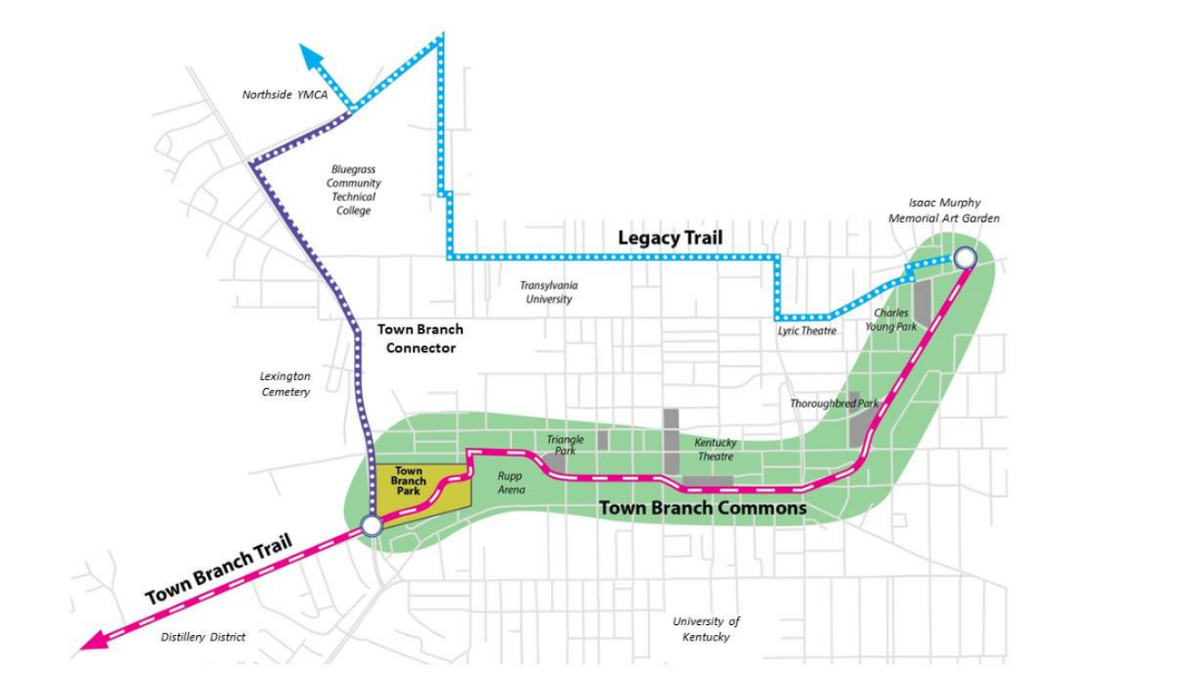
A section between Broadway and Limestone Avenue on Vine Street is substantially finished. Work will continue on the section in front of the Central Bank Center and Triangle Park. Crews will start soon on a section on Vine Street, from Limestone to Quality Street. The rest of Vine Street to Main Street will begin in mid-2021 with work continuing along Midland Avenue to Third Street. The project is slated to be completed in 2022, Peacher said.
A connector between the Town Branch Trail near Manchester Street and the Legacy Trail along Newtown Pike is now complete and was finished ahead of schedule, Peacher said.
No significant archaeological structures were discovered on Vine Street between Broadway and Limestone. That’s largely because there has been a lot of construction in that area. Whatever was under that section of street has been destroyed.
“There are sections between Limestone and Main Street that have not been disturbed in a long time,” Peacher said. “We may find more.”
This story was originally published November 10, 2020 at 3:14 PM.