Lexington churches unite to press city and school officials for change
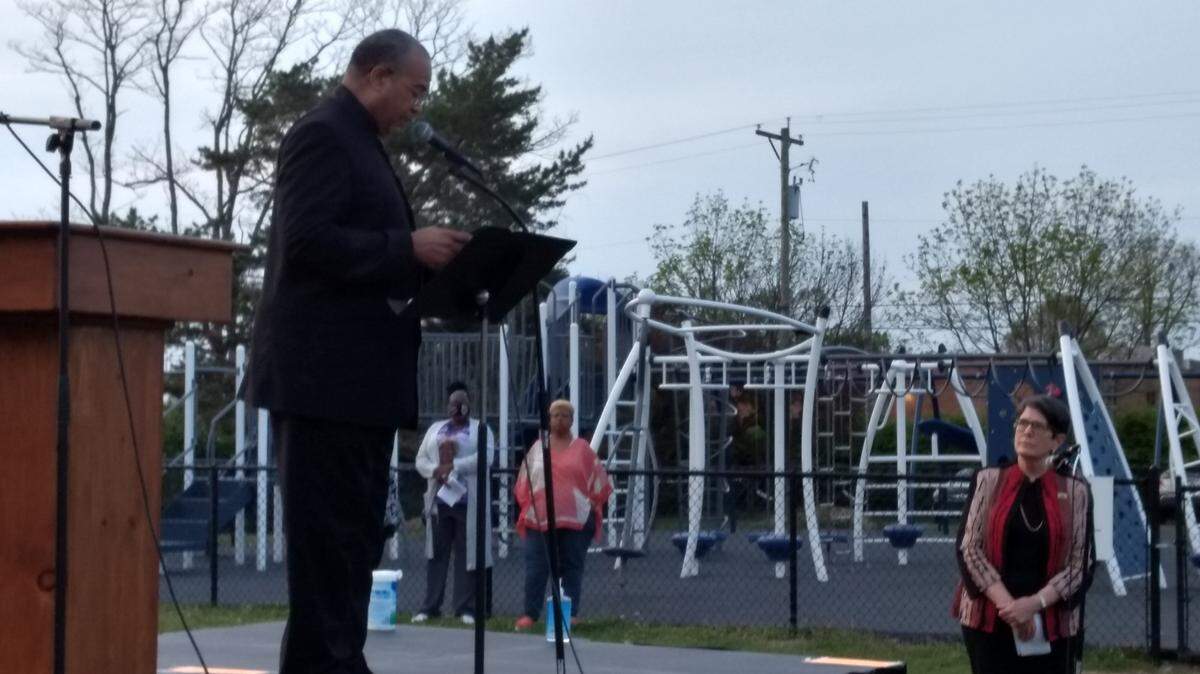
Representatives from 26 Lexington churches got a few “yeses” and one “no” Tuesday night, when they convened with public officials to try to get them to commit to changes that they believe would decrease violence, reduce racial disparities in schools and make more affordable housing available.
While Lexington Mayor Linda Gorton did not agree to BUILD’s demand that the city contract for a specific violence reduction program that the group wants implemented, Acting Fayette County Schools Superintendent Marlene Helm agreed to a pilot program that BUILD hopes will reduce disparities in the rate of disciplinary action taken against Black students as opposed to whites.
And Lexington-Fayette Urban County Councilman James Brown agreed to propose a $10 million increase in funding for the Affordable Housing Fund, which was half what the group wanted.
BUILD, which stands for Building a United Interfaith Lexington through Direct Action, made the asks at its annual Nehemiah Action, where church representatives laid out the problems they want to solve and then asked public officials to commit to the group’s proposed solutions.
The event, which usually draws about 2,000 citizens, took the form of a drive-in gathering outside Mary Queen of the Holy Rosary Catholic Church this year.
People who attended in the parking lot of the church listened in on their car radios, honking their horns in place of applause. Organizers said about 850 others tuned in from home via Zoom.
“As people of faith, we believe we can have a city where there is truly justice for all,” Rev. Rick Smith, of Historic Second Christian Church, said at the outset of the program. “We have one priority ... to stand in solidarity with the marginalized and vulnerable in our community and demand solutions.”
Violence prevention
BUILD has long wanted the city of Lexington to contract with the National Network for Safe Communities to set up its Group Violence Intervention program, but it failed to get a commitment for that Tuesday.
Bryna Reed, of Good Shepherd Episcopal Church, described how the program has been implemented in Oakland, Calif. She said data is used to identify people who are most likely to commit or be killed by gun violence. Then, she said, police set up “direct and respectful communications” with those people, often meeting with them alongside other community members to convey a caring message. She said participants receive a “mentor or life-coach” who can help connect them with other community services if they want them.
Reed said police officers in Oakland are encouraged not to arrest people for crimes that are generally considered more minor, such as drug possession, and to instead focus on “keeping them alive.”
BUILD said the program’s “strategy allows community leaders, law enforcement and social service providers to intervene in the lives of at-risk individuals before they escalate to shooting, and offers the support they need to change their lifestyle.”
“We deserve the very best in violence reduction strategies,” said Cheryl Birch, whose 22-year-old son was shot and killed in 2009. “We want our sons to grow up and have a chance.
“The city doesn’t know how to solve the problem.”
While the city did contract with the National Network for Safe Communities for a study of group violence in Lexington in 2019 and has followed most of its recommendations, the city has not contracted with the group to implement its intervention program.
A news release issued by Gorton’s office after the event said she “has significant concerns about the Group Violence Intervention plan endorsed by BUILD, based on feedback she has received from other cities that have used it.”
“Some of these cities have reported a negative impact on relations between communities of color and law enforcement,” Gorton said in the release. “In practice, Group Violence Intervention has the potential to single out young African American males in a negative way. In a time where racial tensions have increased across the country, I do not want to do anything that could potentially put more strain on those relationships.”
Gorton said she wants to make sure “community leaders understand this concern with the program, and publicly commit to support it.”
“I would like to hear feedback from the local NAACP, Human Rights Commission, the ACLU, and other leaders,” she said in the release.
Rev. Joseph Owens, of Shiloh Baptist Church, said the program targets people not based on race but based on data, with a goal of keeping people at the highest risk “alive, safe and out of prison.”
“They may be young African-American men,” Owens said. “We want to keep them alive.”
Gorton also said during the meeting that other cities using the program “have reported to us their gun violence and violence have gone up, and we need to understand why.”
“I am angry that there’s something that our city leaders could be doing, but they choose not to,” Birch said.
School discipline
BUILD addressed a disproportionate rate of suspensions among Black students in Fayette County schools with Acting Schools Superintendent Marlene Helm.
“When a Black student and a white student commit the same infraction, Black students are more likely to receive harsher punishments.,” BUILD said in its agenda for the night’s event.
Helm agreed to BUILD’s request that the district put in place a “restorative practices” program that involves training school employees with a goal of building “stronger relationships between students and staff to create a more positive school climate.” BUILD says the program “reduces discipline disparities based on race and other factors.”
The group asked Helm and school board members to contract with the International Institute for Restorative Practices by June to implement the SaferSanerSchools model in at least six pilot schools in Fayette County.
Helm said the district plans to put the program in two elementary schools, two middle schools and one high school the first year. After two years, she said staff at 15 schools will have received the training.
Helm also agreed to meet with BUILD quarterly to provide updates on implementation of the program and discipline data for the district.
Housing
Affordable housing has for years been an important issue for BUILD. This year, the group wanted urban county council members to propose allocating $20 million to the city’s Affordable Housing Fund from the funding the city will receive from the American Rescue Plan.
Brown, who represents District 1 on the urban county council, said he would propose $10 million in rescue plan dollars for the Affordable Housing Fund, as long as federal guidelines will allow it.
He also agreed to work with BUILD to find a dedicated revenue stream to generate $10 million a year for the fund.
BUILD successfully lobbied for the creation of the city’s Affordable Housing Trust Fund, which has led to the construction or rehabilitation of 2,008 housing units since 2014.
This was the 18th Nehemiah Action event. Last year’s event was canceled because of the pandemic.
This story was originally published April 27, 2021 at 11:20 PM.