‘Bold, historic investments.’ Gorton unveils $460 million budget, city’s largest ever
Lexington Mayor Linda Gorton unveiled a $460 million spending plan Tuesday that includes five percent raises for most city employees, additional funding for youth violence prevention and youth programming and new programs to address affordable housing.
“The budget I am presenting today is bold, a historic investment in our community,” Gorton said during her fourth budget address Tuesday at the Lexington government center.
During the past two years of the coronavirus pandemic, Gorton and city officials had to make substantial cuts to city programs in previous budgets. Thanks to federal coronavirus relief funding and a robust economic recovery, the city will finally be able to make some key investments, Gorton said.
“This year we have an unprecedented opportunity to invest in our future,” Gorton said.
The city is expecting $42 million in new revenue for the fiscal year that begins July 1. The $460 million budget is a 15 percent increase over the current-year budget of $401 million. It includes no tax increases.
The budget will now go the Lexington-Fayette Urban County Council for its review and eventual approval.
There are 1,000 new businesses now operating in Lexington since the pandemic, many of those now have remote workers. Unemployment has dropped significantly from 14.8 percent in April 2020 to under 3 percent in March 2022, according to county unemployment figures.
The bulk of the budget is spent on personnel costs, Gorton said. The city has recently inked new contracts with five of six collective bargaining units for police, fire and corrections. All those contracts included substantial raises in an effort to retain employees.
In the budget for the fiscal year that begins July 1, Gorton is also proposing a 5 percent raise for employees not covered by collective bargaining agreements.
“Government is a service organization,” Gorton said. “Our employees provide the expert services our citizens demand. We want to ensure that we take care of our employees and that means paying them fairly. We have to compete in a very tight labor market. “
Investments in youth programming, violence intervention
One of the most pressing needs is to address public safety and gun violence, Gorton said.
“Increases in youth gun violence, domestic violence and homicides have been part of the fallout from COVID-19 for cities across America,” Gorton said. “As the leader during this pandemic, I have to find answers that fit our city.”
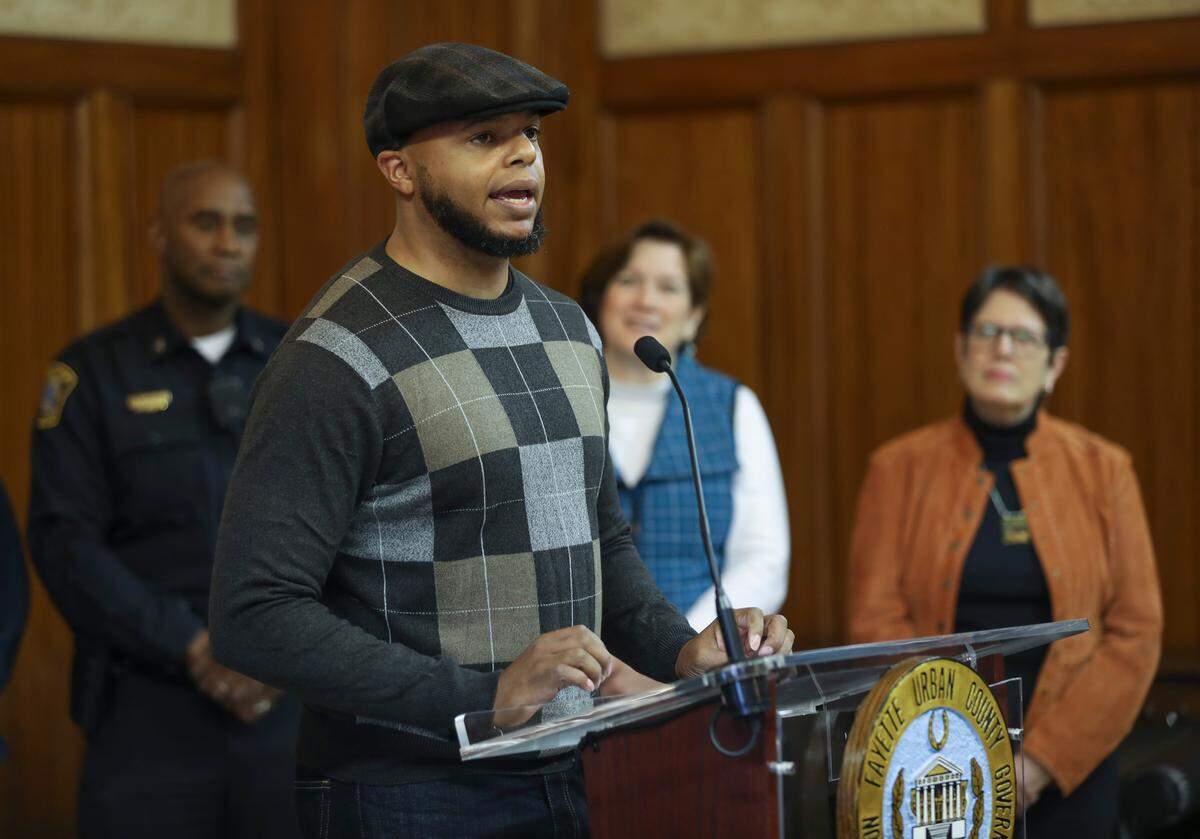
One of the answers has been to expand One Lexington, the city’s youth violence intervention programs, which includes mentoring and other programs. Devine Carama, who has been at the helm of One Lexington for 10 months, needs more help, she said. Gorton’s proposed budget gives an additional $375,000 for One Lexington. In addition, Carama will get an additional staff member, Gorton said.
The city’s park system will also hire recreation leaders in 16 neighborhoods parks to provide and supervise a wide array of new activities for children ages 5 and older.
Gorton said additional programming — particularly for teens — has long been requested by council members and members of the community.
“While it’s too early to assess the full impact of One Lexington and other new youth programming our violent crime numbers are leveling off, thanks to the outstanding work of our community-focused police department and our community partners,” Gorton said.
The city recently unveiled a pilot project for Flock Safety license plate readers that include 25 still cameras. Those 25 cameras were provided at no-cost to the city. Gorton said if the pilot project is successful, her budget includes $275,000 for an additional 75 Flock cameras to be placed throughout Fayette County.
Police have refused to release the locations of those cameras for security reasons.
“Let me be clear, these are not for speeding tickets,” Gorton said. “These tools aide law enforcement in investigations and help them solve crimes.”
In addition, Gorton’s budget includes $5 million to replace police vehicles paid for through a combination of federal coronavirus funding or borrowing; $6.1 million to replace fire equipment -- 3 engines, two emergency medical units, one ladder truck and a mobile air vehicle, used to refill air cylinders at fire scenes.
Affordable housing, social services
Gorton is allocating $2 million to affordable housing. That’s on top of the $10 million the Lexington-Fayette Urban County Council previously gave to the city’s affordable housing fund from the American Rescue Plan Act funding, or federal coronavirus relief money.
Since 2014, the city’s affordable housing program has created or preserved almost 3,000 units of affordable housing, Gorton said.
In addition, Gorton’s budget includes $1 million for the Lexington Neighborhood Investment fund, a zero-interest loan program that will help nonprofits take blighted, dilapidated property and turn it into affordable housing.
“We are very excited about this program,” Gorton said.
A program that helps low-income homeowners fix code violations would also receive $200,000 under Gorton’s proposal from American Rescue Plan Act funds.
In addition, the city is adding $260,000 to buy a mobile food truck with refrigeration service. That truck will go to areas of town where fresh produce is scarce. Addressing food scarcity is one of the recommendations of the Mayor’s Commission on Racial Justice and Equality.
Infill development, new Ag Tech incubator
There is land inside the city’s urban service boundary available for development but infill development is often costly, she said.
“We must recognize that it can be more expensive to develop infill property,” Gorton said.
Gorton is proposing setting aside $3 million for an infrastructure investment fund that would provide repayable zero-interest loans to developers to develop infill properties. Gorton said the funding would be “gap” financing or the last money into the project. City money cannot be the only money in the project.
In addition, the city is putting all of its permitting in one place —a one-stop shop.
“This will make it quick and easy for everyone from land development professionals to do-it-yourself landowners to find out what permits are needed, what they’ll cost and even apply for permits online,” Gorton said.
The building community and developers have pushed the city to make its permitting more user-friendly.
In other business investments, Gorton is proposing $1 million for a Bluegrass Ag Tech Development Corporation. That $1 million will go toward start up costs for the new program that will be a partnership between Kentucky Agriculture Commissioner Ryan Quarles, Nancy Cox, the dean of the University of Kentucky College of Agriculture, Food and Environment and Alltech President Mark Lyons.
Investments in parks, paving and public works
Gorton said the city is also increasing or continuing investments in other cornerstone city services including:
- $13 million for paving, slightly less than the $14.9 million in this year’s budget
- $100,000 for Neighborhood Traffic Management Program
- $5 million for a federal grant match to fix problems on High and Manchester streets near Central Bank Center
- $1.37 million for widening of the intersection of Mason-Headley at Versailles Road.
- $200,000 for better translation services for city services including a new web application that translate all city government web sites into 96 languages
- $3.8 million for grants to social service agencies, an increase of $200,000 from the current-year budget
- $750,000 to replace aging golf carts at Kearney Hills, Lakeside, Picadome and Tates Creek
- 12 new or expanded positions including a traffic engineer manager, two new Global Lex employees to focus on outreach to minority communities
One-time money used to balance budget
Gorton’s budget uses some one-time money to balance the budget.
“That one-time money will only be used on capital projects,” Gorton said.
Sources of funding for the $460 million budget include:
- $419 million in revenue collections
- $12.6 million in savings from the current-year budget
- $12.5 million from a city savings account
- $2.7 million in savings from previous bond savings
- $42 million in bonding or savings
Finance Commissioner Erin Hensley said the $12.5 million from a savings account called the budget stabilization fund is roughly half of the approximately $25 million fund.
The city also has another savings account— the Rainy Day fund— that currently has $37.96 million in it. The city had suspended its contributions to that fund during the past two years of the pandemic. Gorton’s budget restores that $600,000 annual contribution.
The city has not borrowed as much over the past two years. The amount of borrowing versus its revenues is now at around 12 percent, Hensley said. That’s a little higher than the city’s goal of 10 percent. Lexington has been able to maintain its high bond rating throughout the pandemic and downturns in its revenue, Gorton said.
COVID memorial, 250th anniversary art projects
Gorton’s budget proposal also includes $1.5 million for two pieces of art.
“First a memorial to commemorate our community’s COVID victims -- to date there have been 597 deaths,” Gorton said. The memorial will be on the Town Branch Commons Trail at the corner of Main, Midland and Vine streets.
The second will be to commemorate the 250th anniversary of the founding of Lexington— which is in 2025.
“We’re older than the Declaration of Independence,” Gorton said. “Even as I led our city through the darkest days of the pandemic, I knew our community would ultimately triumph. Through 250 years our citizens have risen to meet every test. These memorials will mourn what we have lost, celebrate our past and challenge us for the future, a future that with determination and hard work, we can make bright for everyone.”
This story was originally published April 19, 2022 at 3:44 PM.