Fayette County constable, deputies fined for using police lights on vehicles
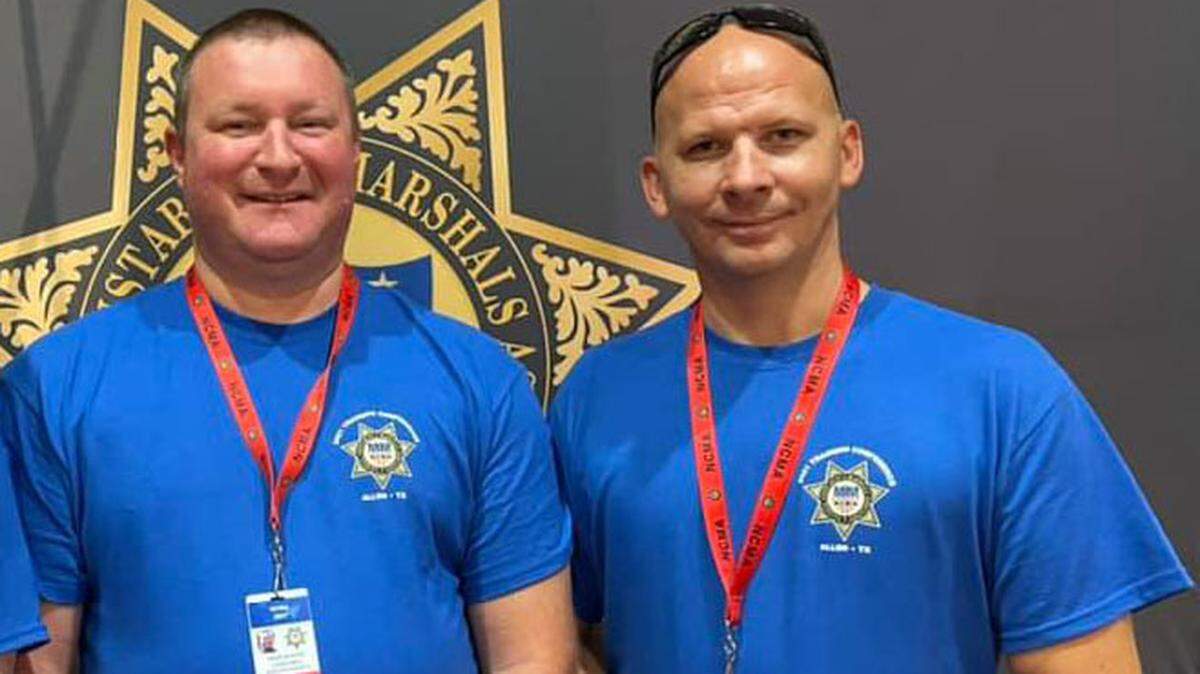
A Fayette County constable, a deputy and a former deputy were convicted by a jury Wednesday after repeatedly using police lights on constable vehicles despite being told not to do so.
Fayette County Constable District 1 Wade McNabb, deputy constable Tony Coffey and former deputy constable Danny Prater were charged with multiple counts each of improper use of blue lights in December 2020.
Each were charged with two counts of the offense. On Wednesday, a Fayette District Court jury found the three men guilty on all counts after a one-day trial. McNabb was fined $500. Coffey and Prater were fined $200, said John Hayne, an attorney with the Fayette County Attorney’s office.
Constables cannot use blue lights on vehicles unless the fiscal court — in this case, the Lexington-Fayette Urban County Council — permits constables to do so.
The council has not given them that authority.
McNabb is running for re-election and faces two other challengers in the May 17 primary. Coffey is running for Fayette County Judge Executive in the Democratic primary.
This is the second time Coffey has been charged with using police lights on his vehicle. He was convicted by a jury in 2019 and given a $100 fine.
Tucker Richardson, a lawyer who represented all three men, was not immediately available for comment.
Prater, who is no longer a deputy, has also been charged with two counts of sexual abuse after a woman said he forcibly kissed her, smacked her behind and sent her unwanted text messages while he was in his constable’s uniform. Prater was working as security at the woman’s apartment complex at the time. That case is still pending, according to court documents.
According to affidavits in the court files, on Nov. 2, 2020, Lexington police Sgt. Bryan Jared noticed Coffey conducting a traffic stop. Coffey’s vehicle had blue lights in and on his vehicle. Prater later arrived at the same traffic stop in a Gold Brown Crown Victoria with flashing blue and red lights on, the affidavit said.
On Nov. 3, 2020, Lexington police were called to Alexandria Drive and Devonport Drive regarding an injury accident involving a Fayette County deputy constable’s vehicle. The vehicle, operated by Prater, did not have any lights on when Lexington police officers arrived. However, McNabb later arrived in a Ford Explorer with blue and red lights working. Coffey arrived at the scene in a Ford Taurus with blue and red lights activated, according to court records.
On Oct. 10, 2020, Lexington police Sgt. James Boyd observed Prater conducting a traffic stop in the area of Hollow Creek Road and Rodney Place with blue emergency lights activated. According to court documents, Boyd said Prater told him he had initiated a traffic stop in the area of New Circle Road and Boardwalk, but the suspect vehicle finally stopped on Hollow Creek.
The driver ran, and Prater later pursued the driver on foot.
“Constable Prater made reference to hitting a pole and colliding with the suspect vehicle,” the report said.
Prior to being charged, Lexington city officials had repeatedly warned constables not to use blue lights on their vehicles after receiving multiple complaints. Fayette County’s constables, the county has three, received a letter in March 2019 warning constables they could be charged if the city found that they had used police lights.
Fayette County constables largely serve as process servers, handling eviction notices and other civil summons. They can conduct traffic stops and write tickets but do not receive the extensive training of police officers. Lexington police officers attend a 32-week training academy.
State law passed earlier this year requires more training for constables.
McNabb has been in trouble with the police before. McNabb served five years of a six-year sentence for third-degree sodomy, but the state Court of Appeals later overturned his conviction in 2010 due to insufficient legal representation. The charges were dismissed and McNabb later had the charges expunged. He successfully ran for constable in 2018.