Lexington faith group presses leaders to address ‘widening gaps within our community.’
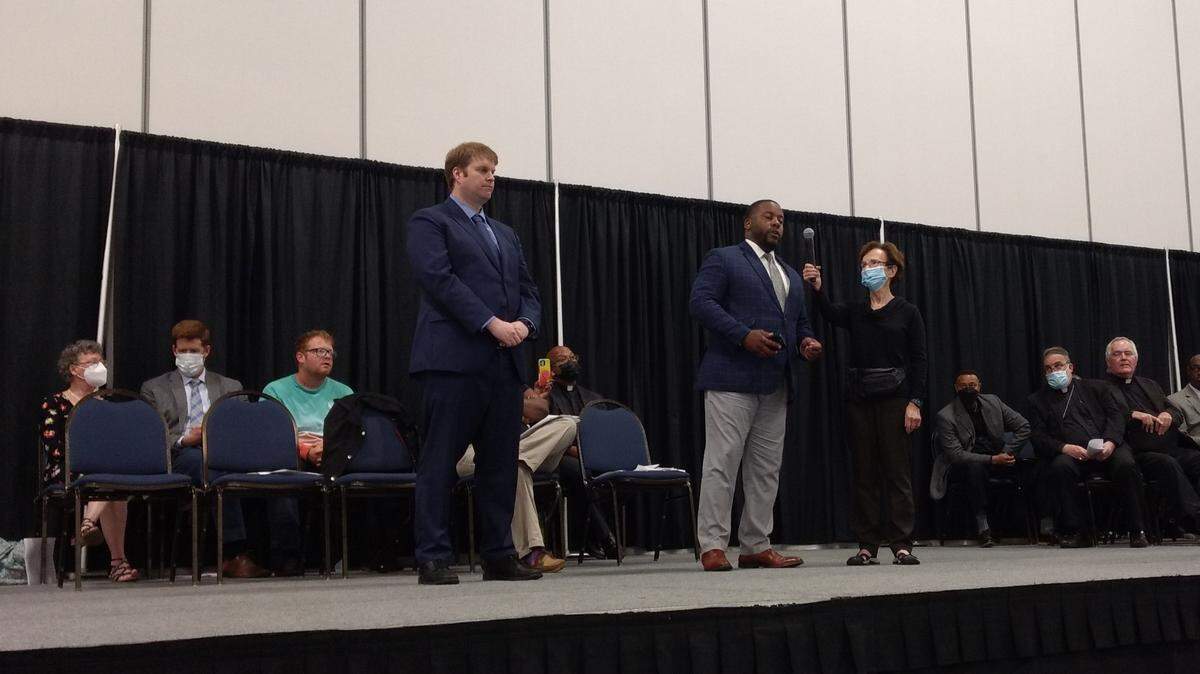
Two Lexington mayoral candidates said at a gathering of hundreds of members of Lexington’s faith community Tuesday night that they support implementing a specific program aimed at reducing gun violence that the group has called for.
For years, the group BUILD, which stands for Building a United Interfaith Lexington through Direct Action, has been trying to get the city to contract with the National Network for Safe Communities to set up its Group Violence Intervention program, or GVI.
Lexington mayoral candidates David Kloiber and Adrian Wallace both said at BUILD’s annual Nehemiah Action Assembly Tuesday night that they support the program.
“This morning I got this report ... that currently we have 20 children between the ages of 10 and 17 in jail,” Wallace said. “Six out of those 20 are facing felony charges because they’ve most likely been involved with firearms. There is no reason we have not implemented GVI to this point. As I’ve said, on day one we’ll make sure that we do that.”
“No one person can solve this problem, and that’s why GVI is such an important tool, because it brings the entire community together,” Kloiber told attendees. “One of the core tenets is to empower the community to work on behalf of the purpose of lowering that violence. We need a new solution, because what we’ve been doing isn’t working.”
Mayor Linda Gorton did not attend the event. She has previously said she is concerned that the Group Violence Intervention program could damage police or city government’s relationship with minority communities and that it has been unsuccessful in some cities.
She said in a letter to BUILD in March that the program has positive aspects “that are similar to other violence prevention and intervention programs that I fully support, and have ensured that our team prioritizes.”
In 2019, the city agreed to spend $35,000 for the National Network for Safe Communities at John Jay College to study group violence in Lexington. After studying 117 homicides and 221 non-fatal shootings over several years, the study determined that 34 percent of the homicides and 30 percent of the non-fatal shootings could be linked to group violence.
Those number were actually lower than what the National Network for Safe Communities typically finds in cities around the country. But the organization was concerned that there were gaps in the information received and used in the study. Local advocates have said they think the percentage would be higher if the study was conducted more recently.
Rev. Richard Gaines, of Consolidated Baptist Church, said he was “disappointed, but I’m not disheartened” at Gorton’s absence Tuesday.
“We have a history of turning absences into yeses,” he said.
BUILD’s event Tuesday night drew representatives from 27 Lexington congregations to Central Bank Center downtown. Besides addressing gun violence, the group urged specific actions around mental health care and affordable housing.
BUILD said one of the primary problems surrounding mental health care in Lexington relates to lack of transportation.
Vallis Pennington told attendees that he recently got a car, but before that, he said he missed many appointments because he didn’t have a ride.
“I went off meds multiple times because I couldn’t make it there,” he said.
BUILD called on New Vista, one of the city’s largest mental health care providers, to meet with a transportation consulting company called Via to get an assessment of what can be done to improve the situation.
Nikki Stanaitis, chief clinical officer for New Vista, agreed that the organization will meet with Via within two weeks to assess Lexington mental health patients’ transportation needs and then report back to BUILD.
BUILD had hoped to secure a commitment from LexTran to cooperate with the assessment and meet with BUILD. A representative of LexTran did not attend, but a BUILD representative said they expect that the city’s transit system will cooperate with the effort.
Lexington-Fayette Urban County Coucil members James Brown, Chuck Ellinger and Kloiber all agreed to work to identify a dedicated funding stream of at least $10 million for affordable housing and to meet with BUILD representatives before June 9 to provide an update on their progress.
Housing has long been a concern of the organization, which for years prodded the city to create the Affordable Housing Fund. The city did in 2014, and Lexington Housing Commissioner Charlie Lanter said Tuesday that since then, it has helped the city create or preserve 2,924 units.
Gaines told the crowd that “current levels of inequality and injustice are unsustainable.”
“The COVID-19 pandemic has acted as a magnifying glass exposing the widening gaps within our community,” he said.. “...We have a choice tonight to make as a city. We can choose to be a city of greater and greater gaps, or a city of opportunity for all. We are actually here to prepare the future of Lexington.”