
Confederate major's relationship with servant remains a mystery
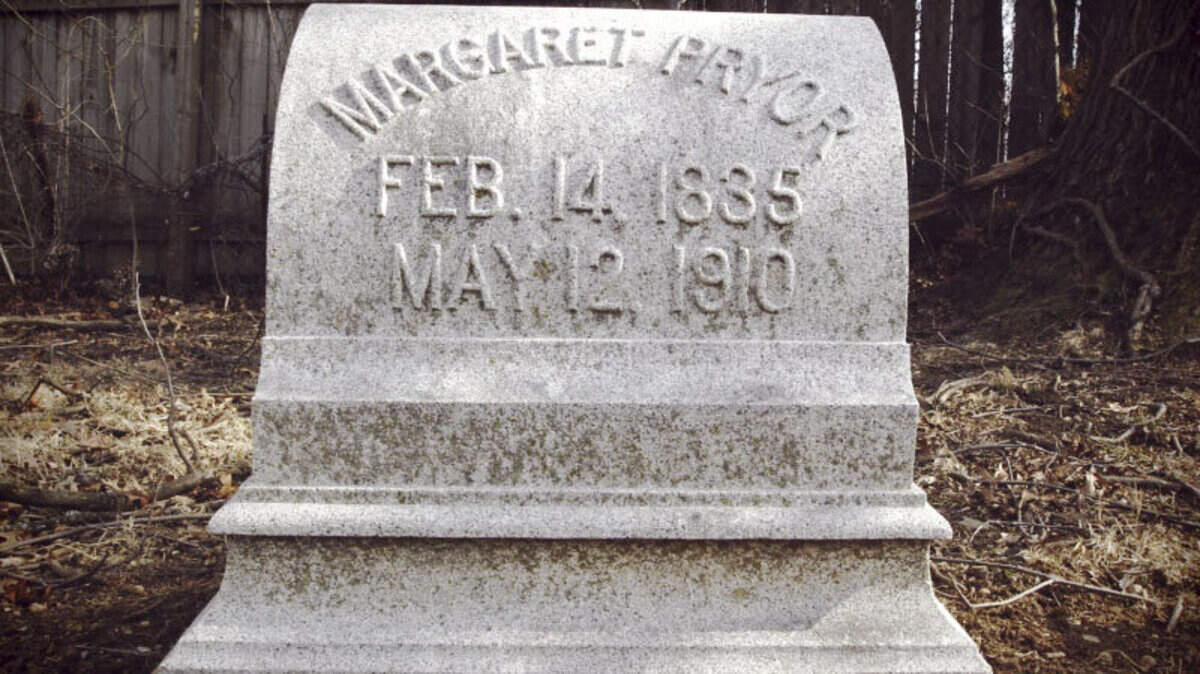
Margaret Pryor would have none of it. She knew what was in Confederate Army Maj. Barak Thomas' will, but she instructed all around that they did not need to bury her in Lexington Cemetery like the major wanted.
She was, after all, not his legal wife and did not have the right to lie in the family plot.
It was enough, maybe, that he had wanted her there. It also was enough that he had made it known that she was to inherit the vast majority of his wealth, all of his remaining Thoroughbreds, his Hira Villa horse farm and his elegant home at 194 West Main Street.
And it was enough that, by dying in 1906, the most famous Thoroughbred breeder of his time made his 75-year-old longtime housekeeper the wealthiest black woman in Kentucky.
What is astonishing — given the age in which she lived — is that his will was allowed to stand. A New York Times story reported on May 12, 1906, that Lexington was not without some remark. Maj. Thomas' will was, the article noted, "a disappointment to many close personal friends who were looking for handsome bequests."
There were additional rumblings that newfound relatives who had not been lavishly gifted were set to petition against Pryor's right to be buried in the white cemetery. Pryor made those proceedings unnecessary by saying she did not want to be buried there.
But, the question lingered, who was she?
It's not black and white
Margaret Pryor's name, lost for a while to Lexington history, came up again when Dixiana, the renowned horse farm out Ironworks Pike, burned last fall. Hidden among all the interesting trivia about the place was the fact that its founder — the one who had bred Domino, the fastest sprinter of his time, and the one who had gone bankrupt, sold the farm, rebounded to great wealth and was much respected upon his death — had left his housekeeper virtually everything when he died. That included $50,000 in cash, or something that would spend like $1.2 million in today's dollars.
Reinette Jones, a librarian and researcher at the Louie B. Nunn Center for Oral History at the University of Kentucky, has worked on the university's Notable Kentucky African Americans Database. In doing so, she says, she's had to rethink, on occasion, race relations and the history of the commonwealth.
"It's so much more complicated than you think. It's not that one person held himself above another necessarily. People were not so ruled by society's norms as you'd expect," Jones says. "It's not, excuse me, black and white. I've learned not to assume that I understand it all."
Yvonne Giles, chairwoman of the Isaac Scott Hathaway Museum in the Lexington History Center, agrees. "You learn to keep an open mind. You weren't there. You can't know."
Margaret Pryor was born in 1835 in Macon, Ga., likely the property of a slave owner named Skelton Napier. Sometime early in her life, she and her four sisters arrived in Danville, still enslaved.
Decades later, when relatives were asked about Margaret's age when she got separated from the others, no one can recall it. They do remember that Margaret left with "Mrs. Ayres' daughter" when the daughter got married and moved to St. Louis.
Asked in a 1910 deposition about how Margaret got chosen for the handmaiden job, former slave and kin Lu Brown, 76, matter-of-factly explained to a white attorney: "She belonged to them, just like they used to do. If you married in a family and I belonged to them and had children, they would give you one of my children."
Margaret, the family explained, had not been seen by her family for many decades. They had heard she was back in Kentucky, in Lexington. One man said he had seen her at "the Colored Fair in Lexington, with colored ladies." But no one had confirmed that despite their living in nearby Harrodsburg.
In a book written in 1927, a former slave named Elizabeth Hummons recalled her earliest days with the Ayres family of Danville. She recalled that when the Ayres family first moved to Lexington from Danville — around 1850 — they boarded at Mrs. Dunham's boarding house on South Upper Street.
Also boarding there, she wrote, was the des Cognets family and the Thomas family, including Barak and his sister Sallie. There is no specific listing of the names of the servants of the families who lived in the house. In 1850, Barak would have been 24; Margaret, 15.
Assisting the major
Thomas was born in 1826. He had graduated from Transylvania University, studied law and civil engineering. He enlisted in the Confederate Army in 1862, serving throughout the conflict and being promoted to major, a title he used his entire life.
The war was hard on him financially, forcing him to try planting and publishing. In the 1870s, he was elected twice to the post of Fayette County sheriff. In 1875, the great horse Himyar, whose grandparentage included both Eclipse and Lexington, was born, and thus began Thomas' reputation as a horseman.
In 1877, he decided to devote his whole heart to the farm he named Dixiana, after his favorite mare, Dixie. He is now thought to be one of the first men in American history to make his living solely off breeding and selling stock.
In 1880, Margaret Pryor's name showed up in census records just below Thomas' as living at Dixiana Farm. The record says she is the "servant and housekeeper."
For 10 years, Thomas' reputation solidified. According to the Thoroughbred Record, "the adoption of jockey numbers on the sleeve and saddle cloth was suggested by Major Thomas."
Still, it was during the early 1890s when Thomas began to have money worries and sold his prize yearling, Domino, to defray expenses. Domino raced undefeated at age 2 and became the 1893 Horse of the Year for James Keene. Thomas, in dire financial straits, eventually sold Dixiana in 1897.
Yet 13 years later, he recovered enough to have a big house on West Main and a stable full of horses at a landed farm that is now part of Mt. Brilliant Farm on Russell Cave Road.
He had more land in Texas, a turf library of international renown and no children to leave it to.
The Thoroughbred Record, in his May 19, 1906, obituary, noted that he had been aware of his failing health and, just prior to his death, had sold his best stallions, maybe explaining the ready cash he had on hand.
In the June 2, 1906, Cleveland Gazette, another obituary let the world know of the unusual will that left "Bulk of Property to his Afro-American Housekeeper." Yet, by way of explanation, the newspaper tells a story that no one else had offered up.
"In the civil war Maj. Thomas killed a Union soldier and was run down by soldier friends of the man. Margaret Pryor did her best to shield him from the blows and cuffs of the soldiers, getting many scars and saving him many hard blows."
No date was given for her heroism.
Assisting the major
Margaret Pryor died in March 1910. She had remained in the Lexington house, which in 1907 was renumbered to be 626 West Main. Her will included gifts to the same black trainer and his wife that Thomas had bestowed some money, and gave $100 to be used to beautify Thomas' grave. "All the rest, remainder and residual" went to the children of Louis des Cognets, whose family had shared the rooming house with the Thomases a half-century earlier.
It was estimated to be in the amount of $50,000.
Margaret's family was outraged.
Claiming they were the rightful heirs, a lawsuit was filed on Sept. 5, 1910, by the children of Ruth Pryor, Margaret's sister. They included Mary Walker, Lillie Brown, Eliza Brown, James Isom, Nancy Isom and Chaina Isom. They claimed that Margaret died without a will because the purported last will and testament that was being put forth as hers "is not her act and deed," because: It is "unnatural upon its fact" for a colored woman to leave all her property to white people. The second reason was that she wasn't smart enough or have "memory sufficient" to understand what she was doing when she made the will.
In the depositions that were taken in Fayette Circuit Court in 1910 in regard to their right to inherit, her relatives were questioned.
Attorney C.E. Rankin of Harrodsburg asked: "Can you recall the man's name she was living with?"
Wesley Johnson answered: "A man by the name of Thomas."
Rankin: "How was she living with him, as a housekeeper, or as man and wife?"
"I would consider it that way," Johnson replied, providing no elaboration.
Rankin asked: "What did she look like?"
"(When she was young) she looked almost like a white girl, straight hair, beautiful girl," Johnson said.
Yvonne Giles, who has helped to find Margaret Pryor's grave in today's Cove Haven Cemetery, says Pryor was not the first, nor the last, former slave to have moved easily in social circles, either because of their relationship with powerful white landowners, because of their beauty, or because no one cared.
She can name six examples in town without consulting a single reference book, adding that only Richard Johnson, the ninth vice president of the United States and a native Kentuckian, "suffered adversely" because of his relationship.
She will now add Margaret Pryor and Barak Thomas to the list of those who managed a long and complicated relationship where there was, she says she is sure, "a measure of love and fidelity that is entirely human."
This story was originally published February 27, 2011 at 12:00 AM with the headline "Confederate major's relationship with servant remains a mystery."