
Renovation of former Fayette County Courthouse could cost $38 million, report says
After decades of neglect and poorly executed renovations, the former Fayette County Courthouse on Main Street is in such disrepair that more than $27 million is needed to fix it, a report released Thursday shows.
The report by EOP Architects and Preservation Design Partnership, or PDP, a Philadelphia firm, estimates the total price for renovations — with design, financing and other costs added — could top $38.3 million.
EOP and PDP spent more than six months doing a thorough analysis of the downtown Lexington courthouse, which has been closed to the public since 2012 after hazardous materials were found in the building. It opened to the public in 1900.
Ninety percent of the construction costs are just to stabilize the building for use, said Jeff Fugate, president of the Downtown Development Authority, which is spearheading renovation efforts.
Those costs include a new roof; an overhaul of the electrical, HVAC and plumbing systems; and restoration of the masonry on the outside of the building.
Despite all of its problems — including water infiltration — the building is mostly structurally sound, which is a testament to the original architects and builders, said George Skarmeas of PDP.
"This building has been neglected, abused and kicked around, and yet 115 years later it's still with us," Skarmeas said.
He said during a tour of the building Thursday that leaving the courthouse in its current state would suck energy out of what is now a vibrant downtown district.
"This is in the heart of the city," Skarmeas said. In recent years, millions of dollars have been pumped into properties around the courthouse. New restaurants and bars have located in the area. The 21c Museum Hotel is under construction across the street.
"This is the hole in the doughnut," Skarmeas said.
A combination of private and public funds could restore the courthouse to what it once was — the heart of the city, he said.
"This can be the living room of the city," he said.
The EOP and PDP study is proposing turning the building into event space that the city could use and private entities could rent. It also could be used to house VisitLex, the city's tourism and convention bureau. The courthouse would be an ideal place for visitors and tourists to begin their visit to Lexington, he said.
But how the space will be used will depend largely on securing a private partner.
Fugate said that if the city wanted to move forward with restoring the courthouse, the city needed to move quickly: A program offering a state historic tax credit that could help pay for redevelopment costs will end soon. That means the city and a private developer must have an application to state officials by July 1.
That state tax credit coupled with a federal historic tax credit could pay for as much as $11 million of the $38 million price tag.
Chief administrative officer Sally Hamilton told the Urban County Council during a workshop Thursday that Mayor Jim Gray planned to put about $22 million for the courthouse project into his proposed budget, which will be unveiled in early April. The $22 million would be bond or borrowed money.
An additional $5 million could come from private investors or other state or federal grants, Hamilton said.
A request for proposals from private developers has been released. The city should know by the end of the month if there is interest in the project. If everything goes as planned, the city could start construction in April 2016, with completion in late 2017.
An official vote on the project was not taken by the council Thursday, but many members expressed support and urged the city to pursue private developers and ensure that the city gets its application to the state by July 1. The council ultimately will have to balance the request for $22 million with other city needs.
"I want us to move forward with the next phase," said council member Bill Farmer.
Council member Richard Moloney said he, too, wanted to make sure the city could pursue the state tax credits.
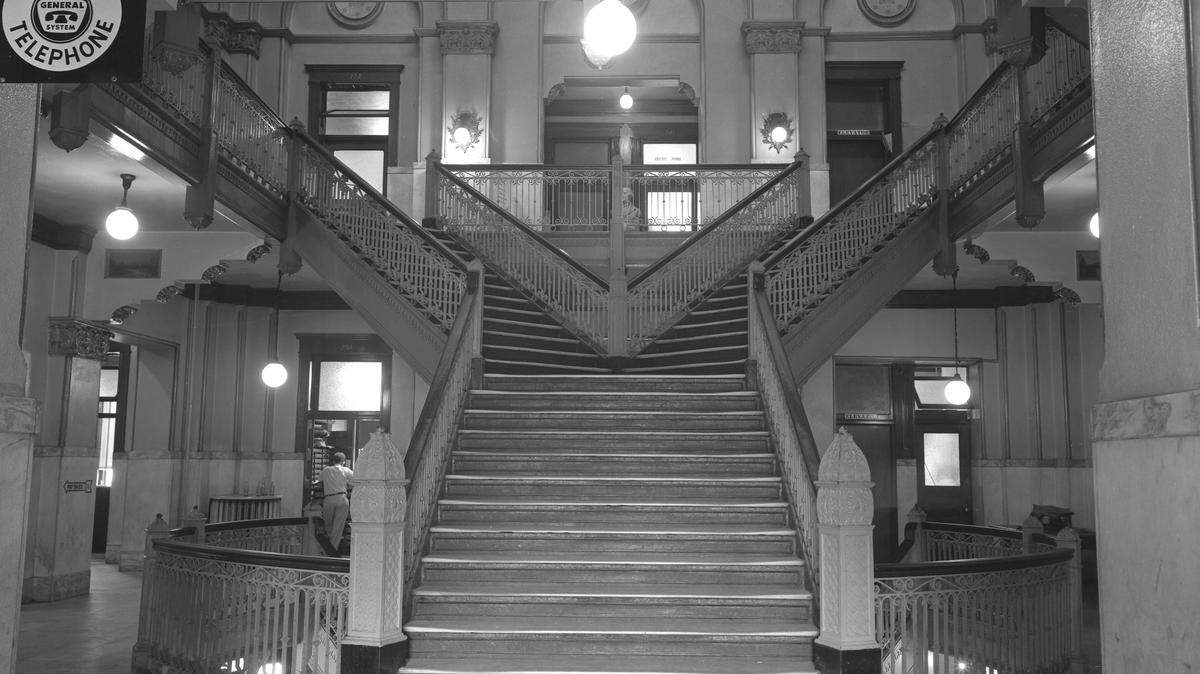
Tentative construction plans would call for restoration of the grand staircase in the atrium or foyer that was removed in the 1960s, and restoring the dome that has been covered up for more than 50 years.
During the 1960s, elevators and HVAC systems were placed in the center. Other renovations also gutted the ornate courtrooms that were in the building, Skarmeas said.
"I have never seen such vivaciousness in attacking the finishes," said Skarmeas, who has worked on several restoration projects throughout the country. "This building was spectacular. The 1960s was a particularly dark period for architecture."
The list of "sins" against the historic building piled up over time. For example, the exterior was sandblasted in 1956, said Andrew Moore of EOP Architects.
"That actually hurt the exterior structure of the building," he said.
The original windows were replaced with aluminum windows, and arches over those windows were filled in in 1972.
What was once an ornate two-story courtroom was gutted and cut in half to add an additional floor. In addition, the dark wood paneling, original chandeliers and distinct lighting fixtures that made the courtrooms unique were removed.
Only a few of the original fixtures were saved, Moore said.
The courthouse was in use through 2001, when two new courthouses were completed nearby. The building was used as museum space until 2012, when it was closed to the public after the discovery of hazardous material, including asbestos.
After EOP and PDP began an initial assessment in July, they found structural problems. Fencing had to be installed around the building after architects discovered that balconies were beginning to separate from the walls. Also, support structures had to be placed under a basement and crawl space that extends to Short Street.
Moore and Skarmeas said water infiltration into the building will continue to cause problems if it is not fixed soon. That means if the city further delays the overhaul, the cost to fix it will grow by about $1 million every year.
"If we delay, we won't be able to apply for those state tax credits that could help pay for those costs," Fugate said.
This story was originally published March 19, 2015 at 6:21 PM.