
Historical slavery marker in Lexington broken; group balks at including it in discussion of Confederate statues
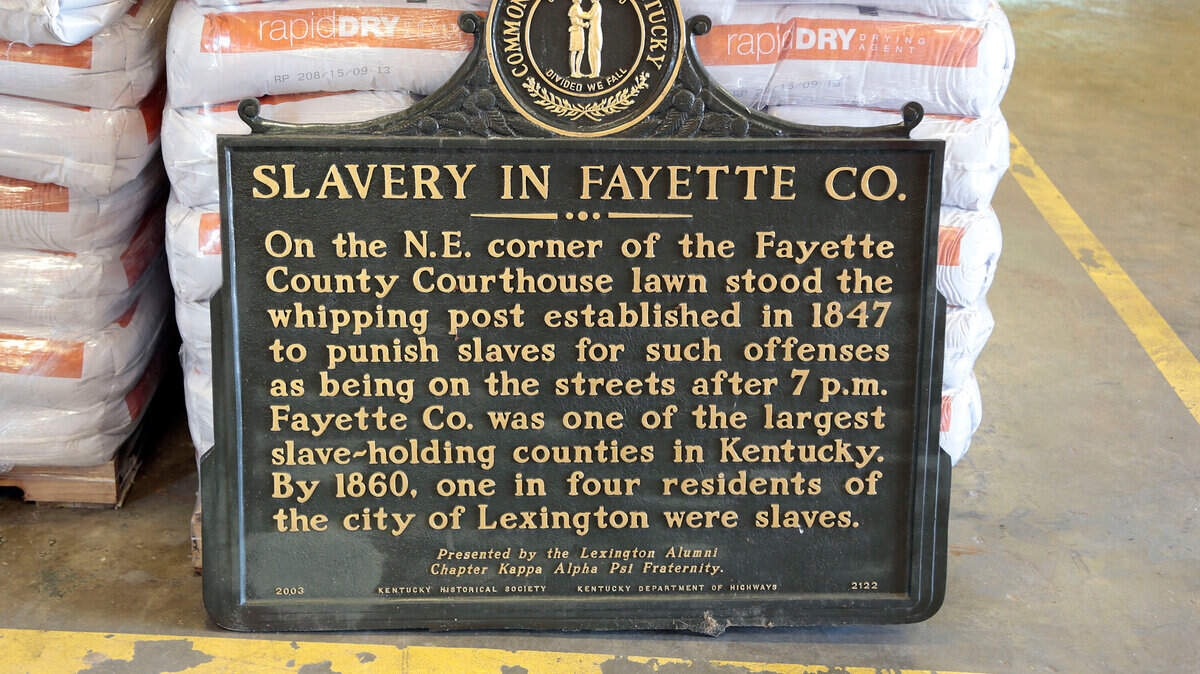
Police have no suspects in the breaking of a historical marker about slavery that was erected in downtown Lexington by the alumni chapter of the historically black fraternity Kappa Alpha Psi.
The sign's fate is uncertain. The Urban-County Arts Review Board, a body of artists, historians and engineers, will determine what to do with the marker, along with the statues of John Hunt Morgan and John Breckinridge, who were Confederate generals.
Police responded July 25 to a call of criminal mischief near the Short Street entrance of the courthouse. They found the cast-iron sign, which was valued at more than $1,500 by a city Parks and Recreation official, broken and lying on the ground.
City spokeswoman Susan Straub said police aren't sure whether the sign was vandalized or whether the destruction was an attempted theft.
Arnold Coffey, president of Kappa Alpha Psi's alumni chapter in Lexington, said he thinks it was vandalism, because the perpetrators would not have left the heavy sign on the ground if it were theft.
Coffey said he was disappointed by the vandalism, and by the city's lumping the sign about slavery in with the Confederate statues.
"We just found out yesterday that our sign was actually included in those conversations," Coffey said. "We feel that the sign tells the truth and that it's an ... educational marker for the city."
Straub said the art board's review will be accompanied by public hearings, which will allow all people to express their opinions of the historical marker. The board will work with Kappa Alpha Psi before making any final decision.
"The board wants to hear from citizens," Straub said.
The sign's damage occurred during a discussion throughout the South over the treatment of black citizens, and the promotion of Confederate statues and flags. The nationwide conversation began after Dylann Roof allegedly shot nine people at a black church in South Carolina.
Lexington's memorials have previously been targeted. Someone vandalized the Morgan statue on the lawn of the Main Street courthouse with spray paint in June by writing "black lives matter" across Morgan's name.
The sign on slavery was snapped off its pole, and it appeared that someone hung onto it to break it, according to a police report.
The sign gives a brief history of slavery in Fayette County.
"On the N.E. corner of the Fayette County Courthouse lawn stood the whipping post established in 1847 to punish slaves for such offenses as being on the streets after 7 p.m.," the sign read. "Fayette Co. was one of the largest slave-holding counties in Kentucky. By 1860, one in four residents of the city of Lexington were slaves."
The sign was erected in 2003 as part of the fraternity's Guide Right program, an educational program for high school and college students.
Although the subject matter is unpleasant, people need to know Lexington's history of slavery and oppression, Coffey said.
"The truth hurts sometimes, but that's what went on in that area," Coffey said. "Several brothers at the time (of the sign's construction) felt it was a need to inform and educate the community and the local area about what went down at the Cheapside area."
The Arts Board might, instead of relocating or removing the statues and the sign, decide to put up more signs that would give information about the generals, rather than just having a statue.
"If we leave John Hunt Morgan where he is, for example, but we put a sign up that says more about him and who he was," Straub said. "It will be a community decision."
The public forum to decide the fate of the statues and the signs will be 6 to 8 p.m. Sept. 21 in the council chamber at 200 East Main Street.
The Arts Board will then, after the forum, make the final decision.
"We plan on attending ... and voicing our opinion," Coffey said.
Mayor Jim Gray will attend a board meeting at 3:30 p.m. Aug. 12 to answer questions from board members. In another meeting, the board will interview "a variety of experts" at 3 p.m. Sept. 16. Both meetings are open to the public and will be related to the statues and the historical marker.
This story was originally published July 31, 2015 at 4:49 PM with the headline "Historical slavery marker in Lexington broken; group balks at including it in discussion of Confederate statues."