
Lanterns set afloat at Lexington park to mark 70th anniversary of WWII atomic bombings
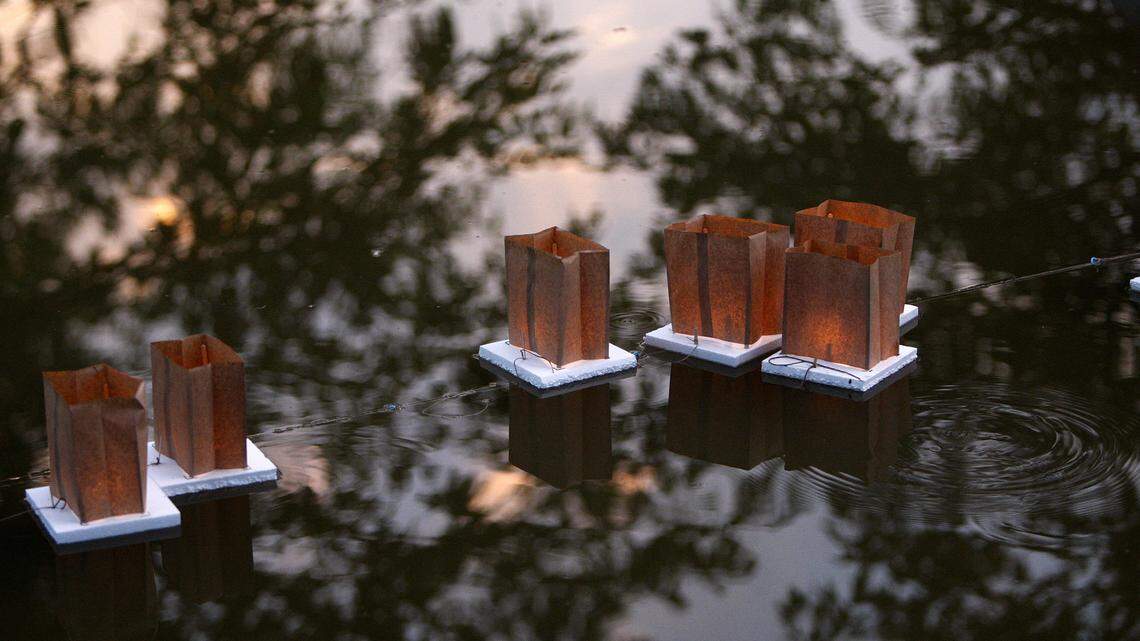
The lighting of paper lanterns and sending them out to sea has long been a way to show respect to ancestors in Japan.
On Sunday night, that custom was re-enacted by the Central Kentucky Council for Peace and Justice to mark the 70th anniversary of the dropping of atomic bombs on Hiroshima and Nagasaki.
Group members lighted lanterns and set them afloat on the lake at Jacobson Park. Nearly 30 people attended and watched as a dozen lanterns were put onto the water's surface in a quiet inlet.
Among those who attended was Ayumi Tadachi, 32, of Japan. She was happy to see the victims of the bombings remembered.
"I have friends from Hiroshima and Nagasaki. I'm just so moved and pleased that this kind of event was thought of," Tadachi said through interpreter Vanessa Grossl. "It's really awesome of our community to think of doing such an event."
C.D. Collins, a Mount Sterling native who now lives in Boston, has just published a novel about the bombings called Afterheat. Collins said her father was an Army sergeant who was in the entourage that escorted Japanese Emperor Hirohito through the ruins of Hiroshima.
"I'm for nuclear disarmament, and that's why I'm here," Collins said.
Those attending read aloud various quotes about the bombings. Collins read a quote from Daisaku Ikeda, president of the Nichiren Buddhist Soka Gakkai, a religious movement: "Japan learned from the bombing of Hiroshima and Nagasaki that the tragedy wrought by nuclear weapons must never be repeated, and that humanity and nuclear weapons cannot coexist."
The Peace and Justice group has held candlelight ceremonies in the 1980s and early '90s to mark the bombings, but Sunday's event was the first involving lanterns.
"The danger of nuclear war is still there," organizer Richard Mitchell said.
In the waning days of World War II, some 74,000 people died in the bombing of Nagasaki on Aug. 10, 1945. That came three days after 140,000 people died in Hiroshima, the world's first atomic bombing.
Japan surrendered unconditionally five days after the Nagasaki attack.
The explosions brought a swift end to a war that otherwise might have dragged on, at a cost of hundreds of thousands of lives. But they killed hundreds of thousands of Japanese civilians, both in August 1945 and subsequently from radiation poisoning.
However, over the past decade, historians have said the entry of the Soviet Union into the war against Japan two days after the Hiroshima bombing might have been more important in Japan's decision to surrender. Japanese military leaders feared the Red Army would directly challenge what was left of Japan's dwindling military at home and in China.
This story was originally published August 9, 2015 at 9:48 PM with the headline "Lanterns set afloat at Lexington park to mark 70th anniversary of WWII atomic bombings."