
Kentucky Capitol's Lincoln statue turns 100; its tradition is nearly as old
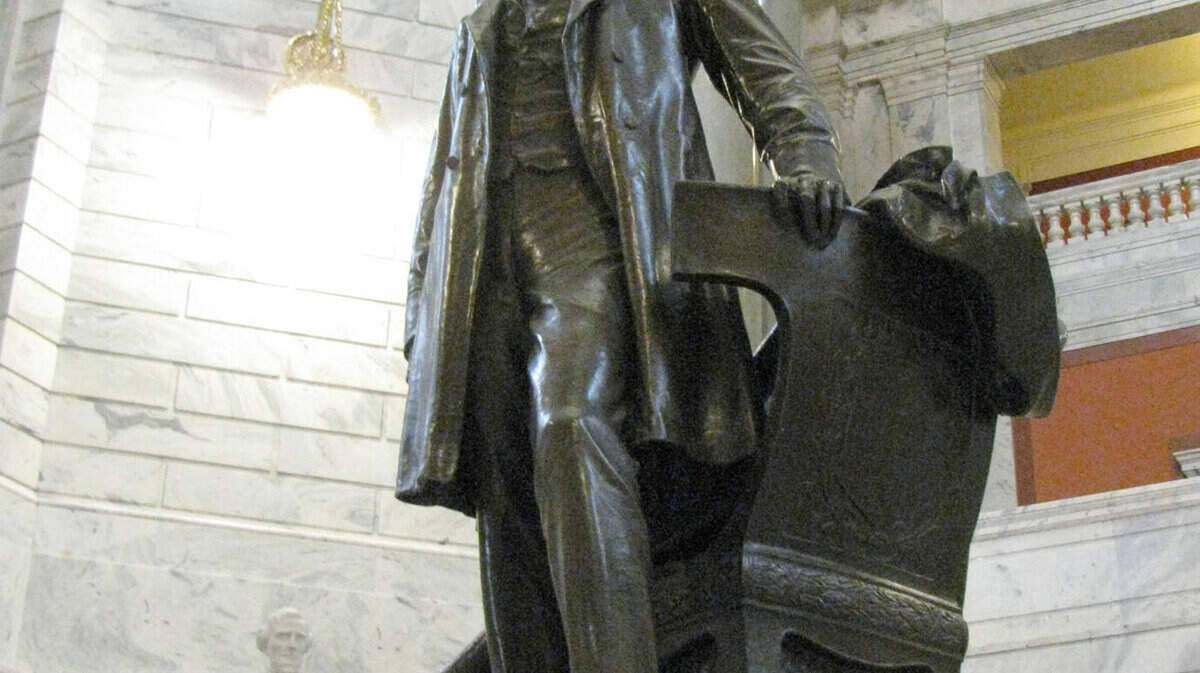
FRANKFORT — For 100 years now, a towering statue of Abraham Lincoln has commanded the attention of visitors to the Kentucky Capitol. And for nearly as long as it has been there, visitors have been rubbing the left boot on the 14-foot bronze statue for luck.
The statue was erected Nov. 9, 1911; the practice of rubbing Lincoln's boot dates to at least the 1920s, said David Buchta , a state curator and the director of the Kentucky Division of Historic Properties.
The traditional boot-rubbing started when legislators took schoolchildren to the Capitol on tours and instructed the kids to rub the boot of the 16th president. Since then, the practice has spread, Buchta said. An estimated two-thirds of the Capitol's 60,000 annual visitors give the boot a pat.
Visitors rub the left boot because it sticks out over the marble pedestal on which the statue stands. People who can reach the right boot sometimes rub that, too, Buchta said. Natural oils and acids on people's hands have caused the left boot to turn a shiny gold. The rest of the Lincoln statue, largely untouched — and unreachable — by visitors, is a deep bronze.
Conservators worry about the damage that so many hands can cause to an important piece of history. During the early 1990s, the Capitol tried to rope off the statue to prevent people from touching it. The barrier did little good; people would sneak around it for a lucky rub, Buchta said.
He said that he appreciated the tradition and that the rubbing amounted to little more than polishing the statue.
"The boot is continually shined by the public's affection," he said.
The statue was the first of five statues now displayed in the Capitol rotunda.
"It's just kind of an awe-inspiring thing to see it," Buchta said. "It dominates the rotunda."
It was donated by James Breckenridge Speed, a Louisville businessman. Speed was a friend of then-Gov. Augustus Willson. Willson, notorious for being a direct man, wrote his wealthy friend Speed and asked him to pay for the statue because the Capitol building didn't have one yet, Buchta said.
Speed donated $40,000 for the statue. When adjusted for inflation, that's more than $900,000 today and, in 1911, it was the largest donation ever made to the state Capitol. President William Howard Taft came to Kentucky to unveil the statue in 1911.
It was created by Adolph Alexander Weinman, a German immigrant who also made the seated Lincoln statue at Hodgenville. Weinman was a noteworthy sculptor who also made war memorials and government monuments throughout the country.
The statue weighs 16,000 to 18,000 pounds, including the marble pedestal. The weight of the five statues combined is almost too much for the Capitol. A recent report said the rotunda floor had reached its weight limit, and no more statues could be added without additional support for the foundation, Buchta said. That means Lincoln and his casted peers will remain the only members of the elite club for now.
On Monday, Jenny Schaffer-McDavid took her great-granddaughters to the Capitol to rub Lincoln's boot. Schaffer-McDavid also brought her daughter Barbara Schaffer, 50, to touch the statue. Schaffer-McDavid's other daughter, Lisa Schaffer-Scheurich, touched the statue years ago during a fifth-grade field trip.
"I guess if you're living and you feel good, it brought you luck," Schaffer-McDavid said.
This story was originally published November 10, 2011 at 12:00 AM with the headline "Kentucky Capitol's Lincoln statue turns 100; its tradition is nearly as old."