
Prison's Braille program benefits visually impaired and inmates alike
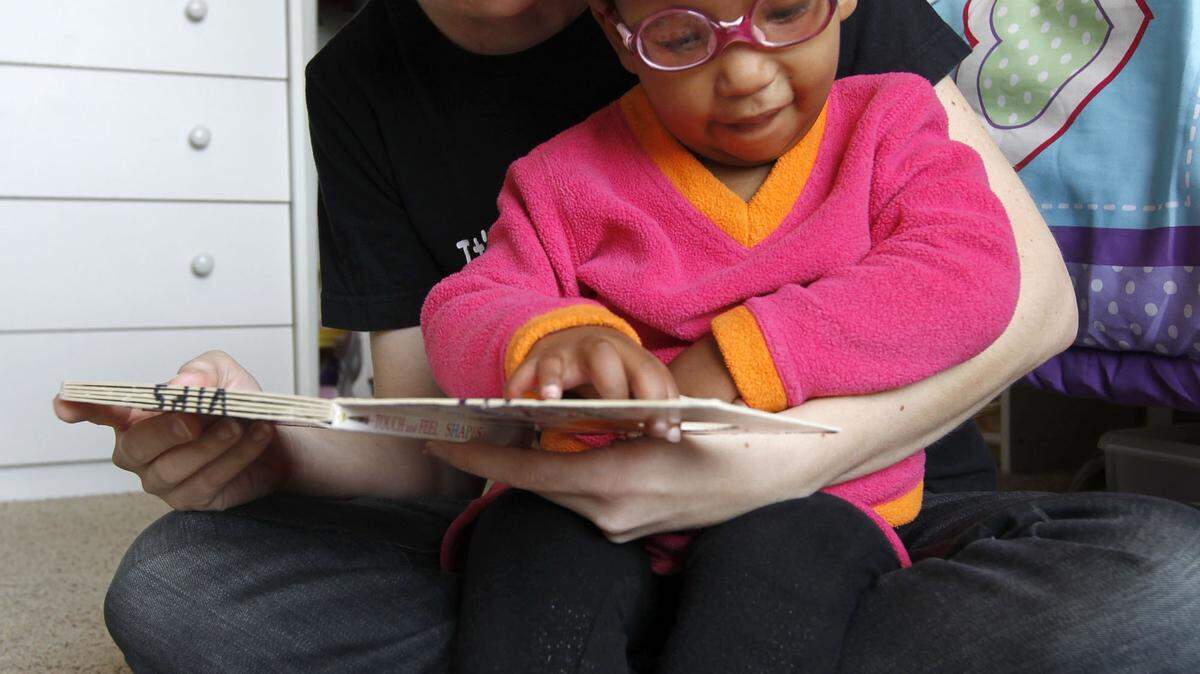
Sera Maas sits in the well made by her mother's crossed legs on her bedroom floor, eager to touch the big, wide-open, white accordion teeth of the crocodile on a book she knows very well.
Sera is not learning to read yet, says her mother, Rebecca, but "when Sera picks up a book, she looks for the bumps in it."
The "bumps" are the raised Braille letters that mimic the text that runs near the art that maybe Sera can make out on the page.
No one knows for sure what Sera sees. She is going blind.
When Darren and Rebecca Maas of Nicholasville adopted her from Ethiopia a year ago, they knew she was visually impaired. Last month, they learned that Sera, now 2, has a congenital condition that soon will rob her of what's left of her sight.
Shortly after Sera arrived in Kentucky, she received a welcome basket from Visually Impaired Preschool Services, or VIPS. Among other things, it contained preschool board books with strips of Braille transcription affixed to each page by a prison inmate.
For more than 10 years, more than 100 inmates from the Federal Medical Center in Lexington have been schooled in the art of transcribing printed words manually and perfectly into the contracted and complex language of raised dots that are "read" by touch by the visually impaired.
Braille transcription is a skill for which demand cannot meet supply. When done by a select prison community, it is cheap labor for a special-needs population that tries to use its money prudently.
And early indications from the American Printing House for the Blind's national field studies indicate that inmates who successfully complete Braille training get a pretty good sense of purpose and rarely return to prison once they've been released.
Marshall Kelly is an inmate in Lexington who hopes to have such success. Kelly, who has a 24-year history in education, has his college-age daughter researching what he can do with his newly learned Braille transcription skills once he is free.
Kelly recently sat in a guarded room in a federal prison full of men who were dressed like him, in prison khaki. He picked up a book that was made so toddlers can feel the textures — a crackled surface, a fuzzy duckling, rubbery feet. It's a book of simple, single-syllable words. Riveting stuff, especially since Kelly has transcribed those words into Braille and affixed the clear raised tape to the book so a visually impaired preschooler can begin to do something that Kelly thinks is crucial to life success.
"Once you get started reading," he says, "you make a lifelong reader."
Kelly knows what you're thinking about the irony of this "life success" lesson coming from a man convicted of conspiracy to distribute drugs and serving a 10-year sentence at the Lexington prison. But he figures you're never too old to learn another life lesson, explaining one of the many reasons the prison Braille transcription program is what educators of the visually impaired and prison officials call "a win-win" situation.
In 1996, the president of the prison's Community Relations Board was nudged by her visually impaired aunt to look into this Braille-transcription business for inmates. Becky Ross's aunt also worked at the Library of Congress — the only entity in the United States that certifies Braillists — and was familiar with the chronic shortage of trained specialists.
Once Ross saw how prison populations could benefit the visually impaired community — the first prison Braille program had begun in Michigan in 1962 — she "worked like a bulldog to make it a reality," says Patricia Simpson-Foley, Braille chairwoman for the Community Relations Board.
That reality is now more than a decade along, but it wasn't until five years ago that Visually Impaired Preschool Services came aboard. VIPS, an early-intervention agency that serves a 19-county area dominated by Lexington and Louisville, provides programs, services and support to visually impaired preschoolers and their families. The agency is what put meat on the bone of the prison Braille program, making sure the inmates were not just churning out training materials for training's sake but were producing work that could be put into the hands of those who could read it.
That's more than 400 books to date, says VIPS director Mary Moore Yohon.
Since 2002, 29 federal inmates in Lexington have become certified as Braillists by the National Library Service. By comparison, 200 people across the country are certified annually.
Aside from the cost of incarceration, none of the Braille work done at the prison is paid for by taxpayers, says Catherine Leslie, the Braille program coordinator at the prison. That's because the American Publishing House for the Blind, which is based in Louisville, provides the equipment, and grants from VIPS donors provide the books and paper. The transcription course materials are free — except at the higher levels of classes, such as those that teach proofreading skills. The costs of those classes are paid by the inmates' families, Leslie says. And the families pay those costs gladly, she says, because the inmates are self-selected and pre-screened to be in the class, which meets two hours every weekday. There usually are no more than 10 inmates in the Braille lab at any time.
Thomas Kent says it's good to be productive while in prison. During the two hours a day he's in the Braille lab, Kent feels, well, "almost noble."
He laughs at himself, says he is trying to remain optimistic about how far he can take this newly acquired skill. He left a large university community in Ann Arbor, Mich., after his conviction for federal conspiracy to distribute marijuana.
Kent wants to go back there and "hopefully, I could volunteer and teach this and show a need for it."
"Realistically, as a felon, I know I have a stigma attached to me, but I want to show society that I am trying to overcome it," he says. "I could do good with this."
This story was originally published March 9, 2011 at 12:00 AM with the headline "Prison's Braille program benefits visually impaired and inmates alike."