
Archaeological diggers in Woodford search for clues to life of Jack Jouett, 'Paul Revere of the South'
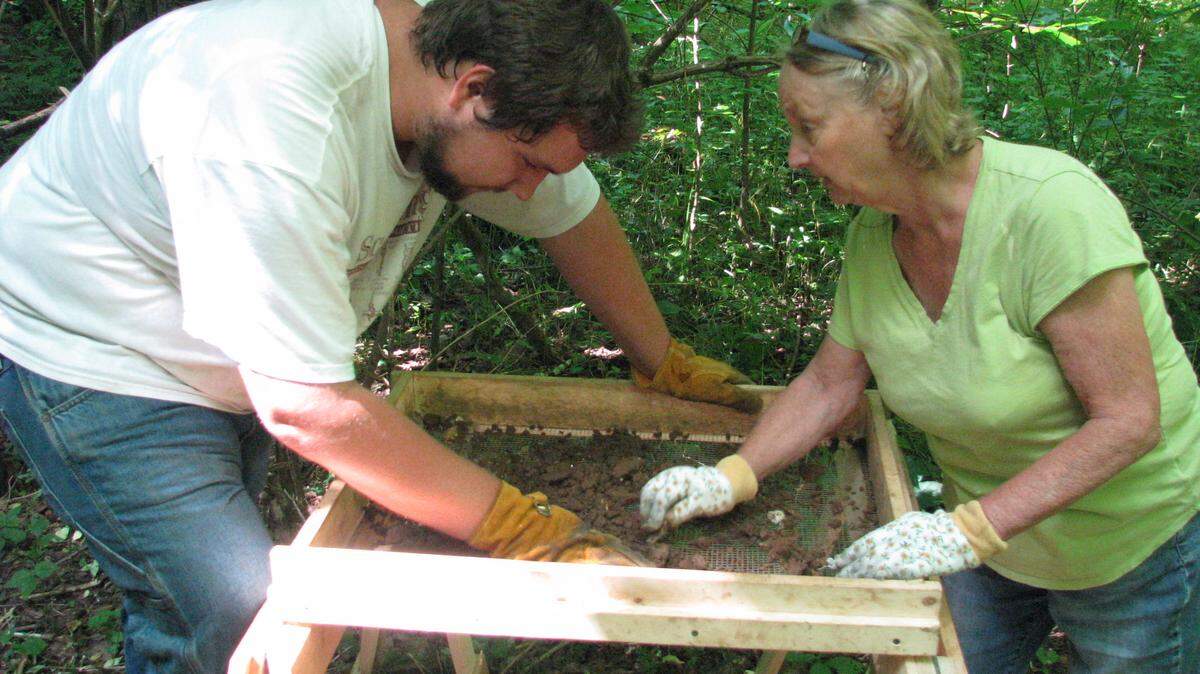
VERSAILLES — The flutelike notes of a wood thrush — ee-o-lay! — and the drumming of a woodpecker echo through the buckeye trees as Gail Combs and Jack Wright make their latest discovery.
"It's a buckle," Combs says, turning the dirt-covered square over in her hand.
The artifact, found by sifting dirt through a screen, joins dozens of others unearthed at an archaeological site in southern Woodford County. The site is thought to be the farm distillery and mill of John "Jack" Jouett, a hero of the American Revolution who was the so-called "Paul Revere of the South."
Beginning this past spring, archaeologist Nick Laracuente, an employee of the Kentucky Heritage Council, has supervised volunteers like Combs and Wright to help dig and sift through the site.
In addition to the buckle, volunteers have found the remnants of a pistol, ceramic shards, animal jawbones and teeth, buttons, coal, charcoal and a variety of nails that date the site to the early 1800s. The 500-foot-long site also has what is thought to be a mill race, a ditch that diverted water from a nearby creek to turn a mill wheel to grind corn.
Before the 1820s, poor roads made it impossible to get corn to market before it spoiled. Distilling the corn into whiskey preserved the product until it made it to market and sold for more money by volume.
Kentucky's identity was built on this success of the distilling industry. In pioneer Kentucky, the barter economy's foundation came from gallons of whiskey that were traded in place of money to purchase goods, labor and property.
"A pack horse could carry only four bushels of corn as grain but the equivalent of as many as 22 bushels after the conversion to whiskey," The Kentucky Encyclopedia says.
Jouett, who moved to what is now Kentucky in 1782, was immersed in this economy. It was known that he operated a distillery and mill from the late 1700s to the early 1800s, but its location was lost to history until Laracuente dug into the state archives. There he found litigation between Jouett and Charles and Peter Buck. Jouett had traded the distillery to the Bucks in exchange for 1,400 gallons of whiskey.
Trouble was, the Bucks never paid, hence the litigation. The Bucks claimed Jouett was supposed to supply the grain for the whiskey.
Whatever the case, the resulting litigation papers listed landmarks that led Lara cuente in September to the location of the distillery on privately owned land. (Lara cuente and Janice Clark, director of the Jack Jouett House Historic Site, a Woodford County museum, asked the Herald-Leader to keep the location secret to prevent looters from raiding the site.)
"When we contacted the landowners, they said, 'Oh, yeah, the distillery! We know about that!'" Laracuente said. "And they knew exactly where it was, although I don't now that they necessarily knew it was associated with Jack."
Three possible walled structures have been found at the site; others might be buried beneath landslides that cleaved from nearby steep hillsides.
For Clark, the discovery of the distillery and mill provides new insight into Jouett, who has fallen through the cracks of history. Every child knows about Paul Revere's "midnight ride." But Jouett's 40-mile ride through the Virginia wilderness warned Gov. Thomas Jefferson and legislators in 1781 about an impending attack by British horsemen.
"Paul Revere rode 16 miles over good roads only to be captured. Jack Jouett rode 40 miles through the back country alone to warn a larger number of more important people — and did not get captured," Clark said. "We feel we're justified in saying that this man saved the American Revolution."
Jouett also represented Kentucky in the Virginia legislature when Kentucky was part of Virginia, was one of the leaders of the Kentucky statehood convention, and represented Woodford County in the Kentucky legislature. He died in Bath County in 1822.
Opening the archaeology site to volunteers has brought a diverse group of people into contact with the Jack Jouett House.
"This is a county museum. Everything we do down here is open to the public," Clark said. "We feel very strongly that we have a duty to serve the citizens of Woodford County but also to educate folks. So what a great way to educate folks."
About 65 volunteers have worked on the project. Not all have done excavating at the site, which is in a remote spot of rough terrain. Some have cleaned artifacts; some entered information into a database; others performed supporting tasks.
Opening the work to volunteers also was a way to enlist the next generation of preservationists who will be keen on saving and inter preting history.
"The people are out here because they want to be," Laracuente said. "It's not like taking a college class where they're forced to be out here for college credit."
For example, Wright, 22, a University of Louisville graduate, drove 90 minutes from Warsaw in Northern Kentucky to dig through the Woodford County dirt. He met Laracuente at an archaeological-law seminar and learned about the opportunity to volunteer at the Woodford dig. Two days later, he was digging at the site; last week was his third visit.
"I think archaeology would be a good profession for me because it's indoors and outdoors," Wright said. "You're out here some of the time, and you're inside doing lab work and paperwork. I'm a history major and have always loved history, ever since I was a kid."
Combs, a Versailles resident, said sifting through the dirt at the site fuels her curiosity about history.
"I've always been interested in old things," she said. "My family was interested in old family history. I took a class in archaeology at Berea College and really enjoyed it. I always thought a dig would be so interesting."
This story was originally published July 20, 2014 at 10:25 PM with the headline "Archaeological diggers in Woodford search for clues to life of Jack Jouett, 'Paul Revere of the South'."