Witness says suspect in Marine’s murder had alibi. Prosecutors raise doubts with phone call
A woman testified in 2018 that the man accused of killing Marine Cpl. Jonathan Price was with her on the night of the fatal shooting. On Thursday, prosecutors questioned her story after they rested their case.
Dawan Mulazim, 36, was tried in 2018 in connection with multiple Lexington robberies, including one that ended in the shooting that killed Price and injured his wife. A jury convicted Mulazim in a robbery at the Quality Inn on Newtown Court, but failed to reach a verdict on the murder and robbery charges connected to Price’s death.
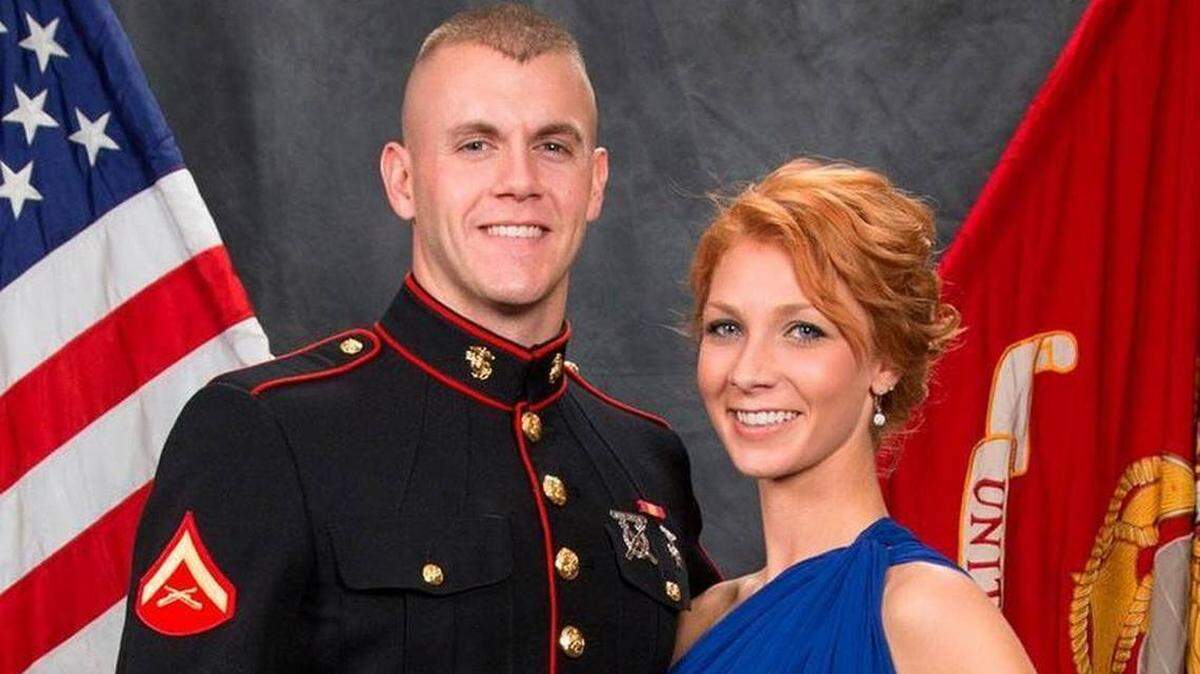
Jonathan and Megan Price were out at Austin City Saloon on the night of June 20 and until about 1:30 a.m. the morning of June 21, 2014 celebrating Megan’s birthday. They were in the parking lot talking when they were approached by two men with guns. Jonathan Price was shot in the back, and Megan Price was shot in the leg.
Mulazim’s current trial also includes a first-degree robbery charge connected to a different incident on Second Street in July of 2014.
Joy Birch, who testified as an alibi witness in Mulazim’s first trial, took the stand again Thursday to say she was with him at a Lexington club the night of Jonathan Price’s death. After her testimony, prosecutors played a phone call from jail that called into question some of the things she had said.
Birch said she gave Mulazim her number after they met at a convenience store. She assumed he liked her, and they texted before the night in June when he showed up at her house, she testified.
Birch said that on that night, the night of the shooting, Mulazim had talked with her at her home before they went to a liquor store to get a bottle of something to drink and cigarillos to roll and smoke weed with. Then the two of them went to Camelot East strip club and stayed late.
A childhood friend of Mulazim’s testified Thursday that she saw him and Birch at Camelot East on the night of the shooting. She remembered, because the shooting outside Austin City Saloon had prevented her from taking her normal route home.
After leaving Camelot East that night, Birch agreed to go to a hotel with Mulazim. But before they could, Mulazim got a call from his wife and Birch was dropped off at her home, she testified Thursday.
Birch told jurors that she barely knew Mulazim and that it was a one night encounter. Birch lost her twin brother to gun violence and told jurors that she would never lie about something in a murder case.
When cross examining Birch, assistant commonwealth’s attorney Kathryn Webster asked if she spoke to Mulazim after the night in June 2014. She said she did not.
Prosecutors then played for jurors a three-way call between Birch, Mulazim and another woman that took place on Sept. 29, 2019.
Birch then told prosecutors that she hadn’t known who she was speaking to at the time of the call, and that she frequently gets calls from people in jail. As prosecutors played more of the call, Birch eventually said she recognized the male voice as Mulazim. In the call, Mulazim called Birch “little sis.”
“You know them people got in touch with me,” Birch told Mulazim at one point during the call.
Mulazim asked Birch who had contacted her, and she said it was someone named “B.J.” Birch confirmed to prosecutors that she was talking about a police detective that had tried to contact her.
“That ain’t my people,” Mulazim told Birch in the call. “I ain’t got no fuzz coming at you.”
Mulazim went on to tell Birch that she didn’t have to talk to the police, and Birch said that she didn’t think she was going to.
Mulazim also told Birch that “nothing’s switched up from the last time,” referencing Birch’s testimony in Mulazim’s first trial. Mulazim can also be heard in the call lining out the chain of events as Birch gave them in the first trial, from their meeting at a convenience store to their trip to a club.
In the call, Mulazim tells Birch “I got you” multiple times, and eventually says “it’ll just drop out of the air.”
Webster asked Birch what he meant by that, and Birch insisted Mulazim meant that his attorneys would come talk to her.
Mulazim told Birch in the call that he needed her to “pull up” on him one more time, and Birch confirmed he meant needing her to testify one more time.
After being questioned about the call and about her testimony, Birch said that her testimony of spending the evening with Mulazim on the night of the shooting was accurate.
The defense also called expert witness Eric Grabski, who works with Envista Forensics as a Digital Forensic Analyst.
Grabski testified that Sprint cell phone records show that the only activity on Mulazim’s phone during the time of the robbery in July 2014 on Second Street showed that the phone was in the area of Village Drive.
Prosecutors pointed out that this evidence only showed that Mulazim’s phone was in the area of Village Drive at the time of the robbery, not Mulazim himself. They also pointed out that the only activity on the phone during the time of the robbery was incoming calls or text messages, and that none of them were answered during the time window.
Dr. Julie Buck, a psychologist who specializes in eye witness memory, testified that multiple factors can affect a witness’ ability to correctly identify a suspect.
Among those factors were high stress, tendency to focus on a weapon rather than a face and divided attention caused by multiple assailants.
Buck also touched on multiple studies that have indicated that people have more difficulty identifying a person of a race that’s different than their own.
In Mulazim’s 2018 trial, he was tried alongside his nephew, Quincinio Canada. Canada was acquitted in the robbery and shooting outside Austin City Saloon, but found guilty in the Quality Inn robbery. Canada was sentenced to 50 years in the case.
Mulazim has already been sentenced to 60 years in the Quality Inn robbery and a tampering with evidence charge.
The trial is set to continue Monday morning.