As Apple TV+ series premieres, Eric Conn’s chaos isn’t over for his former clients
“I’m still going through it.”
As Apple TV+ premieres a documentary on Eric C. Conn, the infamous Eastern Kentucky lawyer imprisoned over massive Social Security fraud, that statement in the series from a former client sums up the uncertainty and anxiety hundreds of them still face over losing their livelihood.
Consider Bryan McCown. McCown went to Conn’s firm to file a federal disability claim after he fractured his neck and back in a fall from a truck at a Pike County coal mine.
He had no knowledge Conn was bribing a judge — he never met Conn — but the Social Security Administration cut off his $1,382 monthly disability check after the fraud came to light.
McCown, who said he has heart problems and diabetes, has been trying to get back his benefits since.
He and his wife, Amber, lost two vehicles after his check was cut off and would have lost their home if not for help from family members. They get by on her job at a pizza restaurant and support from family.
“We barely make it,” McCown said.
The plight of McCown and other former clients of Conn is one thread in the documentary series, called “The Big Conn,” which chronicles one of the strangest sagas in the recent history of Eastern Kentucky.
Apple TV+ is releasing all four one-hour episodes of the series Friday.
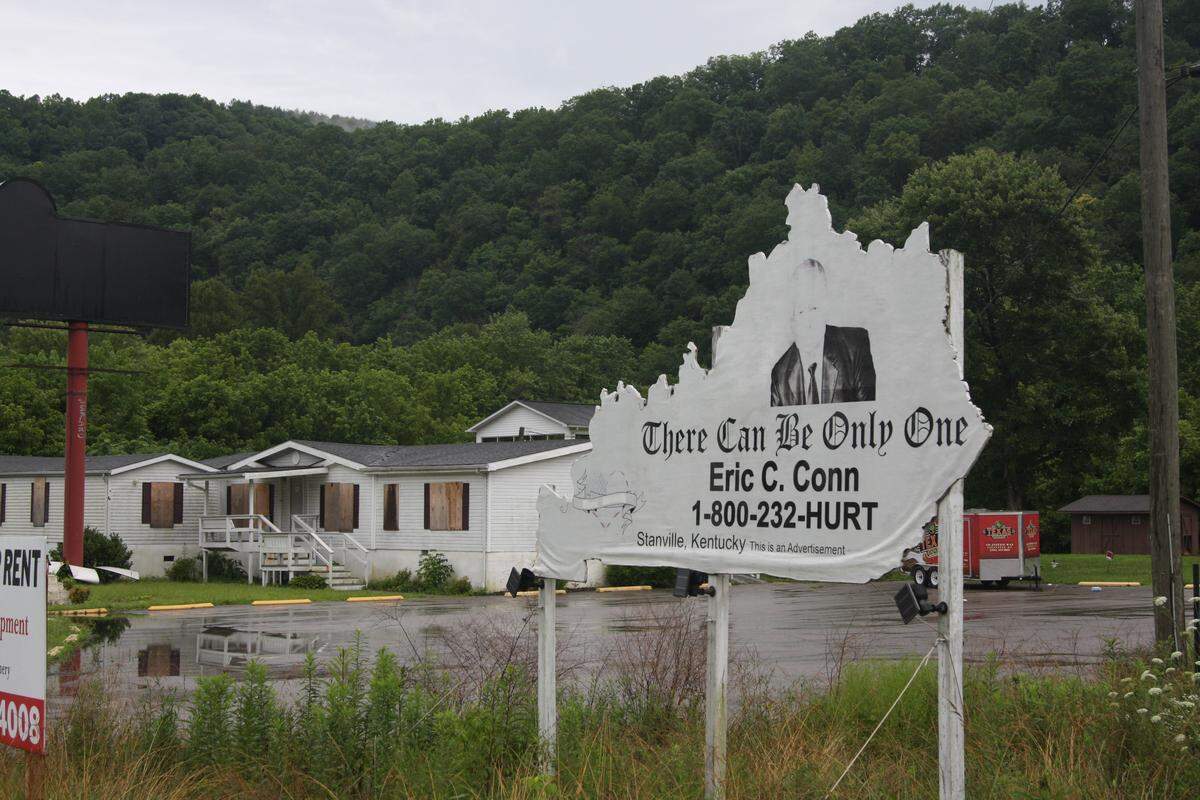
Conn, who lived in Pikeville and had an office in Floyd County, was once one of the most successful Social Security disability lawyers in the country, winning benefits for thousands of people before admitting in 2017 that he had put fake evidence in claims and paid a Social Security judge more than $600,000 in kickbacks to rubber stamp them.
“You’re dealing with a guy that doesn’t have a moral compass,” Lexington attorney Scott White, who represented Conn, said in the documentary.
The scheme would have obligated Social Security to pay more than $550 million over the life of the beneficiaries, federal officials have said.
The story is familiar to many in Kentucky, but the documentary adds detail and captures the craziness that surrounded Conn: how he sprayed pheromones on another lawyer before a hearing, saying it would help him win; his purchase of a bordello in Thailand with a Halloween theme; him sending a voodoo doll to a competing disability lawyer; his 16, or maybe 17, marriages, including one that lasted just a day; and how his overbearing mother would get out a book on committing suicide as a not-too-subtle threat when she and Conn disagreed.
“Everything about this guy is too much to believe, but it all happened,” Damian Paletta, who was a reporter at the Wall Street Journal when he wrote the first story about the apparent fraud in 2011, said in the documentary.
Conn pleaded guilty in March 2017, but that didn’t end the drama. While awaiting sentencing, he cut the electronic monitoring device off his ankle after a meeting in Lexington in June 2017 and escaped to Mexico.
Within days, he started sending emails to the Herald-Leader, and also contacted other media outlets and two attorneys who had represented people suing him.
People close to Conn said at the time that they recognized the chutzpah and narcissism behind the emails; the belief in his own cleverness. In one, he taunted the FBI, saying he could tell agents were trying to track the emails to find him.
“Do they really think they can find me with such a blunt method?” Conn wrote to the Herald-Leader.
Six months later, the FBI did just that, intercepting an email he sent as he hid out in Honduras that said he was craving Italian food, according to the documentary.
Agents checked places in the city that served Italian food. One was a Pizza Hut, where an FBI special agent found Conn having lunch in December 2017 and took him into custody.
Conn was ultimately sentenced to 27 years in prison. He is scheduled to be released in November 2040.
The judge he paid off, David Daugherty, pleaded guilty and was sentenced to four years in prison, where he died.
Bradley Adkins, a Pikeville psychologist who signed falsified forms for Conn, was convicted at trial and sentenced to 25 years.
Charlie Paul Andrus, another judge at the Huntington, W.Va. Social Security office with Daugherty, pleaded guilty to trying to help Conn discredit a whistleblower in the agency and was sentenced to six months in prison.
Have Conn’s clients been Social Security Administration targets?
The documentary raises the idea that some of the people who sought out Conn to file disability claims weren’t really disabled.
“There were a large amount of people who went to Eric and didn’t deserve benefits,” James Lee Hernandez, who directed the documentary series with Brian Lazarte, said in an interview with the Herald-Leader.
But Prestonsburg attorney Ned Pillersdorf, who has represented many of Conn’s former clients, said most of them, like McCown, never met Conn, had no idea he was using bogus information in claims, and were truly disabled.
The response to the fraud sent a shock wave through Eastern Kentucky.
The Social Security Administration said that when there is reason to think fraud was involved in awarding benefits to a person, it has to re-determine whether the beneficiary is eligible.
“It is well-documented that former attorney Eric Conn submitted false or fraudulent evidence in thousands of benefits claims,” said Mark Hinkle, a spokesman for the agency. “Under these circumstances, the agency is required by law to review whether the affected beneficiaries and recipients are actually disabled and thus entitled to benefits.”
That put thousands of former Conn clients at risk of losing benefits, in a region where many people are poor and disability payments are a notable piece of the economy.
Pillersdorf said the Social Security Administration (SSA) ultimately “targeted” 3,700 of Conn’s former clients for hearings to determine whether they would keep their benefits.
Many couldn’t afford lawyers, and the work to keep their benefits was complicated by having to go back and prove they were disabled at a point years earlier, often without records that Conn either had burned or were stored in his locked office.
In the first round, 700 were able to keep their benefits but 750 lost. Of those, 230 got their payments restored after a ruling that the process the SSA used violated their rights, Pillersdorf said.
Hundreds are still trying to get their benefits restored, while others are part of a federal lawsuit Pillersdorf filed to block the SSA from requiring them to go through hearings.
If that lawsuit fails and the hearings go forward, they will focus on whether the people became disabled between 2005 and 2010, something that would be very difficult for many people to prove, the complaint said.
Former Conn clients received letters last year and this year notifying them that SSA planned to hold re-determination hearings for them, Pillersdorf said.
“The panic level’s up again,” he said.
‘Tragic’ effects for those that lost benefits
In the Apple TV+ series and elsewhere, several of Conn’s former clients have described their financial and emotional struggles: losing vehicles and homes, having to move in with relatives, selling jewelry or other property to stay afloat.
“I hit rock bottom, lost everything I had,” Dennis Scott, a former coal miner, said in the documentary.
Several people committed suicide because they lost benefits, Pillersdorf said.
“The effect that it had on all of these claimants . . . is tragic,” said Lazarte, the co-director on the series.
“They get wrapped up in this tornado just because they went with the person that had the best word of mouth,” Hernandez said.
Conn says in the program that his massive fraud was a mistake, that he regrets it and and that he’s “bummed out” so many former clients lost disability payments.
The documentary recognizes the yeoman’s work of Pillersdorf and other lawyers who volunteered their time to try to help Conn’s former clients hang onto their benefits or get them back.
Is there recourse for Conn’s former clients?
Pillersdorf hopes the release of the documentary will prod President Joe Biden’s administration to drop efforts to hold eligibility hearings for Conn’s former clients.
“The tragedy is the SSA was created to protect the least among us,” he said.
The series also recognizes the tenacity and bravery of Jennifer Griffith and Sarah Carver. The two worked at the Huntington, W.Va. Social Security office that handled disability appeals, and tried for years to get superiors to look into their suspicions about collusion between Conn and Daugherty, the crooked judge.
The agency retaliated against them instead of investigating Daugherty and Conn, the whistleblowers said.
Griffith said she was ostracized and a supervisor gave her unjustified bad reviews, followed her around the office to time her work and targeted her for dismissal. She ended up on anti-anxiety medication and left because of the stress, losing her car because of the pay cut and almost losing her house.
Someone slashed tires on Carver’s car at one point, and Conn and Andrus, one of the Social Security judges in Huntington, took part in an amateurish scheme to try to discredit her with a faked videotape that purported to show her violating a policy allowing employees to work from home.
“There’s an inspirational tale of two people trying to right a wrong,” Lazarte said of Griffith and Carver. “But also the consequence of ignoring a problem. When you ignore a problem for as long as (Social Security) did . . . this problem became a tsunami of a problem.”
This story was originally published May 5, 2022 at 1:16 PM.