Over half of incarcerated Kentuckians have kids. Bill would try to keep families together
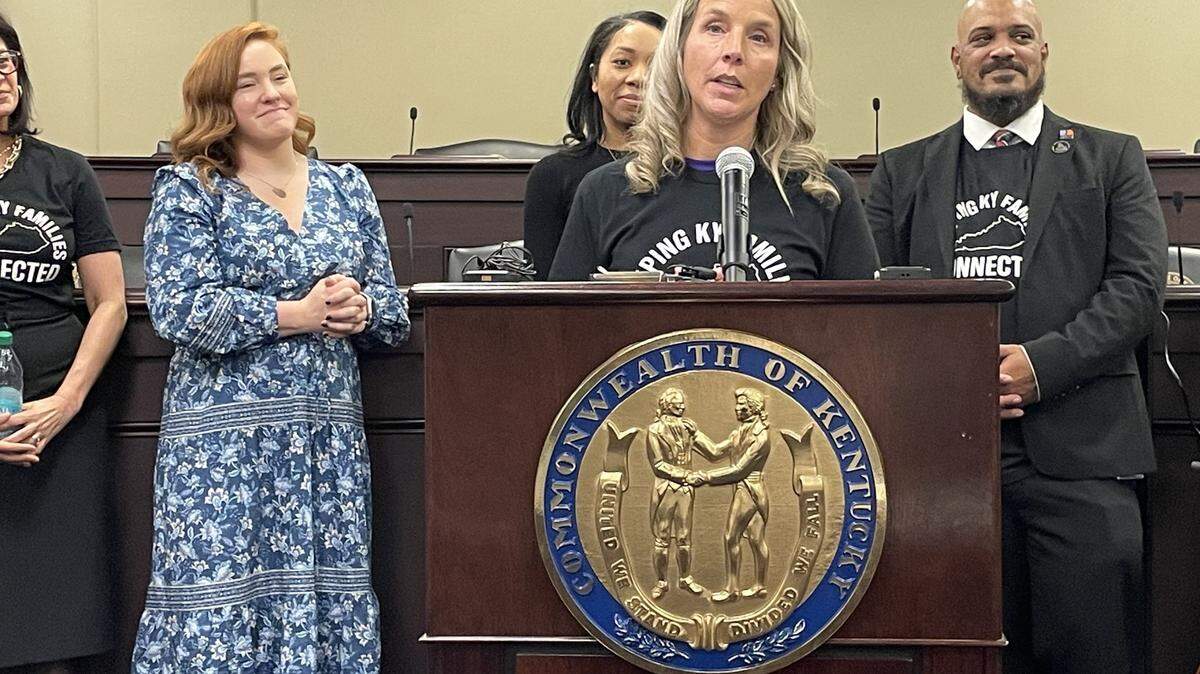
Jessica Ashby was given narcotics at age 29 after the birth of her baby girl.
Ashby had a partner, a job, a house and now, a newborn daughter.
What she thought was a necessary healing measure turned out to be a years-long consequence for her and her family, she said, after she became addicted to the drugs she was given.
Ashby would be sentenced to 12 months supervised diversion, which gave her an opportunity to continue to take care of daughter. In the final month of her program, she failed the one and only drug test she was ever given.
Her young daughter was taken from her, like so many other children whose parents become incarcerated. While she was enrolled in diversion, she was not offered wraparound services, financial assistance, mental health screenings or health services.
“Having a parent who is incarcerated has effects on mental and physical health — despite that — no one offered me or my daughter a lifeline, only consequences,” Ashby said during a press conference at the Kentucky Capitol Annex Wednesday.
However, a new bill from Rep. Nick Wilson, R-Williamsburg, could be one that will help families entangled in the justice system stay together.
Kentucky has one of the highest rates of children with incarcerated parents in the U.S., with an estimated 12% of children affected, according to the Annie E. Casey Foundation. The impact of parental incarceration has long-lasting consequences on children’s health, education and future involvement in the justice system.
House Bill 291, also known as the Family Preservation and Accountability Act, would expand sentencing alternatives for primary caregivers convicted of non-violent offenses in an effort to keep families together.
Therapy, case management, recovery services, vocational training and educational programs are offered as some methods of alternate sentencing.
Wilson said Wednesday he has personally experienced the impact of an incarcerated parent. His mother spent time in jail when he was in high school for a misdemeanor.
“I saw the impact it had on my baby brother to have to live with mamaw and papaw for a while, or me, or my older sister who was already out of college,” he said. “I wonder if my mom would have had the parenting classes available or some of those things.”
What House Bill 291 would offer
Nationally, nearly half of all incarcerated people are parents to minor children. But in Kentucky, 64% of women and 55% of men incarcerated are parents, according to the Kentucky Department of Corrections data from 2019 cited by the ACLU.
Kentucky also incarcerates women at one of the highest rates in the nation. Women are more likely to be primary caregivers to children.
Sen. Julie Raque Adams, a Louisville Republican and backer of the bill, said it would not excuse crime or eliminate punishment. The bill would ensure that when a non-violent, non-sexual offense is committed, Kentucky judges have discretion to impose sentences that hold offenders accountable while keeping families together wherever possible.
The bill is modeled on legislation from Tennessee and Louisiana, and provides community-based alternatives such as:
- Courts are required to consider an individual’s caregiver status before sentencing for non-violent offenses and explore alternatives to incarceration when the individual does not pose a safety risk.
- The bill encourages sentences that support the parent-child relationship, including parenting programs, mental health counseling and vocational training to reduce recidivism and improve family stability.
- Courts must provide written findings on sentencing alternatives, and the Administrative Office of the Courts must report annually to the Kentucky General Assembly on the bill’s implementation and impact.
Supporters of the bill say implementing it could reduce adverse childhood experience by preserving healthy parent-child relationships and lower foster care placements by enabling primary caregivers to remain at home.
Today, Ashby is steadily employed, sponsors women in recovery and is obtaining her second college degree.
She’s proud of her beautiful life, she said, and while she sees her daughter regularly, she has not regained custody.