
KY doctor on probation for ‘gross ignorance’ in directly issuing medical marijuana cards
A Kentucky doctor’s medical license has been put on probation by the state Board of Medical Licensure after the agency found he was creating and directly issuing medical cannabis cards to patients, in many cases without performing medical histories.
Dr. David P. Easley, a psychiatrist practicing in Louisville, agreed to undergo five years probation, according to an agreed order signed by Easley and his attorney, Daniel G. Brown, March 17, with the state board.
Brown did not respond to a phone call and email placed with his Louisville office Thursday.
Under the terms of the order, Easley agreed to pursue and complete additional training, including a clinical skills assessment and a course on professional ethics with the stipulation he “unconditionally pass” the program, according to a copy of the order obtained by the Herald-Leader. Any violation of the terms could result in additional disciplinary action, including license revocation, the order states.
In Kentucky, the only genuine medical cannabis cards are issued by the state. They come with a barcode attached to the cardholder’s electronic certification, which is itself obtained from medical professionals registered with the state’s Office of Medical Cannabis. Easley’s name does not appear in the state’s directory when conducting a search for authorized practitioners within 50 miles of Louisville specialized pain management or psychiatry.
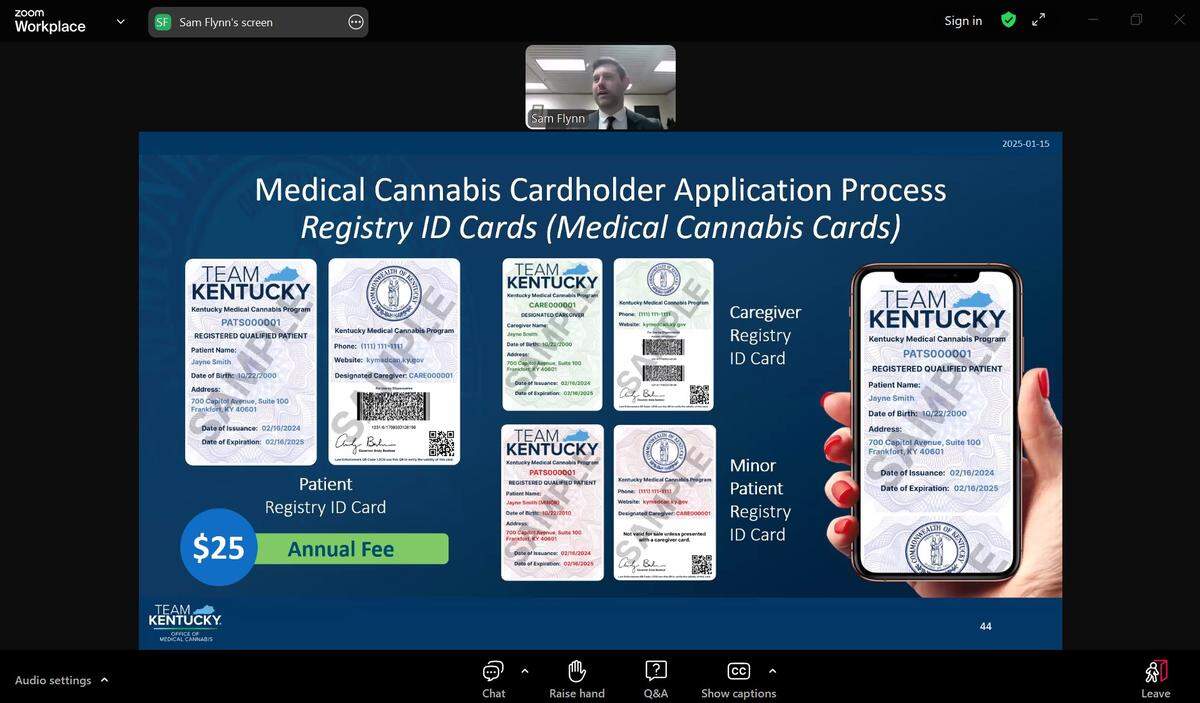
Senate Bill 47, the state law that established Kentucky’s Medical Cannabis program, went into effect in January. An earlier executive order issued by Gov. Andy Beshear in late 2022 granted a conditional pardon to people possessing small amounts of marijuana if purchased legally in a part of the U.S. that allows it.
To qualify under the order, Kentuckians had to carry a certification from a licensed medical provider verifying they suffer from one of 21 eligible medical conditions. The certifications were also required to include a statement from the medical provider verifying a “bona fide healthcare provider-patient relationship” with the individual.
In April 2024, according to the order from the Kentucky Board of Medical Licensure, Easley issued a card to a patient.
The card bore the words “Kentucky Medical Cannabis” and the seal of the commonwealth of Kentucky. It also included Easley’s name and medical license number, in addition to stating, “My patient has a medical condition qualified for cannabis possession.”
In a letter later submitted to the Kentucky Board of Medical Licensure, Easley wrote he had issued medical cannabis cards to 1,292 patients. Easley added he first began issuing such cards on or around January 2023.
“Although it was not my intent to make the card appear as though it was, in fact, issued by the state, I later recognized that inclusion of the seal could lend itself to that interpretation,” Easley wrote in the July 2024 letter.
Easley wrote he included the state seal to “reflect that the patient met the Kentucky-specific criteria for immunity from prosecution,” referencing the governor’s executive order.
“More specifically, the card includes a statement indicating that the patient suffers from a medical condition that qualifies him/her for possession of medical cannabis,” Easley wrote in the letter.
In response, the state board subpoenaed a list of patients Easley had provided medical cannabis cards since January 2023. It was provided with a list of 1,399 patient names, according to the order. The board randomly selected and subpoenaed the medical records of 10 patients identified on the list, and turned their charts over to a consultant for review.
The consultant’s overall finding was “a pattern of failure to conform to acceptable and prevailing medical practices and a pattern of conduct demonstrating gross ignorance or gross negligence,” the agreed order states.
In each of the reviewed cases, the consultant found Easley had not performed patient medical histories, such as a past psychiatric history, previous hospitalizations, medications and treatment trials, among other evaluations.
“All documentation that I have reviewed fails to meet that requirement,” the consultant said, according to the order.
Do you have a question about Kentucky for our service journalism team? We’d like to hear from you. Fill out our Know Your Kentucky form or email ask@herald-leader.com.