
Fayette school board members clash after former committee chair says she couldn’t get budget
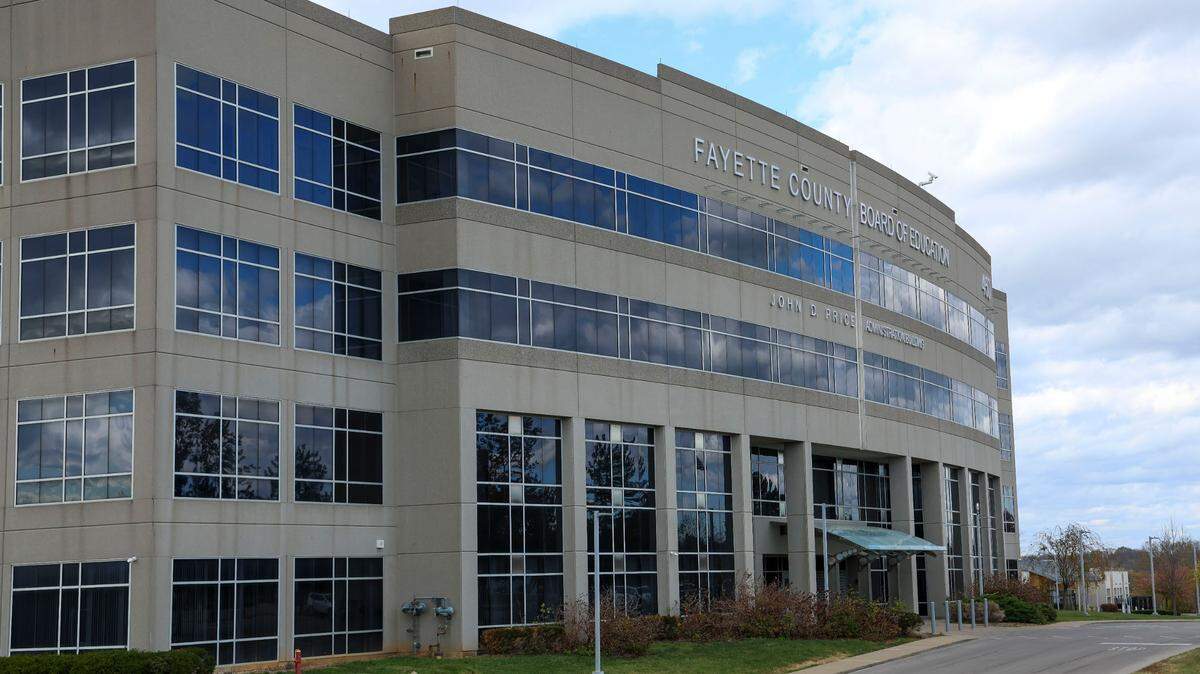
A clash over access to a detailed budget erupted between two Fayette School board members at a recent budget workshop, with interjections from the superintendent and school board chairman.
The heated exchange between school board members Amanda Ferguson and Penny Christian at the February 27 budget workshop happened after Ferguson said — and other board members confirmed — a recent chair of the board’s budget and finance committee said in an email she couldn’t get a full, line-by-line copy of the district’s budget.
“I would think for true transparency, the chair of the budget committee could at least see the full budget,” Ferguson said at the meeting.
Christian later responded: “We received the same email that she did, and I think it’s completely unrealistic.
“And I think it’s also disingenuous to imply that this board or this district was hiding something that is completely public,” Christian continued. “So when she had that problem, she knew good and well that you don’t need to get hundreds of pages of every (school council) budget of every school that you can’t control.”
The disagreement came as the district is working to finalize a budget of more than $800 million for the 2025-2026 school year. The board approved an initial draft budget in January, and now they must approve a tentative version in May.
But some parents have accused the district of lacking transparency as some schools cut classes, including art and chorus. And the board’s most recent budget workshop late last month was derailed by similar transparency accusations.
Christian indicated that the district is being transparent about its budget. As a former PTA district president who’s been on budget and audit committees, she said, “I’m sensing a few personal agendas.”
School board members did not identify the former school board budget and finance committee chair. One former chair, a parent, did not respond to questions from the Herald-Leader.
“We know everyone here in this room understands what transparency means. It’s being weaponized and being used as an excuse,” Christian said.
As the conversation escalated, Christian said, “I will not be silenced.”
Ferguson said she has had trouble getting information and was told by Superintendent Demetrus Liggins she’d have to obtain it through a records request.
“This is my 13th year on this board,” Ferguson said. “You don’t know what I’ve experienced.”
“I don’t. And I don’t care right now,” said Christian.
“Okay, come on,” said school board member Monica Mundy.“ We’ve got students in the building. So let’s all take a deep breath. Let’s all calm down.”
Superintendent Demetrus Liggins acknowledged at the meeting that the board has not provided a full, line-by-line accounting of district spending like the former committee chair sought, but he denied it was a matter of transparency.
“Anyone can see the thousands of pages of the full budget, but it’s a matter of efficiency,” he said. “The reason that we have not ... given a full-blown, thousand-page budget is because it’s not efficient... use of anyone’s time. They’re more than welcome to have it. I don’t think most people would understand all the numbers.”
Ferguson said the former chair said members of the budget and finance committee, which make recommendations to the board,don’t see departmental budgets, individual school budgets, and other costs, so it’s not feasible for them to make recommendations about how the money is spent.
Liggins said the vast majority of the budget is already allocated to personnel and set costs. The main purpose of the budget and finance committee, he said, is to make recommendations about potential new sources of revenue for the district.
Liggins said he was not asked for the full budget.
“I just share her concerns, because I have repeatedly asked for information and not received it as well,” Ferguson said. “You told me that if it was information that was not being provided to everyone, I had to file an open records request.”
Board chair Tyler Murphy said the budget and finance committee is not intended to develop the budget. Rather, he said, it supports the school board’s oversight of the district’s budgeting process.
Dia Davidson-Smith, spokesperson for the district, said Monday the budget posted on the district website is the draft budget for next school year.
That is a different version than the line-by-line version of the budget sought by the former committee chair.
Once the board adopts the tentative budget in May and submits it to the Kentucky Department of Education, it will finalize budget priorities in July, and then finalize the budget in September.
“Also important to note, the public can always review our actual expenditures,” Davidson-Smith said. “Those numbers are found on the financial transparency dashboard.”
Mundy, in an email response to the Herald-Leader after the meeting, said “The email statement we received from a dedicated committee volunteer raised valid and thoughtful concerns about the school board’s Budget and Finance Committee — particularly its role in the budget planning process and the need for greater transparency and effectiveness. “
“Many of these concerns are ones I share. Regarding the budget workshop and discussion of this email, our focus should remain on developing a budget that prioritizes students and their academic success. These discussions should be conducted with decorum and professionalism,” said Mundy.
Christian also responded to the Herald-Leader after the budget workshop.
“Understand I am speaking as an independent board member and not speaking for either the board or the district. The parent in question can have access to the budget just as any other citizen,” Christian said. “However, a large portion of the district budget is not in the committee’s purview, such as salary and (school council) budgets. ... It is extremely frustrating to continue to deal with a narrative rooted in personal agendas and falsehoods, while catering to a small but loud group of voices.”
Budget details
The school board took some steps to work on the 2025-2026 tentative budget at the workshop.
In February, district spokesperson Dia Davidson-Smith confirmed to the Herald-Leader the total draft budget for 2025-2026 was $820,374,547, approved by the school board in January
Dia Davidson-Smith noted the amount is tentative.
No final decisions about the budget were made at the workshop — that will be up to the board after receiving recommendations from Liggins and his staff.
At the workshop, Liggins said staff has been working for months on the budget, talking to stakeholders in the district, examining current spending, talking to pupil personnel to project student enrollment at each school and providing principals with staffing allowances.
Estimated increases in revenue and operating expenses have been considered. Staff has also collected budget requests from each department.
“Transparency and accountability” is at the forefront of the budget process, Liggins said.
He said the district will maintain fiscal responsibility and avoid unnecessary expenses.
Rodney Jackson, who handles financial accounting for the district, said as of January 31, revenue is trending about $6.5 million more than last year.
Property taxes revenue is trending $8.4 million higher; occupational license taxes revenue is trending $2.1 million higher; motor vehicle taxes revenue is trending $1.2 million higher.
Expenses are trending $860,000 more than last year.
Vendor payments are trending significantly lower than last year because of a focused approach to help offset inflationary costs.
Cash flow is trending about $1 million less than last year.
The net overall fund balance of all funds is $207 million for the 2024 fiscal year, compared with $236 million for the 2025 fiscal year. So overall, the district is trending about $29 million better this fiscal year.
Ann Sampson-Grimes, who handles budget and financial planning for the district, said the district’s general fund budget has grown more than $100 million since the fiscal year 2020 working budget.
Revenue increases average $8 million to $10 million per fiscal year, based on a 4% increase in revenue.
Maintenance and infrastructure needs continue to grow as buildings and systems age.
Student growth has flattened, which affects state funding received, whereas those with special needs have increased.
With the opening of two new school buildings, Grimes noted it’s important to reduce current-year and future-year costs.
Fayette district officials expect to receive between $92 million and $94 million next year in state funding known as Support Education Excellence in Kentucky.
SEEK is a formula-driven allocation of state provided funds to local school districts. The formula includes funding for transportation costs and special needs students as reported by districts.
The per pupil rate is $4,586 for fiscal year 2026.
Utilities for the district for next year are expected to be between $15 and $17 million.
In building the budget, there is a focus on student achievement.
Fayette County pays its teachers the most of any district in the state. The salaries and benefits forecast for fiscal year 2026 are estimated to be $593.8 million.
Sampson-Grimes said last fiscal year the estimated average teacher salary was $70,813, higher than the state average of $56,153.