
Do Kentucky students, schools and teachers have a test cheating problem?

Hundreds of thousands of state-required tests are taken in Kentucky schools each year to determine students’ academic progress.
If trends found in a Herald-Leader analysis of 1,249 testing allegations from 2022 until 2024 are any indication, one thing is certain for this past year’s testing:
Dozens of students and even some teachers likely cheated or were caught trying to cheat. Teachers likely gave answers to cheating students, failed to watch them closely enough or violated testing rules by giving them the wrong tests or falling asleep.
Students likely used their cellphones, prohibited websites, and hidden scraps of paper filled with test answers to cheat.
Those are among the key findings of a monthslong Herald-Leader review of records maintained by the Kentucky Department of Education and school districts.
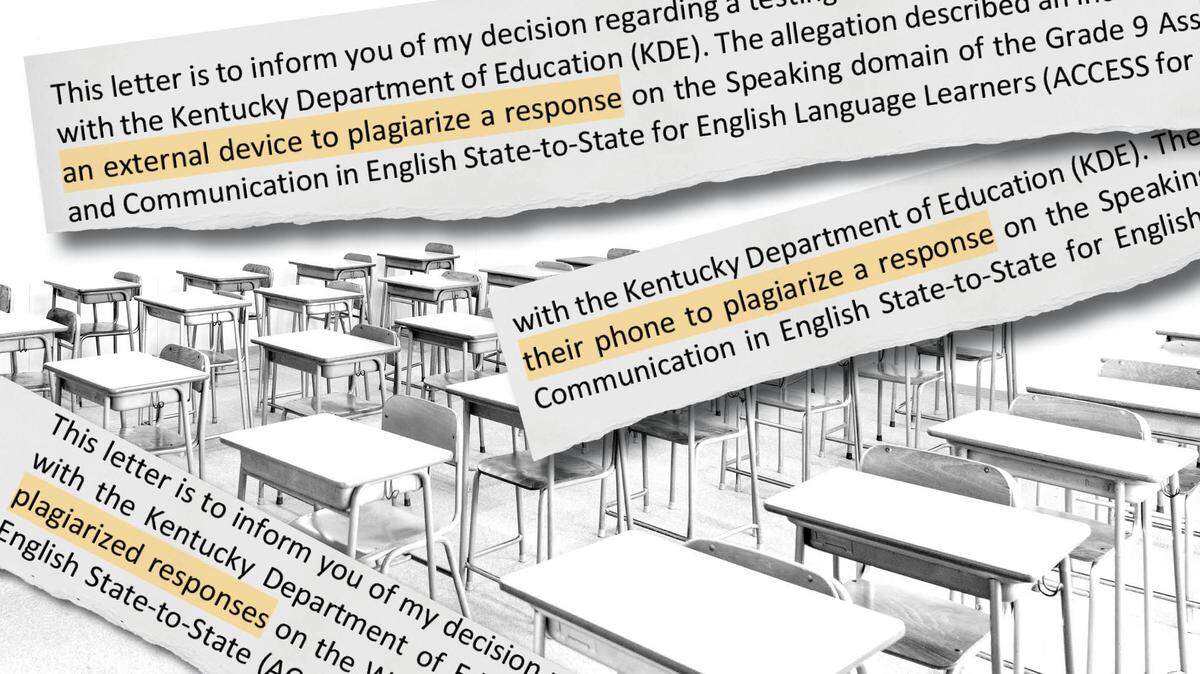
Our analysis shows there were nearly 200 more violations in 2024 than in 2014-2015.
And it shows no signs of slowing down, despite the state’s efforts.
Test violations are soaring over the past decade
The Herald-Leader’s analysis reveals some startling points:
▪ Test violations of every kind have increased significantly in 10 years. There were 422 violations in 2023 and 430 in 2024 alone.
▪ That’s an increase from 312 violations in 2016-17; 261 in 2015-16; and 241 in 2014-15, according to previous Herald-Leader articles.
▪ Of the 1,201 violations since 2022, at least 157 Kentucky students and teachers (mostly students) either blatantly cheated or were caught as they tried to cheat on state-mandated tests in 2022, 2023 and 2024.
▪ There were at least 34 incidents of cheating in 2024.
▪ In 2022, there were 67 cases of cheating, and another 56 in 2023. Both those years saw multiple students involved in a single incident.
All the numbers and incidents raise an important question: Do Kentucky public K-12 schools have a cheating problem?
State officials deflected the possibility.
“For the questions about whether there is a cheating problem, these numbers represent a fraction of 1% of the hundreds of thousands of students tested each year,” Kentucky Department of Education spokesperson Jennifer Ginn told the Herald-Leader.
Records show there were 27 testing violations in Fayette County in 2022, with five incidents of cheating, including plagiarism at Frederick Douglass, Tates Creek and Lafayette high schools. There was one cheating incident in the 12 violations found in 2024, when a student attempted to use notes at Henry Clay High School.
There were two attempts at cheating in 16 testing violations in Fayette County in 2023.
At Paul Laurence Dunbar High School, a student took a cellphone from his pocket and looked at the screen during a writing test. A test administrator caught the student before he was able to use the phone during testing, a testing violation letter said.
At Frederick Douglass High School, a student was using his hoodie to try to hide his earbuds when his cellphone fell out of his pocket 15 minutes into the test. A test administrator confiscated the devices and stopped the student’s test.
Students had been instructed to place all electronic devices in their backpacks before testing. The test administrator caught the student before they could use the phone during testing.
“As for cheating — we take academic integrity seriously here at FCPS. It is the cornerstone of everything we do each day. We monitor students during all testing events. But when issues arise, we identify them quickly and offer additional training to those who proctor these tests,” Dia Davidson-Smith, who was Fayette County Public Schools spokesperson when the Herald-Leader asked questions about the district’s testing violations.
Where were high-profile cheating incidents?
Here are some examples of what the Herald-Leader found in its analysis:
▪ In Carter County in 2024, an East Carter High School student cheated on a college readiness exam using their cellphone to search for answers.
“We take Kentucky Assessment and Accountability very seriously and take great care to prepare our teachers and test proctors to maintain appropriate testing ethics,” Carter Superintendent Paul Green said.
He said the student used the app “Photo math” during the KYOTE college readiness exam for math, which recognizes equations and provides step-by-step instructions on how to solve them.
“The instructor did not take the student’s phone before the exam and did not properly monitor the student during the exam,” Green said. Carter County Schools self-reported the violation to the Kentucky Department of Education and submitted an Education Professional Standards Board complaint based on the teacher’s actions as an ethics violation.
The teacher’s contract was not renewed.
▪ A Hardin County teacher in 2023 was found to have provided “inappropriate assistance and information” to 16 students who plagiarized on state-mandated tests, a violation that resulted in a reprimand by Kentucky’s educator certification board.
The teacher denied the allegations found in a state investigation, her attorney told officials from the board that oversees educator discipline in a letter. He added she decided to leave the teaching profession with no plans to return.
▪ A Jesse Stuart Elementary teacher in Hopkins County in 2024 was temporarily banned from participating in statewide tests, and her name was turned over to Kentucky’s educator certification officials on the Education Professional Standards Board. A teacher created a Google document about a test with nine pages of detailed notes about it. She gave it to another teacher to prepare for next year’s exam.
Her “actions were clearly intentional for the purpose of gaining a testing advantage,” investigators said.
▪ In Northern Kentucky, a school staffer giving a test failed to detect at least 13 students cheating on statewide tests at Newport High School when they accessed information on other websites during an exam in 2022.
▪ The same year, five Fayette County Schools students were among several in Kentucky who plagiarized responses on statewide tests. In Madison County, a Madison Southern High School student admitted he cheated on a statewide exam, copying an essay in its entirety.
Thousands of students take state-mandated tests each year, which include reading, mathematics, science and social studies and several other subjects, Kentucky Department of Education officials said. In all, 45,000 students took the Grade 6 math test. That’s just one grade, one test. Even more students took math tests in grades 3, 4, 5, and 7.
”The Kentucky Department of Education investigates allegations that the Administration Code for Kentucky’s Assessment Program was violated during administration of required state assessments,” Ginn said.
In the past, the Kentucky Education Commissioner has reviewed decisions about allegations of cheating and violations found by a state Testing Board of Review, and then sent superintendents a letter if they agreed there had been a violation.
That changed in December 2024 when a regulation was amended. The Testing Board of Review no longer reviews these allegations. An investigator now makes recommendations instead of the Testing Board of Review.
Documents obtained through the Kentucky Open Records Act described the student violations, which included blatant cheating, including:
▪ Looking at each other’s screens, plagiarism, and tapping into computers and cellphones to find answers.
▪ Some students sneaked in materials with academic information, hiding papers with math formulas, for example, that gave them an advantage on the test. The Herald-Leader investigation shows most student-cheating incidents involved plagiarism.
▪ State documents revealed examples of teachers providing answers, answering certain portions of tests for the students, and even handing out a “cheat sheet” to students.
For example, in Bullitt County in 2022, a school district teacher gave students clues as they took a state-required test, an allegation that was investigated and found to be a violation.
“When a high-stakes accountability system and culture is prevalent that labels schools and districts based on a standardized assessment result given at a single moment in time, we are opening ourselves up for things like this to happen,” Bullitt County Schools Superintendent Jesse Bacon said.
“Great people make bad decisions when desperation meets opportunity,” he said. “There is a litany of research out there that confirms there are better ways to measure the effectiveness of a school and/or district. Yet, we continue to rely on an antiquated system that doesn’t tell the entire story.”
Bacon said his district takes the integrity of the assessment system seriously and provides extensive training to staff before tests that explicitly covers what test proctors can and can’t do.
Any time there is an alleged violation, he said, the district investigates the allegation thoroughly, reports findings to the Kentucky Department of Education, and takes appropriate personnel action when necessary... “all of which was done in this instance,” Bacon said.
Expert: Blame state-mandated tests for cheating
While nobody is condoning cheating, some experts said they know why it’s happening.
“Test cheating is one part of the educationally poisonous fallout from the government-mandated explosion of standardized exam misuse and overuse in our public schools,” said Bob Schaeffer, Public Education Director of FairTest: National Center for Fair & Open Testing, a Massachusetts-based organization that lobbies against the misuse or overuse of standardized testing.
“When policymakers attach rewards and sanctions to test results, some students and educators feel compelled to obtain the scores they need by hook or by crook. Though morally wrong, that behavior is understandable.”
Most of the cheating allegations disclosed in state records involved students. If officials determined that students gained a testing advantage, they could lower or invalidate the score.
Scores being lowered as a result of a testing violation is not the same as the score being invalidated. If the state department of education lowers a score as a result of a testing violation, the score attributable to the school (not the individual student) is lowered to the lowest possible score on that particular assessment.
For example, if the score was originally “distinguished,” it would be lowered to “novice” for the school, Ginn said.
Invalidating test scores is a function performed by a testing vendor as part of their own processes to ensure test integrity. For example, ACT may investigate a matter and determine that a student’s score will be invalidated.
If this is the case, the student is not able to send the score to a college or university for admissions and scholarship awards.
Generally, in cases of cheating where state officials determined a student received an advantage, scores were invalidated or lowered. In addition, 59 scores were lowered and 41 were invalidated when test administrators made errors, such as giving students access to calculators they shouldn’t have.
Violations resulting in a testing advantage or not necessarily the result of student cheating, Ginn said. “For example, a violation and testing advantage may occur when a student receives an accommodation in error through no intentional act of the student.”
“For allegations filed during the 2021-2022 and 2022-2023 school years, KDE lowered scores for 62 and 51 allegation cases, respectively. These numbers represent approximately 0.004% of required individual content assessments administered to students throughout the commonwealth each year, “ Ginn said.
Educators responsible for violations in the past three years were required to get additional training and in at least two cases, were reported to the Education Professional Standards Board that oversees educator certification and educator discipline. That board can suspend or revoke the licenses of educators or impose other conditions on them.
Some students caught cheating or breaking rules, such as using cellphones during exams, were sent to the principal’s office. State documents don’t indicate what happened after that.
Nearly all state-mandated tests in Kentucky are administered in an online system. A small number of test booklets are produced for students with accommodations that require printed materials, such as a student who cannot test online due to a medical situation.
An example would be a seizure disorder triggered by electronic usage.
Teachers involved in cheating
In 2024, at Lone Oak Intermediate School in McCracken County, an instructional aide reported that a test administrator asked her to take a test for an absent student. The test administrator had submitted answer sheets that the administrator completed for absent students.
She also submitted a seating chart showing students were present for testing on days they were absent. Once the violation was discovered, the answer sheets were not submitted for scoring.
Documents obtained from McCracken County Schools under the Kentucky Open Records Act showed that an investigation revealed the teacher falsified state testing records in both 2023 and 2024.
A May 2024 letter from McCracken Superintendent Josh Hunt to the teacher said, “Your employment with the District is terminated because you, on multiple occasions, falsified state testing records for students in your classrooms who qualify for alternative testing assessments.”
The Kentucky Department of Education determined the actions were intentional. Her termination was reported to the Education Professional Standards Board..
In the 2023 Hardin County plagiarism case, the Kentucky Department of Education reported the teacher to the Education Professional Standards Board for a testing violation after concluding an investigation of North Hardin High School and John Hardin High School.
The board reprimanded her and said she could no longer participate in state-mandated testing.
An investigation found she provided inappropriate assistance and information to students during the test sessions.
Investigators found the teacher answered questions about language or content on the assessment, verbally provided examples of test responses and checked written responses for spelling and other errors. The teacher also provided a document that was essentially a cheat sheet to some students, according to state department of education records.

The teacher allowed students to use their cellphones to photograph the document so they could read from or copy the responses on the online test platform.
Other students who did not have phones passed the cheat sheet around and read from or copied their test responses from it during the test session, according to investigators’ recap.
“The teacher who moderated the assessment is no longer with Hardin County Schools. We fully cooperated with the Kentucky Department of Education in investigating this incident,” said Hardin County Schools spokesperson John Wright.
The test administrator was barred from participating in any future state-required testing, a state document showed.
A teacher who helped students find the right answer
At Sixth District Elementary School in the Covington Independent District in 2022-2023, a test administrator engaged in inappropriate activities while giving a statewide test to fourth graders, according to a testing violation document.
The test administrator would not let students submit answers until he checked their screens. He reminded them of specific strategies. He asked them to go back and show him that they had completed all the answers and made sure they answered all the multiple-choice questions before they could move on.
He told at least one student to recheck a specific question and another to look at a chart.
One student said the test administrator helped her with a restatement and said “mmmm” or “nah” to some of her multiple-choice responses. Another said that the test administrator walked around and helped people with writing and read words the student did not know, according to state education records.
He was required to get training, and his name was turned in to the Education Professional Standards Board.
“We have no comments,” Covington Independent Superintendent Alvin Garrison said.
Teachers asleep on the job while students took tests
In 2023, at Kammerer Middle School in Jefferson County, two teachers in the room reported the test administrator was reading aloud to a visually impaired student, as well as clicking and moving the mouse and typing responses while the student slept.
The student was allowed to have someone type their responses, but neither teacher heard the student telling the test administrator what to type for the test responses. The teacher was required to get three hours of extra training.
State regulations say test administrators must not engage in any behavior that would help students understand or respond to any item on the test. Evidence suggested the integrity of the test scores was compromised and the student gained a testing advantage, so that student’s score was lowered, according to state education documents.
There were four incidents — two each in 2023 and 2024 — where teachers were reported sleeping during the tests.
In one case in 2023, at Pulaski Day Treatment-Eagle Academy in Somerset, a test administrator dozed off numerous times while proctoring the ACT assessment. A teacher looked in the door and saw the test administrator asleep on a futon in the testing room while the two students in the session were still testing.
The teacher went in and had to shake the test administrator’s knee to wake her, according to state documents.
“We self-reported the incident to (the Kentucky Department of Education) and followed (state) protocols in dealing with the situation,” said Pulaski Superintendent Patrick Richardson.
In Bullitt County, a test administrator helped at least two students answer questions on the test by searching for information on Google, hummed to indicate the correct answers and discussed test items.
The test administrator was seen on surveillance video talking to a group of students during the test administration, repeatedly using her mobile phone, hovering over a student’s shoulder, and gesturing toward the screen, according to KDE investigation documents.
“No one shall coach, edit, point out errors or missing answers in student work on any item of the test to improve student scores,” the violation document said. The scores were invalidated.
Where do Kentucky students cheat? Across the commonwealth
▪ At Anderson County Middle School in 2024, a testing administrator saw a seventh grader hiding a calculator under his leg and confiscated it. Officials determined the test score was compromised and he gained a testing advantage, so the score was lowered.
“This student misconduct was reported immediately as required, and it was fully investigated,” said Anderson Superintendent Sheila Mitchell.
Following the Kentucky Department of Education’s review of the incident, Mitchell said, the Kentucky Department of Education concluded the testing violation occurred as a result of one student’s prohibited behavior rather than any failure to properly monitor the test session. Because of this conclusion, the individual student’s test grade was lowered, but no new staff training was required.
▪ At South Laurel High School in 2024, a test administrator caught a student opening another browser window to locate an answer to a test question. Officials determined that the student gained a testing advantage, so the score was voided.
▪ At the Newport School of Innovation in 2024, a student plagiarized by using an electronic device to access the internet. The student copied information from a website. The score was deemed invalid.
Three cases emerged in 2024 in Jefferson County involving artificial intelligence, computer systems capable of performing tasks that typically require human intelligence.
Students submitted AI-generated test responses, causing their scores to be lowered.
In the Newport Independent Schools case in 2022, 13 students opened new browser windows and accessed other websites during the assessment, and their scores were invalidated, state documents said.
Superintendent Tony Watts said that on March 3, 2022, a Newport schools’ testing coordinator ”was notified by the principal that teachers were concerned that students possibly cheated on the assessment by using a website called MATHWAY.
“The team investigated and found that the allegations were legitimate. They called KDE and reported the allegations. They sent all the findings to KDE, and we dealt with all individuals involved,” Watts said.
Where were most cheating incidents? Jefferson County, by far
Louisville’s Jefferson County, the state’s largest school district with more than 96,000 students, had the most incidents of cheating at 45.
There were at least five incidents of students using an AI-generated response to cheat in 2024, including at Southern High School, when a student used an AI-generated response during a test. The test administrator observed the student using their phone multiple times and repeatedly instructed them to put the phone away.
The score was lowered. A reminder was issued to the test administrator to monitor students for prohibited behavior.
Here are other Jefferson County incidents:
▪ A student at Iroquois High School was flagged for plagiarism on a statewide test in 2022. The student’s test was scored as a zero. The student copied two complete sentences, word for word, from a website and included them in her response to the test, the violation letter said.
▪ In 2023, at Fern Creek High School, a student admitted to using a cellphone to look up an answer for the exam. The student was removed from the room, and their score was invalidated.
▪ In 2023, at Atherton High School, the test administrator observed a student opening another web browser window and entering a test item on Google. The test administrator advised the student that such behavior was not allowed, stopped the student’s test and invalidated the student’s score
▪ Also in 2022 in Jefferson County, students at Waggener High School, Newcomer Academy, Jeffersontown High School, Marion C. Moore School, Valley High School, Doss High School and Seneca High School all plagiarized, according to Kentucky Department of Education documents.
“We’re always disappointed when a student chooses to break the rules of test taking,” said Mark Hebert, communications manager for Jefferson County Public Schools.
“While standardized tests aren’t a complete reflection of what material the student does or doesn’t know, copying the work of others and having an entire test invalidated hurts not only the student, but their teachers’ ability to have a broader measure of the academic areas where the student may need tutoring or extra help in order to be successful,” he said.
State records show a wide range of violations and problems across the commonwealth during the three-year window:
▪ In 2022, a Garrard County High School student cheated by visiting unauthorized websites during online testing. The student waited for the proctors to pass by and then opened another browser window on the testing computer to search for answers to test questions. The student admitted to cheating when confronted with the report.
▪ In 2023, at Mason County Middle School, when the test administrator did not actively monitor a statewide math test, one of the two students in the test session accessed notes from their backpack and used them on the test for approximately 10-15 minutes. The test score was lowered.
▪ In 2022, a Madison Central High School student used his phone to plagiarize a response on a statewide test. The student was interviewed and admitted he plagiarized the test response. Another two students used their phones to plagiarize. The scores were invalidated.
“Accusations of plagiarism and other cheating on any assessment are taken very seriously by Madison County Schools,” said district spokeswoman Erin Stewart. “Superintendent Gilliam was made aware of the incidents in our schools pertaining to state assessments and those incidents were dealt with accordingly.”
▪ In Lewis County Schools in 2022, a Foster Meade Career Technical Center student admitted in writing he had used information obtained from other websites to answer approximately five test items.. The score was invalidated.
“Our student took advantage of a loophole in (the) state’s testing security by opening an additional browser to conduct searches. All other state assessments are locked down and do not allow multiple browsers to be opened during testing,” said Lewis County Superintendent Jamie Weddington.
▪ In 2023 in Daviess County, an Apollo High School student copied information from a website and submitted it as a test response. When confronted, the student admitted to using the phone during testing. In addition, the student reported that the test administrator remained in an adjoining room during the test session instead of remaining in the testing room with the student.
The scores were invalidated.
During testing, test administrators must circulate throughout the testing site to monitor students as they work, according to state rules.
How are Kentucky schools preventing students from cheating?
Districts and schools across Kentucky continue to work to make state testing secure, said Jana Beth Slibeck Francis, Daviess County Schools’ assistant superintendent of teaching and learning.
“District Assessment Coordinators train staff each year and review guidelines for test security. Unfortunately, incidents of cheating may occur occasionally,” she said. “When those incidents occur, the district follows the procedures for reporting them” to the Kentucky Department of Education.
Carter County Superintendent Paul Green said, “The high-stakes nature of testing can create an environment where both students and staff feel pressure to ‘do anything’ to succeed.
“This can lead to some folks doing things that are outside their normal behavior. While we do not condone this behavior, and will not tolerate the breakdown of testing ethics, we do have sympathy for folks, as the pressure to be successful can lead to bad decisions by otherwise outstanding people. Our goal is to make sure students and staff understand that their best efforts and personal integrity are what we expect.”
▪ In 2022, in Boone County, a testing administrator saw a Jones Middle School student using notes from under his Chromebook during a statewide test. The score was lowered.
▪ In 2023 at Stuart Pepper Middle School in Meade County, a student alleged she was texting a friend, but the test administrator observed the content showing on the student’s phone matched the test content on the computer screen. The score was invalidated.
“We appreciate the thoroughness of our testing team and the investigation by the Kentucky Department of Education, ensuring testing integrity,” said Meade Superintendent Mark Martin.
“We’re proud our staff diligently followed all appropriate measures, reflecting our commitment to high standards.”
▪ In 2022 in Scott County, an Eastern Elementary School student pulled a multiplication chart from her desk several times during a third-grade test and admitted using it. Desks were subsequently turned around so students could not reach inside their desks during testing.
“I can confirm that the instance referenced occurred in May 2022 and was handled immediately and appropriately,” said Renee Holmes, Scott County Schools’ Community Education Director.
▪ In Madison County, in 2024, a test administrator answered a survey question in the state’s accountability system for a student who had already transferred to another district, based on how he thought the student would respond to each question and submitted it as though the student had completed the survey.
No test scores were lowered, but the test administrator was required to get three hours of additional training.
Cheating Incidents 2022-2024:
▪ Jefferson: 45
▪ Hardin: 20
▪ Newport Independent: 14
▪ Madison: 8
▪ Fayette: 8
▪ Bullitt: 6
▪ Kenton: 4
▪ Shelby: 3
▪ Daviess: 3
▪ Paducah Independent: 3
▪ Warren: 3
▪ Meade: 2
▪ Covington Independent: 2
▪ Garrard: 2
▪ McCracken: 2
▪ Muhlenberg: 2
▪ Russell: 2
▪ Allen: 1
▪ Anderson: 1
▪ Ashland Independent: 1
▪ Bath: 1
▪ Boone: 1
▪ Boyle: 1
▪ Campbell: 1
▪ Carter: 1
▪ Crittenden: 1
▪ Fort Thomas: 1
▪ Hopkins: 1
▪ Jessamine: 1
▪ Knott: 1
▪ Knox: 1
▪ Laurel: 1
▪ Lewis: 1
▪ Lincoln: 1
▪ Marion: 1
▪ Mason: 1.
▪ McLean:1
▪ Montgomery: 1
▪ Nelson: 1
▪ Ohio: 1
▪ Pike: 1
▪ Scott: 1
▪ Trimble: 1
▪ Wayne: 1
▪ Williamsburg Independent: 1.
This story was originally published July 16, 2025 at 5:00 AM.