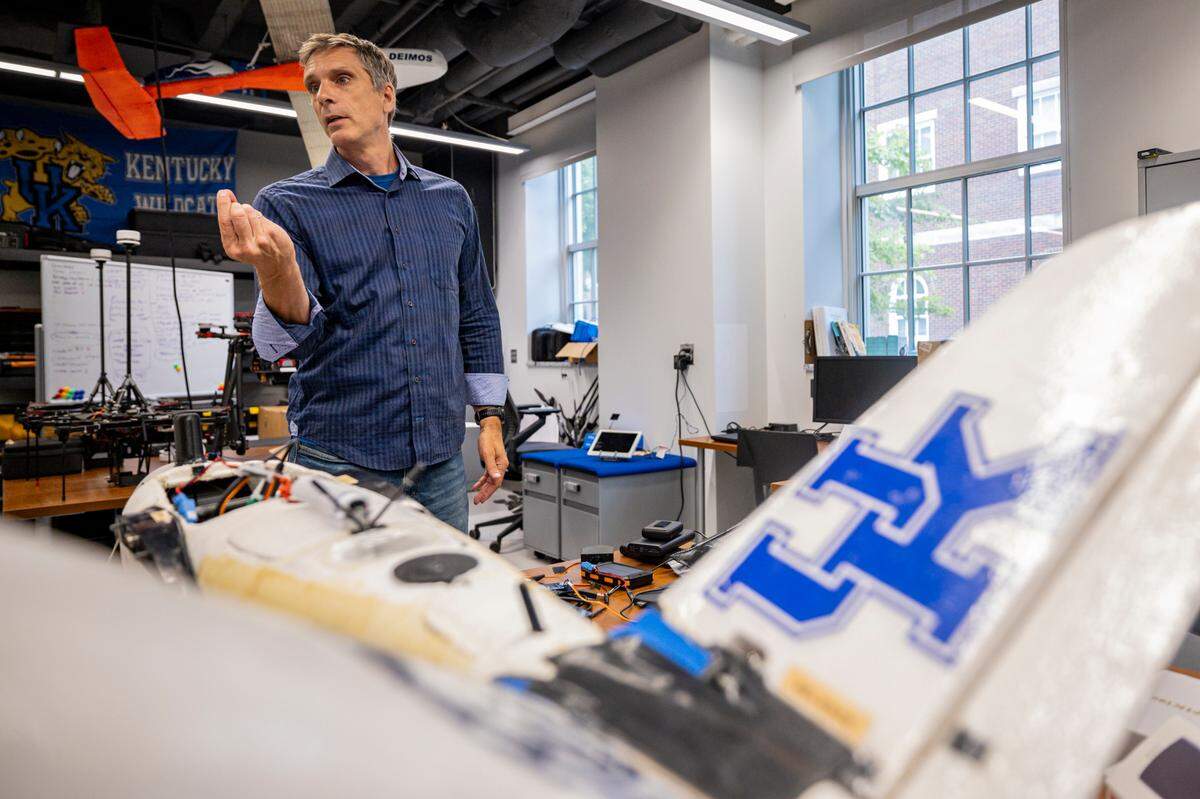
‘Visualize the invisible’: How UK researchers use drones to explore the atmosphere
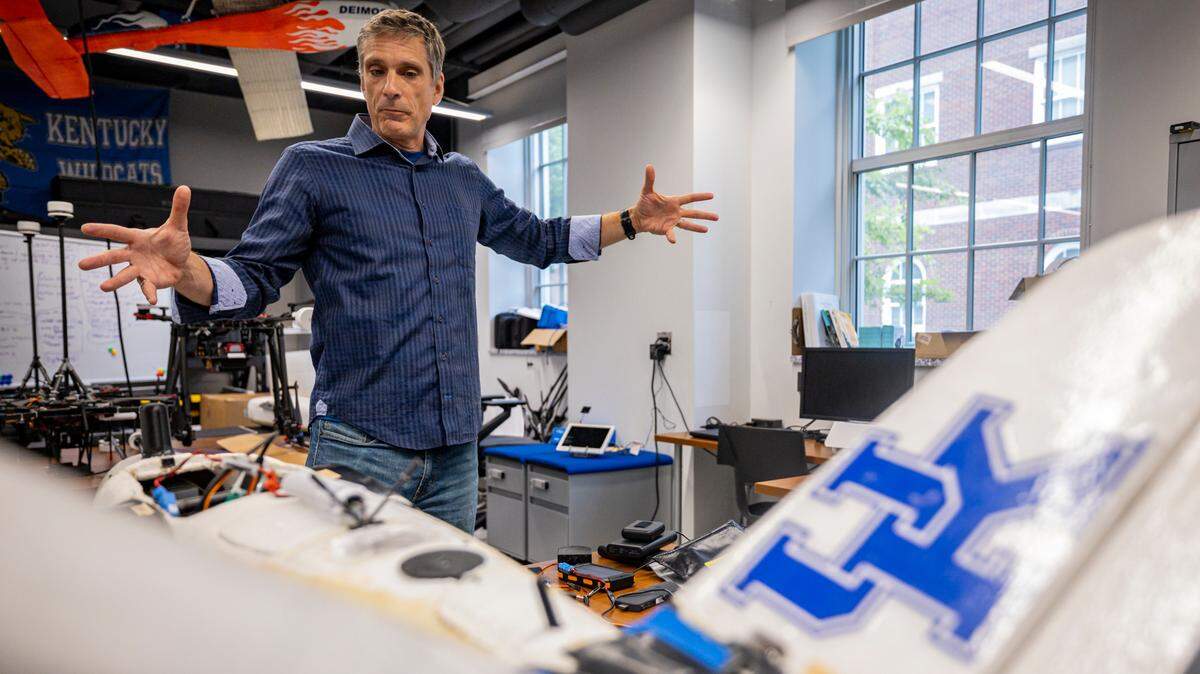
What once started as a mission to test an aircraft on Mars has turned into research using drones at the University of Kentucky that now helps engineers predict tornadoes.
UK has been using drones in research since the early 2000s, which initially focused on flight control. But now, those same drones are considered advanced and low-cost engineering tools to measure atmospheric properties useful for meteorologists.
Most of the foundational work was led by Suzanne Smith, an emeritus professor who recently retired after working more than 20 years with drones. When UK researchers first began testing drones, they were primarily looking at collapsible, inflatable, deployable wings.
The question that drove early experiments was: “Can you actually have an aircraft that will inflate its wings and then be able to successfully fly?”
“You can see that the wings are kind of basically air mattresses,” said Sean Bailey, UK mechanical and aerospace engineering professor.
Later on in 2005, that question evolved into broader experiments — including sending a wooden box and inflatable wings attached to a weather balloon into the upper atmosphere, where air density is similar to that on Mars, where they successfully flew.
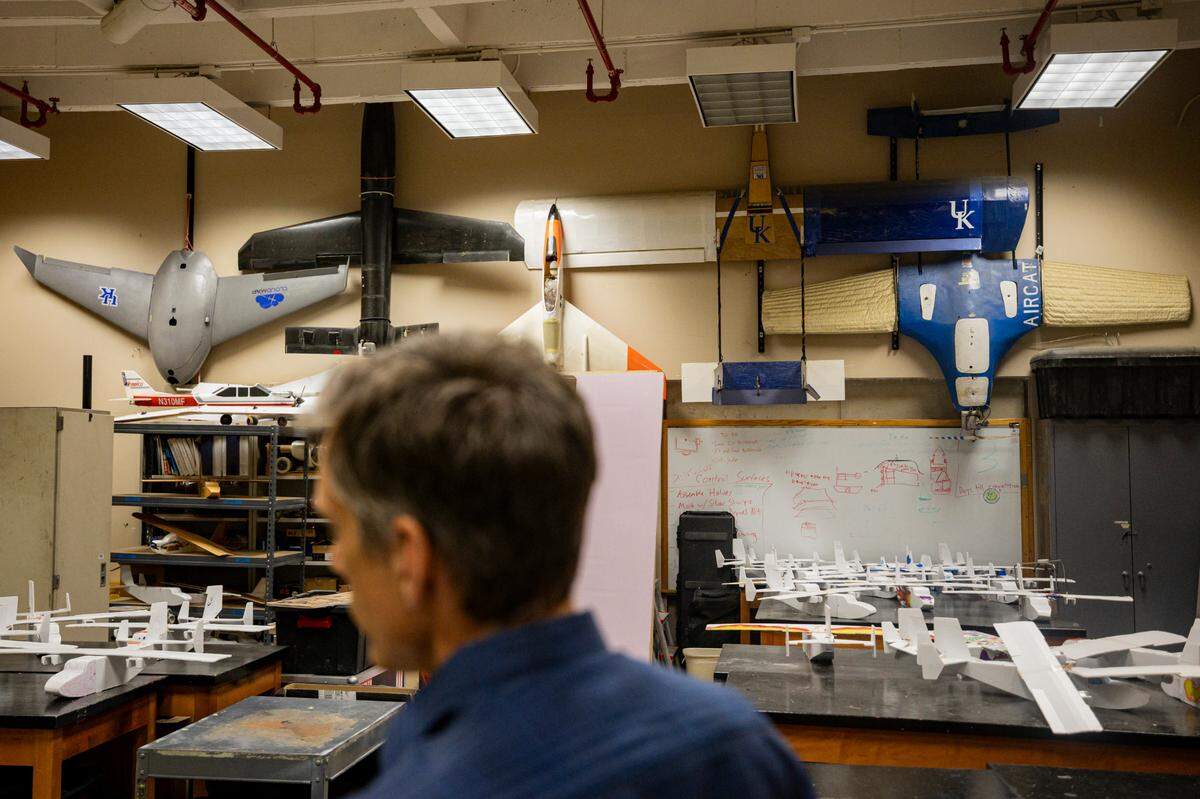
When that project ended, Bailey said there was a clear transition to design projects and student design competitions related to drone building, where students plan, build and fly the aircraft.
When he joined UK’s mechanical and aerospace engineering department in 2010, Bailey deepened his focus on aerodynamics and turbulence. Drones helped him study the atmosphere in a more practical way.
“You can take them (drones) wherever you want them to, so they’re very portable,” Bailey said.
Drones can also access altitudes where towers do not usually reach, which eases the process of gathering measurements that can be collected for whole days or nights.
“You can just take it out to a field and you can fly it up and down, get your data in,” Bailey said.
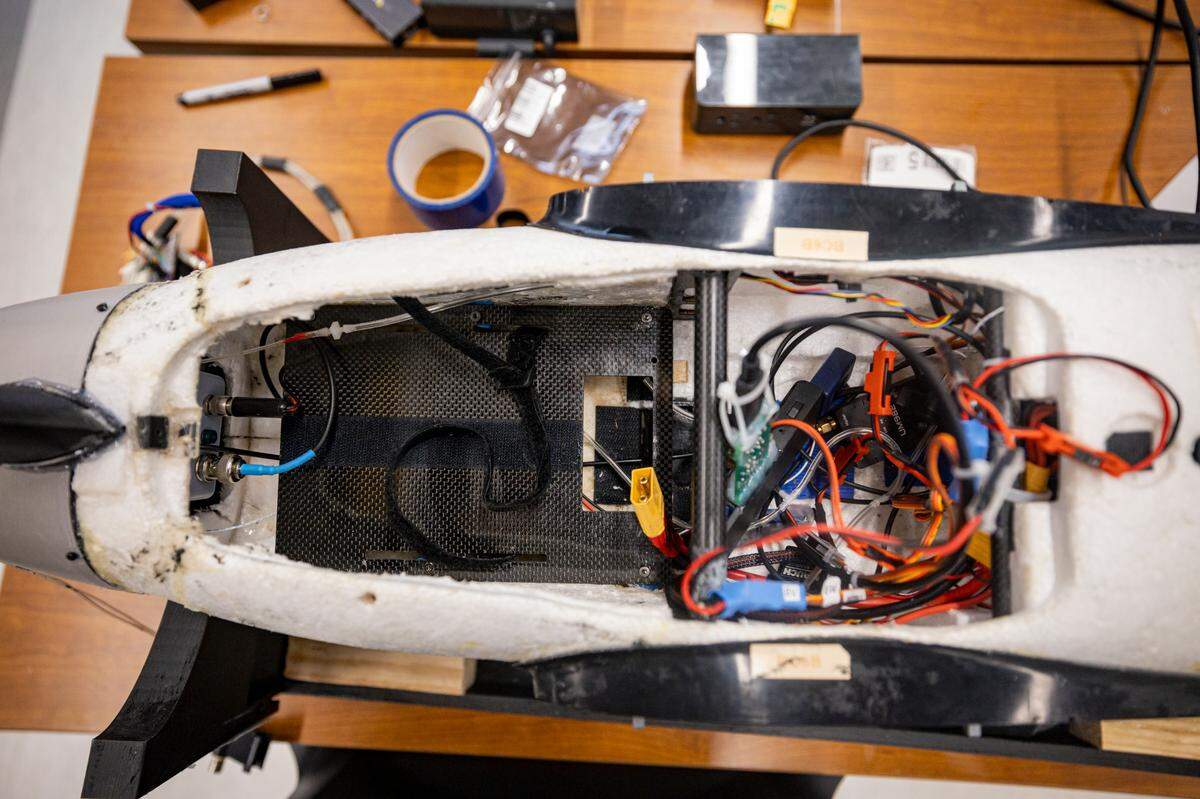
One of the completely student-designed aircrafts, called Blue Cat One, was the first gas-powered drone designed at UK to fly fast over long distances, capable of carrying multiple instruments at once.
However, Bailey said it wasn’t until Blue Cat Five that he and his team discovered successful combinations, which later enabled them to transition from gas-powered to completely electric drones.
“We got to a point where we were flying several of these aircraft at the same time,” Bailey said.
From that moment on, the department began integrating sensors into more traditional drone aircraft.
According to Bailey, each drone had its specific characteristics for how they could fly — some were good at just flying horizontally, others for collecting vertical atmospheric data.
More recently, Bailey and his team returned from Tulsa, Oklahoma, where they have used drones to study how wind behaves around buildings — especially how gusts and turbulence form.
Their goal was to better predict how wind flows and changes near structures, which has become pivotal for aviation meteorology.
Student innovation takes flight
Bailey has also opened the door for sophomore engineering students to gain hands-on experience by building drones from scratch.
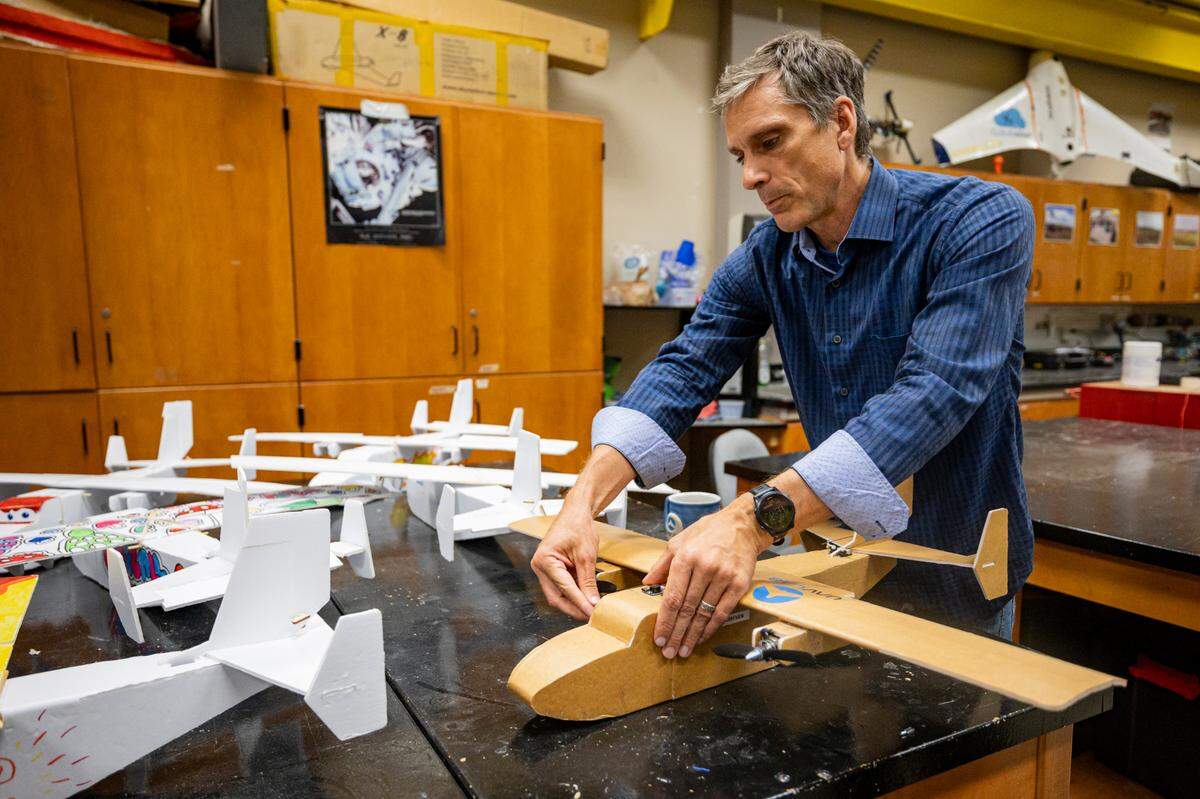
“They have to learn about the weight and the balance of the aircraft, make sure it applies properly,” Bailey said. “And then we also have them put a little autopilot on.”
Other teams, including capstone and senior thesis project groups, have also expanded their knowledge of underwater drones.
In a lab at the Ralph G. Anderson Mechanical Engineering Building, researchers built a boat that can recover ocean capsules — a prototypical model for technology used to protect spacecraft when they land deep down in the ocean.
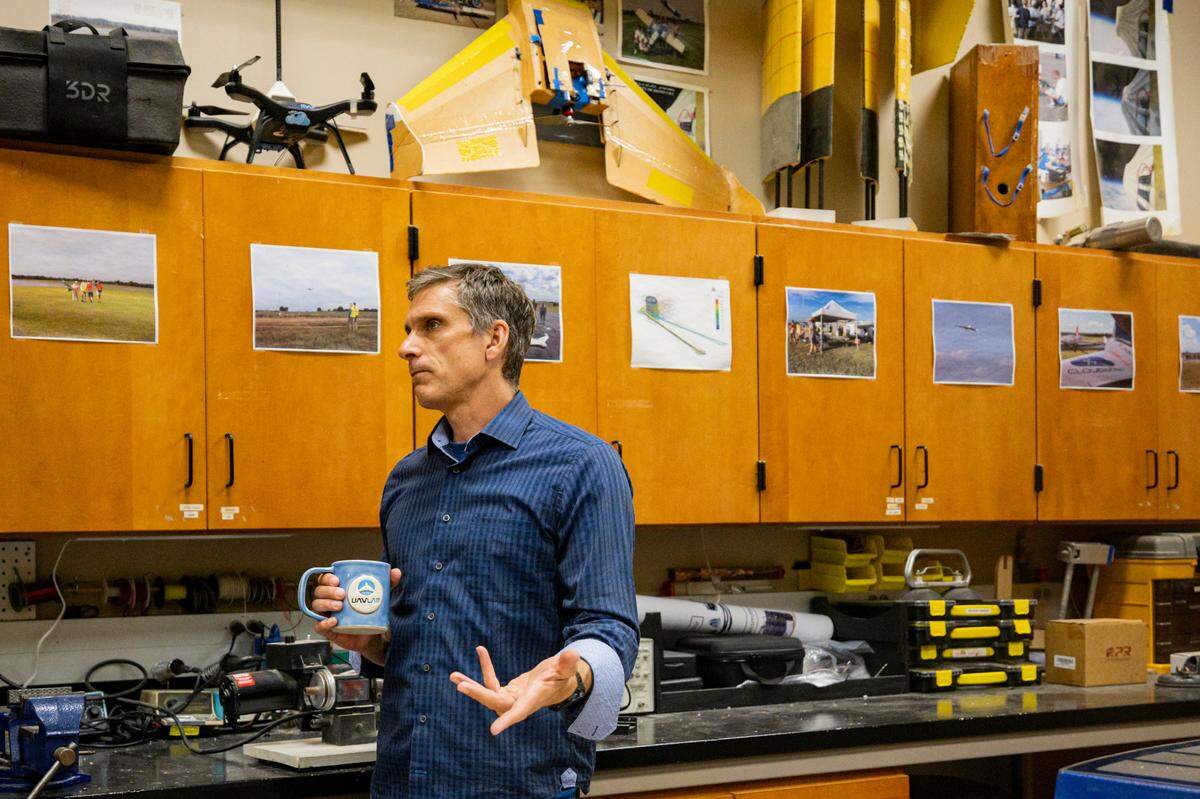
Bailey’s current research, conducted in partnership with a Penn State meteorologist, examines the factors that influence whether a storm produces a tornado.
Ryan Nollan, an engineering associate who works alongside Bailey, has built a craft below 250 grams, relatively disposable and adept to handle pressure, temperature and humidity during heavy storms.
“Ryan’s flown this aircraft in a couple of storms already and successfully has flown fine in the rain,” Bailey said. “In the most recent one, we were able to get the sensors to work in the rain.”
The logistics behind it
UK has several policies in place before a drone can be flown on campus, including review by the Federal Aviation Administration and Air Traffic Control at the airport. The FAA rules everything — from drone shows to scientific experiments.
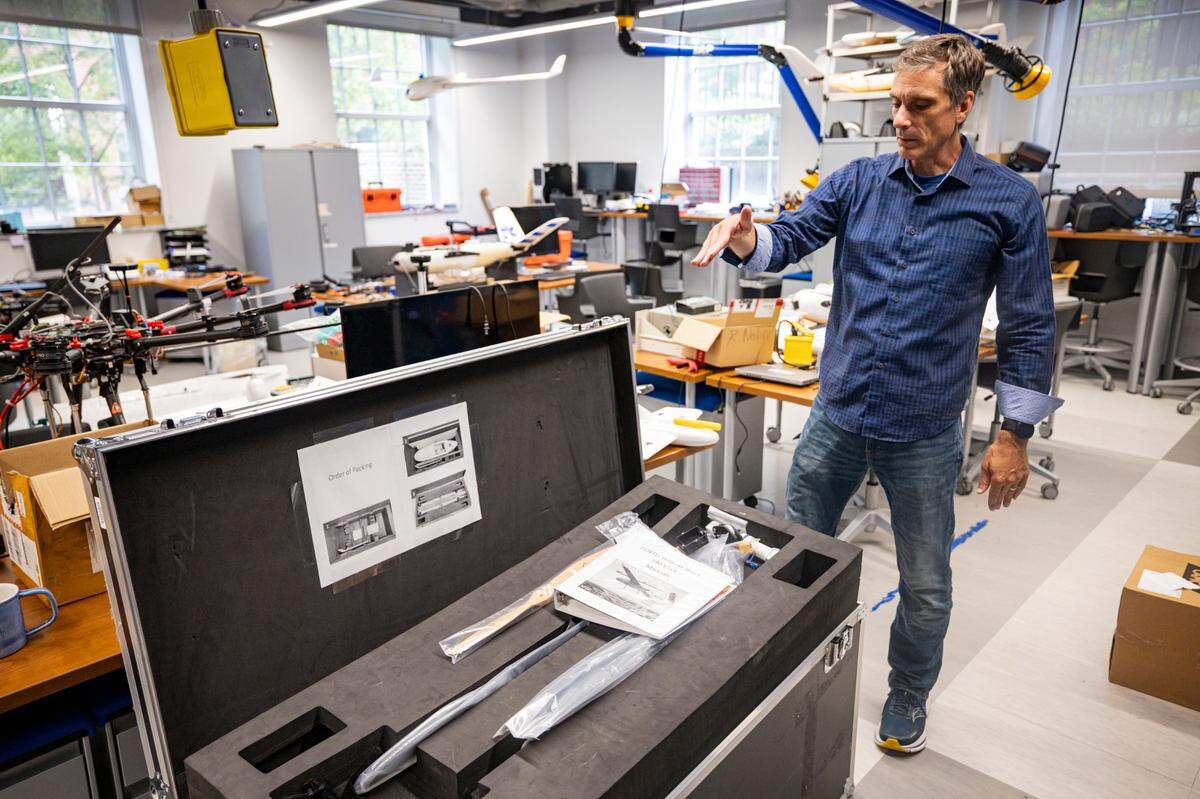
The use of drones for educational and research purposes at UK has also partnered with other fields, including agriculture, geology and anthropology through EduceLab, a heritage science lab.
“A lot of my motivations (involve): ‘maybe we can do better weather measurements, which will then improve weather predictions, which could potentially improve all sorts of aspects of human life,’” Bailey said.
Flying drones also has some challenges, including the necessity of having many people involved — a pilot, an observer and someone handling the data.
Researchers also have to be mindful that drones stay within their line of sight to ensure no other aircraft will run into them.
Despite misconceptions about privacy issues, Bailey said drones are valuable tools for the future of science, especially when looking at atmospheric properties.
“Part of what you’re doing is trying to visualize the invisible,” Bailey said.