
Angry critics blast FCPS leaders: ‘We have been met with scandal after scandal.’
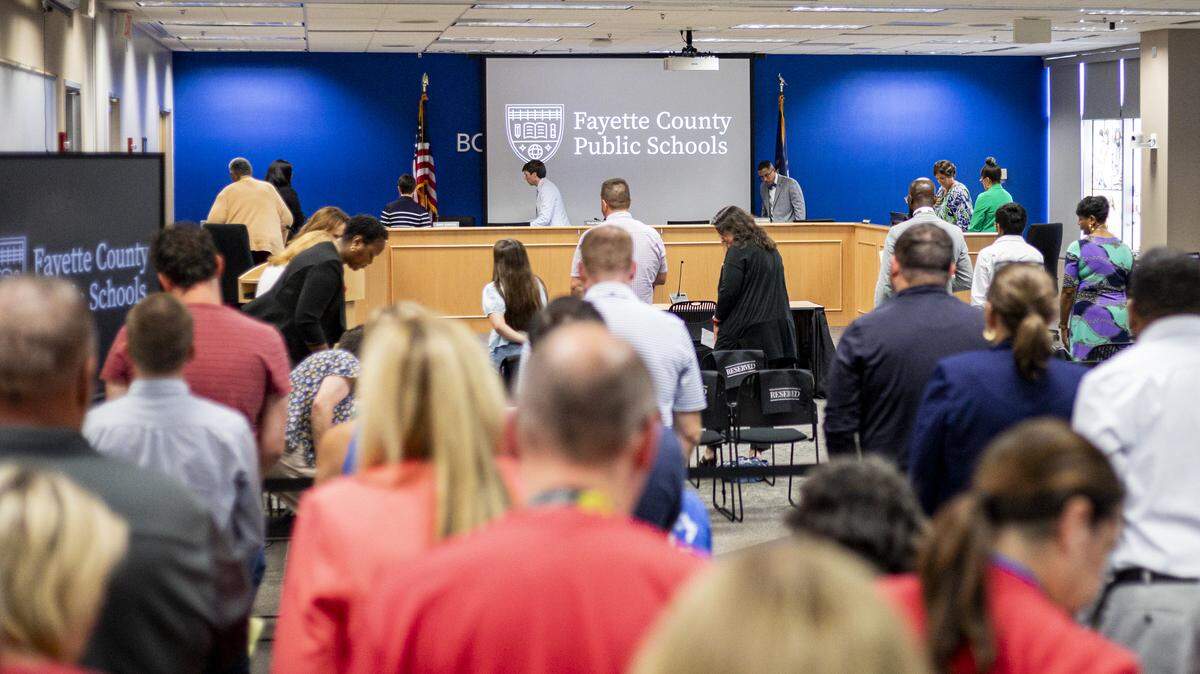
At nearly the four-hour mark of Monday night’s marathon Fayette County Public Schools’ meeting, pent-up frustration from district residents, taxpayers and parents exploded.
In a barrage directed at some board members, Superintendent Demetrus Liggins, and his administrative staff, critics lambasted a lack of communication, questioned financial moves and hinted to bigger problems confronting the cash-strapped district.
Lexington resident Matthew Vied said he was addressing Liggins, his staff and board members Amy Green, Tyler Murphy and Penny Christian, when he called them “incompetent.”
Or, Vied added, “to give you the benefit of the doubt I would say you just simply lack the wisdom and discernment to be in the position you are in.”
Others expressed their frustration: “We cannot as a community ignore this anymore,” said parent Jillian Kyde.
“We have been met with scandal after scandal, and it just keeps getting worse,” added another parent, Rachel Buser.
The backlash followed widening concerns about the financial health of Kentucky’s second-largest school district.
Last week, Liggins revealed the district’s contingency fund was significantly smaller than originally expected. It was estimated to be about $42 million, but may be as low as $15 million to $22 million, Liggins said.
Officials aren’t certain what the current fund balance is, they said Monday.
The district has a $16 million budget shortfall. The contingency fund was to be tapped to bridge the deficit.
Mindful of a damning Kentucky Attorney General’s opinion regarding a tax increase attempt and an upcoming state audit, school board members and community members at Monday’s marathon meeting criticized the district’s handling of the $848 million fiscal year 2026 budget.
“I’m pretty concerned that we have gone into the contingency the amount that we have, and we weren’t made aware of that as a board,” said board member Monica Mundy. “None of the conversations we’ve had has ever led me to believe that we have gone into the contingency to that amount.”
She asked district financial director Rodney Jackson if, as board policy dictates, if board members were ever told that money was being siphoned from the contingency fund to meet other expenses.
Jackson said at the end of last fiscal year, which would have been in June, he noticed that there was a potential problem with the contingency fund.
He told Mundy he alerted the Budget Solutions Work Group, a task force of community and business leaders formed to review the district’s finances, at its second meeting that the contingency might not be $42 million.
“The minute I knew, I reported it,” Jackson said.
However, he added, the factors causing problems “were unseen” until late June.
“The minute I knew, I told,” he said, referring to the school board.
“I think there needs to be a procedure in place that when something like that happens, it goes to all five board members fairly quickly,” Mundy answered. “Because we don’t have any more wiggle room for this to happen again.”
“I totally agree,” Jackson replied. “We are going to get procedures in place to address that. There’s always going to be unknowns. But I pledge to you. We are looking at all that.”
Jackson said he couldn’t tell board members the balance of the district’s contingency fund.
“I’m very hesitant to give you a number,” Jackson said.
He added he would know by the middle of next week and would report it to Liggins, who would share it with board members.
Jackson said the district goes through a process every year related to accruals, year-end expenses and revenue.
“Once I get that number, it will tell me what number we are at, how far we’ve dipped into contingency, if at all,” he said.
Liggins said the district would “tighten its belt,” but he insisted there has been no wasteful or frivolous spending.
That drew an immediate derisive response from parents and community members.
Retired employee Frankie Langdon told the board that according to the board’s own guidelines, the contingency fund should not have been touched without board knowledge and approval.
“You were given the golden key to our house and right now, it’s burning down,” she told Liggins. “The five-alarm fire is here and now.”
Speaking to Liggins and board chairman Tyler Murphy, Langdon added: “You need to own this and be responsible and accountable or move aside and please let others steer the ship.”
Murphy said the message he keeps hearing from the public is no students or classrooms should be affected by cuts.
Four of five board members reached a consensus to hold a Sept. 5 public hearing to discuss a proposal to increase Fayette County Schools’ occupational license tax and to consider other potential options to solve the $16 million budget shortfall.
That drew a stern response from community leaders from Keeneland, the University of Kentucky and Commerce Lexington, all on a Budget Solutions Group. The district should find alternative funding plans and not pursue a tax increase, they said.
Carla Blanton, chair of Commerce Lexington, spoke against that move Tuesday: “We are disappointed and disheartened that the presentation at last night’s school board meeting so summarily dismissed the recommendations of the work group, which comprises members of all segments of the community and was selected by FCPS.”
“In particular, the focus on — and characterization of — the occupational license tax being a recommendation of the work group and the only solution without a negative consequence was misrepresented to the board. The tax was, by far, the lowest ranked option of a group that was, again, handpicked by school leadership.”
Blanton added: “Nevertheless, we remain committed to doing the hard work of finding small budget cuts that don’t impact students and getting to the bottom of the status of the contingency, which must be part of the solution. We also will work with FCPS on longer-term solutions to help it regain fiscal strength.”
Earlier this summer, Kentucky Attorney General Russell Coleman ruled the board’s previous attempt to raise the tax was unlawful. On the heels of Coleman’s ruling, state Auditor Allison Ball launched a “special examination” of the district.
District Deputy Superintendent Houston Barber offered a, “What happened to the planned contingency?” presentation to board members and those at the meeting.
It showed:
- $42 million was budgeted for unexpected costs or emergencies.
- Rising inflationary cost increased greater than forecasted.
- There were increased expenses in pre-K funding, child nutrition services, and additional retirement payments.
“The contingency fund is intended to maintain uninterrupted services to schools, students, and staff. FCPS has insured that services to students and staff have been maintained,” Barber told the Herald-Leader.
Ultimately, district officials explained, budget woes can be distilled to this: Despite planning and no new spending, fixed costs rose faster than revenues.
District officials said this is a national trend for school districts, flat state funding and higher costs lead to pressure on local budgets.
This story was originally published August 19, 2025 at 1:56 PM.