
FCPS enacts new financial controls as calls for independent investigation grow
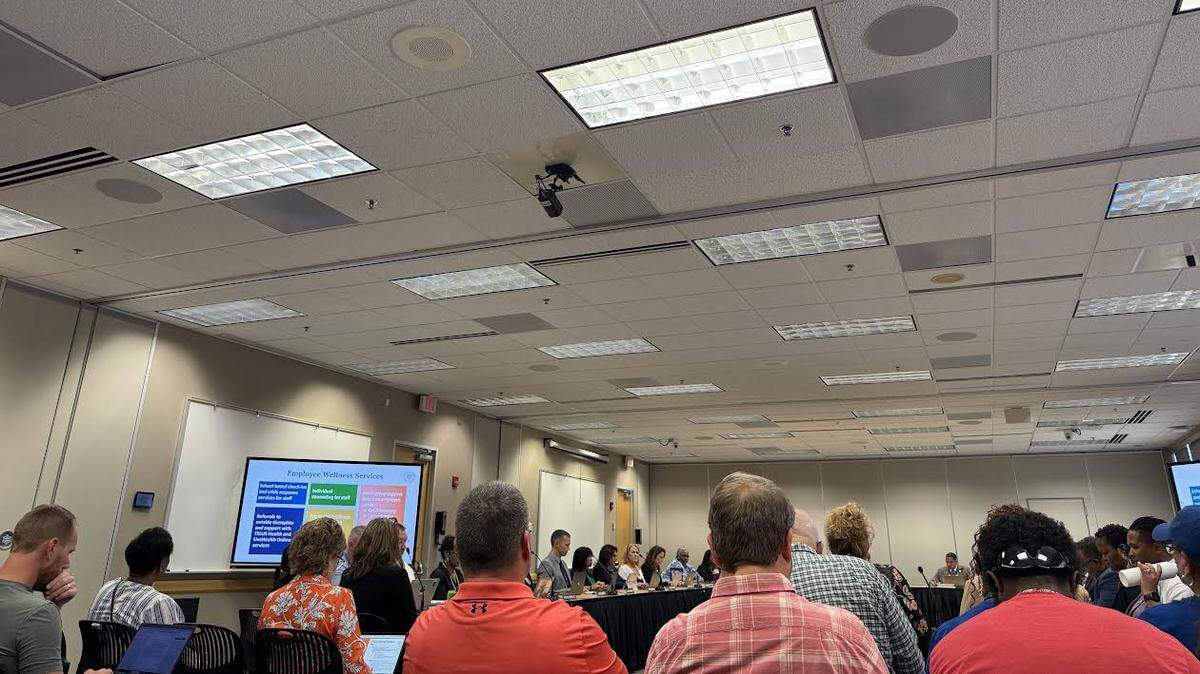
Fayette County Public Schools has enacted new financial controls to ward against budget problems that surfaced this summer.
The new controls are aimed at ensuring the projected contingency more closely aligns with the year-end fund balance, which did not happen recently, district financial director Rodney Jackson said at a Monday school board planning meeting.
The contingency was $42 million and the year-end fund balance, according to Superintendent Demetrus Liggins, was $26. 3 million.
The district is tightening financial monitoring and forecasting and strengthening financial reviews across all departments to provide more accurate, real-time data in the face of a barrage of bad budget news throughout 2025.
Variances are being flagged earlier so corrective action can be taken mid-year rather than waiting until year-end, officials said.
There are new expenditure controls. The district has frozen certain district level positions and slowed discretionary spending. All budget requests are being reviewed through a stricter approval process.
The district is factoring in more conservative revenue assumptions, particularly in areas where collections may lag. That ensures that projections don’t overstate available funds, Jackson said.
At least two people who spoke at the meeting joined the call for an independent forensic investigation instead of the internal investigation that Liggins has launched. Liggins reiterated he wished he had asked “more probing questions” and been more deeply involved in the budget.
He said he is doing that now.
“There are far too many amazing things happening in Fayette County Public Schools to allow this to stop our momentum,” Liggins said.
The $827. 2 million proposed budget is balanced without raising the occupational license tax and still protects investments in classrooms, Liggins said.
Liggins said at the meeting that as the staff began closing out the books for the fiscal year that ended June 30, they found several areas where expenses had come in over budget, which reduced the carry forward amount in the budget from $42 million to $26.3 million.
The internal investigation is looking at what happened, “so that we won’t be facing the situation again.,” Liggins said.
At least three speakers demanded an independent forensic audit, not the internal review that Liggins has launched.
“I do not have any faith or trust in this board. Whatever the outcome of the investigation, it won’t really mean much.” said Bradley Hill, who said he worked in the community. “If you want to restore faith, then have an independent investigation.”
On Monday night, Liggins did not say if he would support an independent forensic audit or independent investigation.
The 2025-2026 budget to be voted on Sept. 22 is $21.4 million less than the tentative budget presented in May. The total tentative budget revealed in May was $848.6 million, which had a $16 million shortfall.
FCPS spokesperson Miranda Scully said Monday morning that the 2025-26 tentative budget, which the board approved in May, included the anticipated revenue from increasing the occupational license tax. Liggins took the tax increase proposal off the table after receiving pushback from business and community leaders.
Scully said the proposed 2025-26 working budget includes $17 million less in anticipated occupational license tax revenue as well as lower expenditures due to the budgetary reduction measures.
“Our team has gone line by line to make cuts at the district level and protect investments in the classroom,” she said.
Among the cuts::
$39 million will be spent for Business Support Services, which represents a $6.7 million decrease from the previous year. Activities in this area support schools, programs, and departments to ensure the district maintains continuity of operations.
Functions within this category include human resources, payroll, and accounting, as well as printing, postage, and telecommunications.
$10.4 million will be spent on District Administrative Support Services, representing a $1.2 million decrease from the previous year. Activities in this area include activities associated with the overall general administration and executive responsibility for the district, including the superintendent, board of education, legal services and tax assessments.
Liggins said the money in the proposed budget that the board will vote on September 22 includes:
Instruction including salaries and benefits for teachers, materials, technology: $404. 5 million.
Staff support services, curriculum development, library, media resources: $35.9 million.
Student support services for guidance, health, enhanced instruction $44.1 million.
School administrative support services includes salaries for principals and assistant principals; $37.7 million.
Community services supporting family resource and youth services centers: $476,963.
Other instructional: $651, 429; student transportation: $30.6 million; plant operations and maintenance: $55.7 million; debt service: $2.9 million; fund transfers: $800,000; contingency fund $27 million.
Questions about carry-forward balance
On Monday, Fayette school board member Amanda Ferguson and community advocate Matthew Vied questioned whether the district’s carry-forward fund balance for the 2026 fiscal year budget was actually $15.6 million, not $26.3 million as Liggins has said.
“Twelve million dollars has vanished, disappeared,” Vied said at the meeting.
Scully responded earlier in the day by saying the claims were “misinformation.”
The negative $12,021,474.91 figure in that account reflects money that the district will still receive, Scully said.
“Mr. Vied’s next false claim relates to the contingency fund. First, he uses the wrong figures, and next, he misrepresents how the Kentucky Department of Education calculates contingency,” she said.
“ I still have questions,” Ferguson told the Herald-Leader after the meeting.
Property tax rate reduction
The Fayette County Public School Board approved its property tax rate at Monday’s school board meeting.
District officials recommended a decrease of approximately 1.1 cent per $100 of assessed property values. That would be a decrease from 80 cents per $100 of assessed value to 79.8 cents per $100 of value. The projected revenue is estimated at $340,212,439.47, board documents show.
This story was originally published September 9, 2025 at 7:48 AM.