
New investigative report on Fayette County schools reveals ‘systemic deficiencies.’
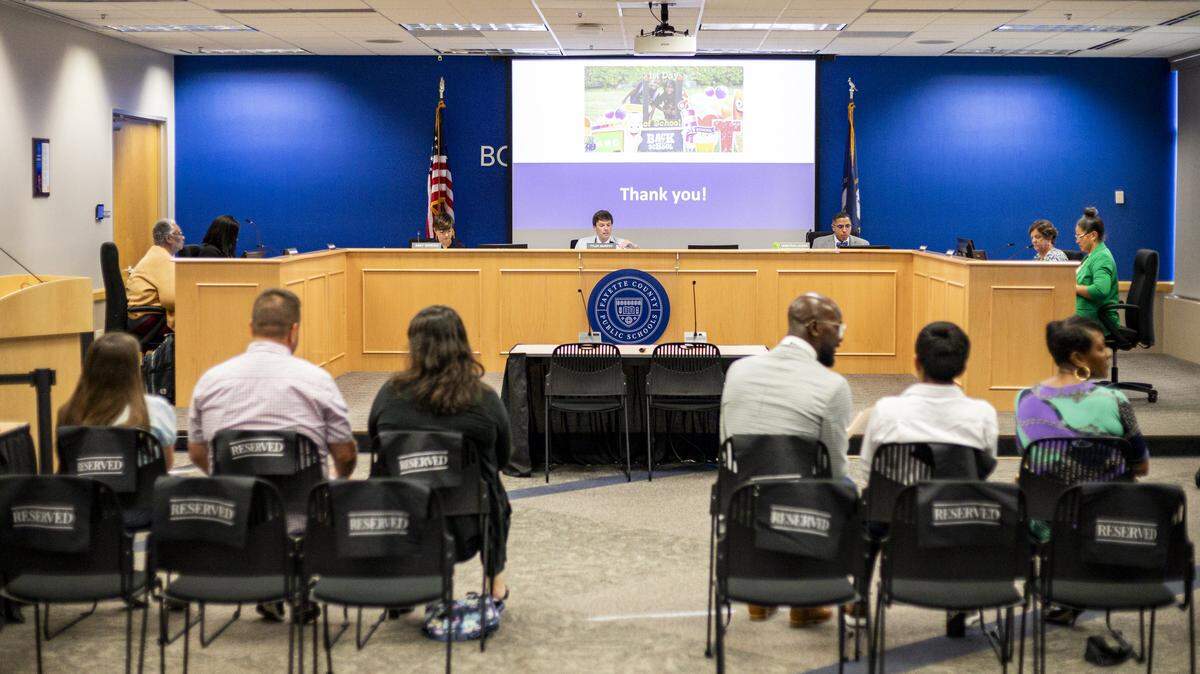
An independent investigation into Fayette County Public Schools’ budgeting practices “identified systemic deficiencies in forecasting, financial monitoring, and internal communication,” according to the investigation, which was released by FCPS Monday.
The law firm of Tueth, Keeney, Cooper, Mohan and Jackstadt, in Missouri, found that the evidence demonstrates there was unauthorized use of the district’s contingency — or rainy day — fund, which resulted from breakdowns in communication among senior personnel and repeated failures to timely identify and address emerging budget deficits.
Superintendent Demetrus Liggins said the report reflected “our continued commitment to openness and clear communication with our community.”
“The report finds no evidence of intentional misconduct by district personnel,” Liggins said in a statement. “However, it identifies significant systemic deficits in budgeting and financial processes, as well as breakdowns in communication and collaboration, that must be addressed.”
The district acknowledged last year it was facing a projected $16 million budget shortfall, and a contingency fund that was expected to be big enough to fill that gap actually held much less money than expected, district officials said.
Liggins said the findings were being taken seriously, and he took responsibility as superintendent. He reiterated that steps have been taken to put the district’s finance and budget departments under his oversight, and said he’s strengthening communication and accountability in those departments.
“I am reviewing this investigation’s conclusions and recommendations to determine what additional actions are needed to strengthen the district’s financial practices,” Liggins said.
Liggins also said FCPS is now operating under a balanced budget with a contingency fund “well above state requirements.”
“We will continue redefining our processes to ensure our operational and financial practices match the high standards our students, staff, and community deserve,” Liggins said. “Our focus remains steady: Support student success while responsibly stewarding public resources.”
The Fayette County Board of Education already is meeting in closed session Wednesday to discuss possible personnel action against Liggins based on another report from a Kentucky attorney that said he had failed to follow policy on budget issues.
At the same time, House Republicans in the General Assembly are trying to remove Fayette school board chair Tyler Murphy from office, alleging he failed to provide adequate oversight of the FCPS budget.
Fayette schools officials hired the law firm to conduct an independent investigation into concerns related to the FCPS’s budgeting and finance practices.
Why the investigation occurred
In August, FCPS became aware that the amount of the contingency fund available as part of FCPS’ general fund was much lower than originally believed. It also appeared that the money in the contingency fund was low enough that the school board needed to be notified, but that hadn’t occurred.
The investigators were asked to investigate what events or actions, if any, by FCPS personnel led to the budget issues and figure out if any FCPS policies, procedures, expectations or laws were violated.
District administrators with responsibility for budgeting and financial matters were aware of changes impacting the district’s financial health in fiscal year 2024, such as stagnant enrollment, inflation, and a “$20-30 million investment” in salaries, the Missouri law firm’s investigation found.
Despite being aware of issues, district administrators failed to appropriately take some of this information into account when budgeting, and failed to budget for foreseeable increases in salary expenses, which account for the majority of FCPS’ general fund costs, a report from the investigation says.
That failure resulted in significant under-budgeting of key expenditures, the report says.
The Investigation was initiated at the direction of Liggins, so the firm investigated people who were Liggins’ subordinates.
What investigators found
Review of financial records showed the district’s general fund balance decreased by nearly 50% at the end of FY 2024. A working budget shown to the board during a Sept. 25, 2024, meeting showed a drop in the fund’s balance from over $82.5 million to $42 million.
The drop in money was communicated to the board, but the substantial reduction didn’t appear to prompt more comprehensive analysis by district leadership, and officials didn’t appear to analyze the contingency fund balance at the time, the report says.
The investigation identified systemic deficiencies in forecasting, financial monitoring, and internal communication.
In fiscal years 2024 and 2025, which were the years in focus for the investigation, FCPS had two key financial leadership positions. Ann Sampson Grimes served as executive director of budget and financial planning, and Rodney Jackson served as executive director of financial accounting and benefits. Both of them reported to Deputy Superintendent Houston Barber.
The investigation found that during FY 2024, Budgeting Specialist Jessica Williams conducted periodic manual reviews of expense data and alerted Grimes at both the beginning and end of FY 2024 of concerning trends.
In one instance, Williams alerted Grimes to a projected salary shortfall of about $17.9 million in October 2023. The investigation found that Grimes may have told district leaders, including Liggins and Barber, that the district would need to make budget reductions during FY 2024 and more expenses couldn’t be sustained.
But the investigation also found that Grimes didn’t clearly communicate the specific salary overages.
“Grimes prepared a projected budget for FY 2025 that did not account for the District’s actual FY 2024 salary expenditures,” the report says. “By failing to incorporate those known expenditure levels into the FY 2025 projections, the resulting budget did not reflect the salary gap and made the already growing deficit less apparent to those responsible for reviewing and approving the budget.”
As a result, the magnitude of the salary shortfall was not readily discernible from the proposed FY 2025 budget.
During FY 2026 budget preparations, there is no dispute that starting in approximately March 2025, Grimes repeatedly raised serious concerns about the projected deficit to district leaders, including Barber and Jackson.
The magnitude of the shortfall wasn’t clear in the FY 2025 budget, the investigation showed. Starting in March 2025, Grimes repeatedly raised serious concerns about the projected deficit.
Barber and Jackson both reported that Grimes was emotional in a budget meeting while presenting a budget with a deficit of $16 million or more. District leaders shared that information with the school board and began discussing how to address the deficit.
There was no information to suggest that there was the same level of clarity or urgency in discussions about budget deficits for prior budgets, according to the report, and the growing deficit should have been clarified earlier.
That delay hurt the contingency fund, the report said.
The report said there wasn’t anything to suggest Grimes engaged in intentional misconduct, but the investigation showed she didn’t fulfill her responsibilities as head of the budgeting department.
Grimes was placed on administrative leave, but later returned to work. She has filed a lawsuit against FCPS over alleged retaliation.
Brandon Voelker, Grimes’ attorney, told the Herald-Leader Monday night the “report is a joke.”
“Liggins without board approval hires a Missouri law firm lacking a Kentucky law license to provide legal advice. It’s a choreographed show akin to a broadway performance,” he said. “The board hires an attorney to criticize Liggins. Who then blames staff and right before their meeting his out of state attorney justifies what he is saying. This fictional production should be shown in theatres.
“Unfortunately the Board Chair has been complicit throughout. Hopefully the residents of Fayette County can see through the nonsense.”
The investigation also found that Jackson, who oversaw accounting and benefits, didn’t collaborate with Grimes as much as was needed to review and analyze costs before the FY 2025 budget was finalized.
Jackson said that after concerns related to the contingency fund came to light in summer 2025, he reviewed data to find there was a “clear trend” of increased special education expenses which began years ago, according to the investigation.
Jackson said it was Barber’s responsibility to review special education expenses incurred after Dec. 1 and advise of needed adjustments, but his job description clearly outlines that he was supposed to collaborate with Grimes to “prepare reports and analysis in support of budgeting to ensure sound business and financial practices,” according to the investigation.
Barber said he relied on Grimes and Jackson to collaborate regarding the district’s budgeting and finance, according to the report.
Jackson reported that he had no knowledge that the FY 2025 budget failed to incorporate actual salary expenses from FY 2024, the investigation says.
Jackson also failed to meet expectations by not doing enough analysis and communicating the implications. Jackson also didn’t engage in intentional misconduct, but didn’t fulfill “responsibilities as the head of FCPS’ Financial Accounting and Benefits department,” the investigation said.
Liggins said it was Barber’s responsibility to ensure effective oversight of FCPS’ budget by facilitating coordination and communication between the budget, finance, and human resources departments. Liggins reported that he has recently learned that Barber did not consistently hold the necessary coordination meetings to maintain an accurate and up-to-date understanding of the district’s financial position, the investigation says.
Liggins told investigators that the lack of structured communication and oversight was a breakdown that delayed the awareness of budget issues.
The report said that Barber’s oversight and coordination of relevant financial and budgeting departments was insufficient, and he didn’t “adequately investigate, anticipate, or implement necessary financial adjustments to ensure compliance with FCPS’s Contingency Fund procedures, particularly in light of known pressures and the substantial reduction in the District’s Beginning Balance at the close of FY 2024.”
Barber also didn’t do anything that constituted intentional misconduct, the investigation found, but it accused him of “deficient performance and failure to fulfill responsibilities” in his role.
The investigation didn’t indicate that district leaders were aware of the use of contingency funds prior to August 2025.
“This is particularly notable given that FCPS had historically maintained fund balances well above minimum reserve requirements,” the report said.
Additionally, the investigation did not uncover evidence that district leadership intentionally sought to circumvent the 6% contingency requirement that dictates how much money should be in the fund. However, the evidence demonstrated that both Barber and Jackson relied, at least in part, on anticipated additional revenue from an eventually failed Occupational License Tax to offset budget deficits. That reliance influenced and potentially delayed planning decisions, the report said.
Neither Jackson nor Barber immediately responded to requests for comment.
The investigation found that FCPS’ recent financial concerns resulted from a combination of under-budgeted salary expenditures, and insufficient analysis of actual versus projected spending.
“While the investigation finds that certain individuals failed to meet professional expectations and internal procedural standards, there is no finding of intentional misconduct or deliberate violation of FCPS policies—specifically as it pertains to issues within the scope of this investigation,” the report said.
The investigation also found that financial reports weren’t clear enough to show how much money was actually in the contingency fund, and didn’t account for the use of the contingency money that had reduced the fund’s balance.
This story was originally published March 2, 2026 at 6:04 PM.