
US has already seen 20+ school shootings in 2026. How UK trains people to prepare
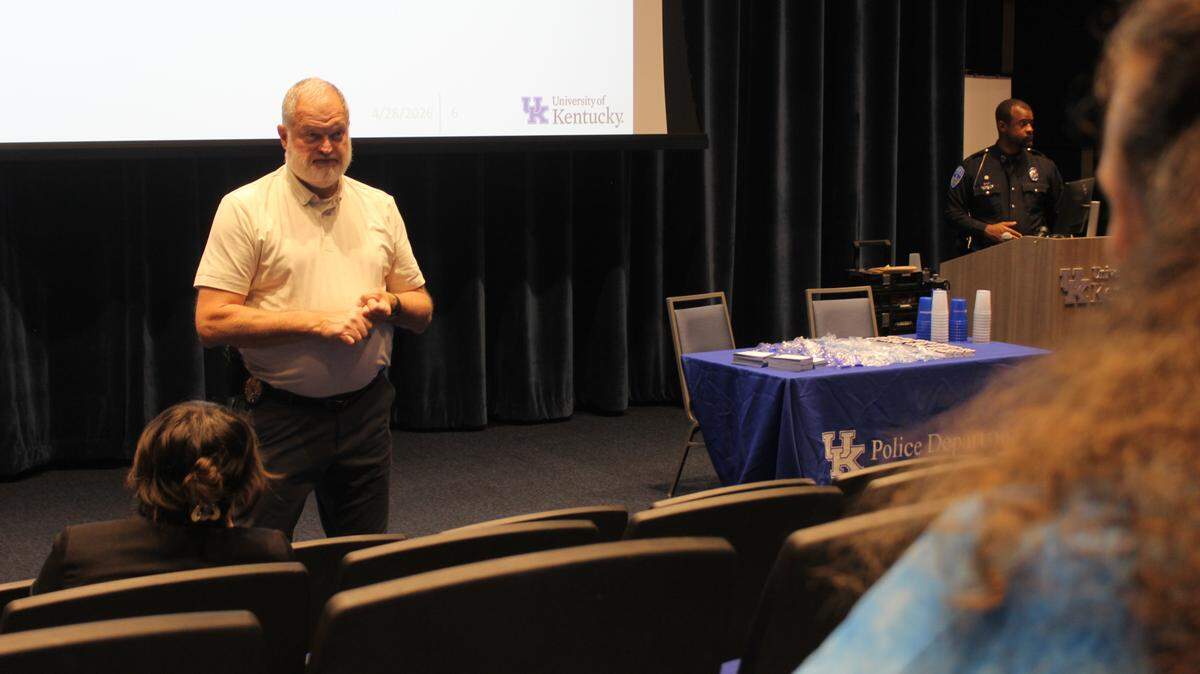
The University of Kentucky Police Department trains its community to use a rudimentary yet fundamental tactic if they were to encounter a shooter or attacker on campus.
“Run, hide, fight,” UKPD Chief Joe Monroe told students, faculty and staff at an aggressor response training Tuesday. “The wrong thing is not doing anything.”
There have been at least 21 school shootings, including eight on college campuses in the United States so far this year, as of April 14, according to CNN.
Officer Brandon White said he hopes these trainings, which occur every few months, will spread via “word of mouth,” as they aren’t required for faculty and students, and only a couple dozen people attended Tuesday’s training.
It can be difficult to find safety in a chaotic environment such as a shooting. Fine motor skills, and auditory and visual senses can be weakened as a reaction to stressful situations, according to the National Library of Medicine.
Officer Michael Culver said he learned that first-hand when radio dispatchers told him a code to enter the building where a potential active shooter was feared to be present in 2018.
“That auditory exclusion is kicking in,” Culver said. “You can hear it over the radio, them telling me what the code is. I didn’t hear any of that. I go through two billion combinations before I get in.”
Dani Jaffe, associate director of UK crisis communications, said that 2018 incident occurred at UK’s Barker Hall.
White presented a series of body and security camera videos that showed victims in disbelief during mass attacks, including at a board meeting, grocery store and concert.
They initially appeared to be in disbelief, which is a common reaction to an active shooter situation. Monroe noticed similar responses when shots were fired Saturday at the White House Correspondents’ Dinner.
“Some of them are going under the tables, you got a couple of them that are eating their mashed potatoes and drinking still,” he said. “They don’t know what to do. That’s when people get injured or killed.”
Running away from the sound of violence was the key takeaway.
“If you just take your chance and run away from the sound of violence, you have a good chance of survivability,” White said.
Lizzy Rodriguez-Hallahan, a UK HealthCare worker, said she was taught in elementary school to usually hide during lockdowns in active attacks.
However, UK leans on the FBI’s advice to use instincts, and people should run away if they’re not in the line of fire.
“It just confirms some things I normally do like I looked at the exits when I walked in,” Rodriguez-Hallahan said.
If exits are inaccessible and running is not an option, officers recommended hiding and being prepared to fight the attacker if they approach you.
Gun violence is the leading type of mass attacks, but a rise in vehicle-ramming internationally has prompted the university to slightly shift its preventative measures at large-scale events, according to Monroe.
“We have started using some barriers as mitigation techniques to keep vehicles from coming in there, the areas where we have large crowds,” he said.
When a professor asked whether to run or hide with students in her glass-walled classroom, White recommended either cramming into a closet, a next-door classroom or pressing a red emergency button.
“As long as everyone’s on the same page, you can have a location they can travel to or an exit strategy,” White said. “That’s the best practice.”
Some classes have a red emergency button, which, when pressed, immediately locks the room from the outside and alerts UKPD of a threat on campus.
“You can still exit if you have to evacuate, but then nobody can get in except law enforcement,” Jaffe said. “Look and see maybe if there’s one of those (buttons).”
Officers recommended downloading the Safe Zone app to report suspicious activity on campus. If someone calls 911 in a UK-related emergency, Lexington Police Department will transfer the caller to campus dispatchers.
This story was originally published April 29, 2026 at 12:05 PM.