
Kentucky State may cut political science, childhood development programs
Kentucky State University is expected to cut three academic programs as a way to alleviate its financial distress and shift to a polytechnic focus.
The KSU Board of Regents approved a plan on Thursday to end academic programs including political science and childhood development, as well as areas of music besides general music, and music industry and technology — which the university plans to grow, according to Michael Strysick, a university spokesperson.
The programs expected to end have “limited (or low) current enrollment,” Strysick told the Herald-Leader.
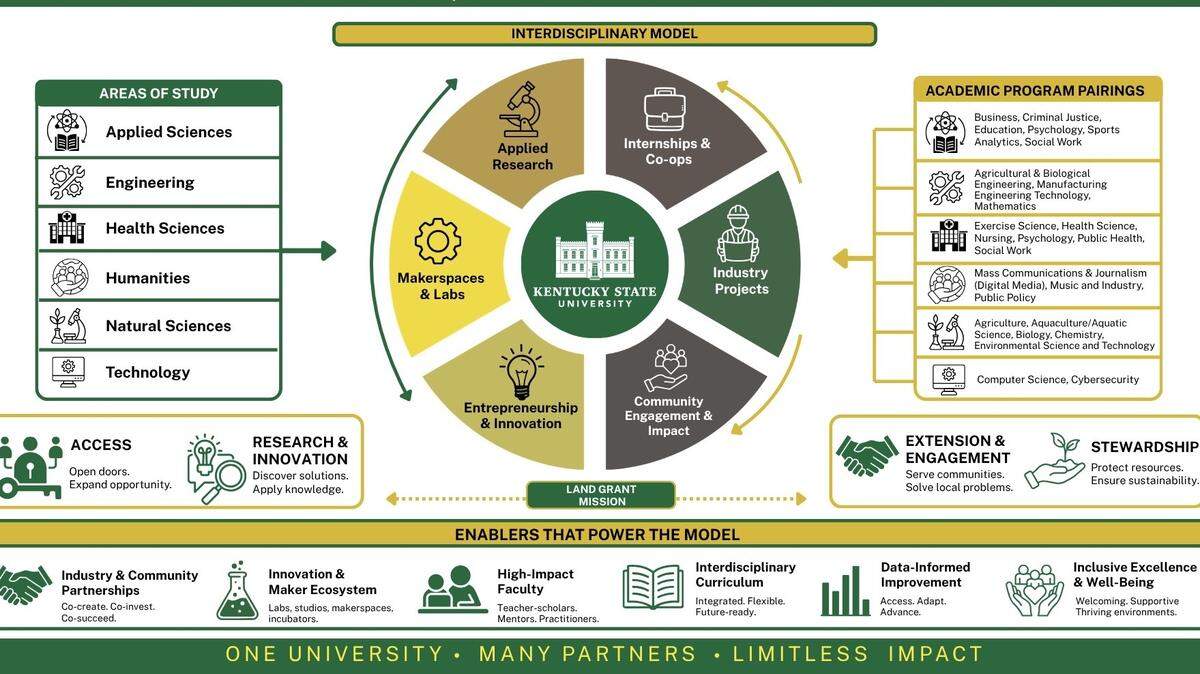
The polytechnic approach will encourage more “research, internships and co-ops, industry projects, labs and makerspaces, entrepreneurship, community engagement, and Extension,” a KSU news release said.
“This work also requires difficult decisions,” KSU president Koffi C. Akakpo said in a statement.
Students enrolled in closing programs will “have a path to completion through appropriate teach-out plans or arrangements,” he said. It’s unclear what those plans will entail or how many students will be impacted. Strysick said the amount of students is “limited.”
All remaining areas of study will include applied sciences, health sciences, natural sciences, humanities, engineering and technology, according to a KSU organizational graphic. A handful of programs will fall under each category, and “most current majors already fit within those areas,” Strysick said.
- Applied sciences will include business, criminal justice, education, psychology, sports analytics and social work.
- Health sciences will include health science, exercise, nursing, psychology, public health and social work.
- Natural sciences will include agriculture, aquaculture/aquatic science, biology, chemistry; and environmental science and technology.
- Humanities will include mass communications and journalism; music and industry; and public policy.
- Engineering will include agriculture and biological engineering; manufacturing engineering technology and mathematics.
- Technology will include computer science and cybersecurity.
The university considered factors including “student demand, market competition, job market trends and institutional costs,” Strysick said.
Gray Decision Intelligence, a higher-education analytics firm that utilizes artificial intelligence, informed the decision to reorganize certain programs, according to Strysick. It followed recommendations by the university’s shared governance and were “reviewed independently by two groups of faculty, staff and students,” according to Strysick.
“Gray DI is a data, software, and services firm that helps higher education institutions grow, become more efficient, and improve student outcomes,” its website said. “Our Program Evaluation System informs decisions on academic programs to start, stop, or grow.”
The Kentucky Council on Postsecondary Education, which oversees the state’s public universities, will make a final decision on the program changes.
The university was required to limit its spending because Kentucky Senate Bill 185 declared KSU is in a state of “financial exigency.” The institution must have no more than 10 academic areas of study for the next five years, or until the Kentucky General Assembly considers it financially stable, according to the law.
The university’s narrowed offerings and focus on becoming a polytechnic university will not remove its status as a historically Black college or university, the law said.
“So the polytechnic focus is being developed within that identity (as an HBCU), not instead of it,” Strysick said.
For example, changes to the music programs “would not jeopardize Kentucky State’s Concert Choir or Marching Band, both important parts of the University’s history and heritage,” Akakpo said.
SB 185 recognizes KSU as a land-grant university and Kentucky’s only public HBCU.
The law requires KSU to be “a four-year residential polytechnic institution that focuses on highly technical, industry-based applied learning and offers liberal studies and polytechnic programs that are aligned with the workforce needs of the Commonwealth and consistent with the historical mission of an HBCU.”
Students have sued the university to block the law from taking effect. One of two lawsuits, which are open and were filed in May, claims, “It is about students who enrolled at Kentucky State University for a particular education, in particular programs, with particular faculty, at Kentucky’s only public HBCU.”
But the law received support from a group of alumni, who said they viewed the changes as a positive way forward. The university did not address the lawsuits “because this is active litigation,” it said in a previous statement.
The polytechnic model will strengthen its humanities and interdisciplinary studies, according to Akakpo.
“A polytechnic model does not abandon the essential skills that help students think critically, communicate clearly, solve problems, adapt to change, and lead with purpose,” he said. “It connects those skills to the technical, scientific, health, agricultural, business, and community-centered work our students will be called to do.”