
Breakthrough allows University of Kentucky software team to capture writing on ancient scrolls
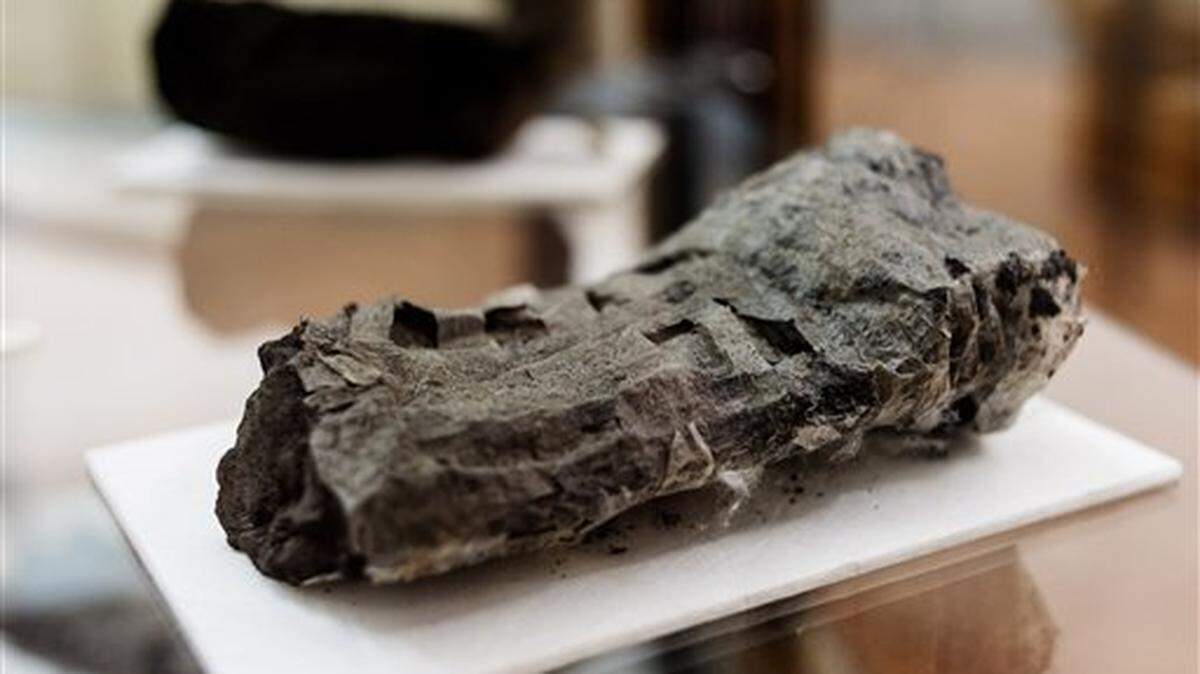
University of Kentucky computer scientists who have struggled to unlock the secrets of some 2,000-year-old Roman scrolls think a new technological breakthrough finally might provide the key.
The UK experts thought they had the problem licked in 2010. But the X-ray imaging system they used proved unable to "see" the ink that authors used to write on the scrolls. The fragile scrolls can't be unrolled manually for reading.
Now, Italian researchers working with UK have produced the first, faint images of writing inside the scrolls, using a new method called X-ray phase contrast tomography, according to a report Tuesday in the journal Nature Communications.
The efforts identified some individual handwritten letters inside one rolled-up scroll, and two complete words inside a fragment of another scroll that had been forced open long ago, the report said.
"It's very exciting that we now have a method that shows ink because it moves the whole process forward," said W. Brent Seales, chairman of UK's computer science department and head of the UK scrolls team. "But we still have a lot more work to do."
The UK team plans to join the Italian researchers this spring in a joint international effort to further refine the imaging system and produce even clearer digital pictures of writing from the scrolls, Seales said Tuesday.
Their three-year goal is to produce a full scan of at least one complete scroll that could be digitally "unrolled" on a computer screen for scholars to study. It might even be possible to identify the scroll's author, researchers said.
"That's what we're hoping for," Seales said. "Other than the software we're building, there is no other tool available for visualizing this material in this way."
The overall plan is to use phase-contrast X-rays to snap "pictures" of the interior of the scrolls. Then UK's computer software would produce digital images showing what's written inside the scrolls.
Pulling any kind of images from the scrolls seems miraculous.
The papyrus scrolls were stored in the library of a Roman statesman's villa in the city of Herculaneum, at the foot of Mount Vesuvius, when the volcano exploded in A.D. 79.
The eruption — one of history's most famous — buried Herculaneum and nearby Pompeii under tons of superheated volcanic ash, killing the people but preserving buildings and contents.
Well diggers stumbled upon the site of Herculaneum in 1709. About 50 years later, investigators uncovered the Roman villa, which contained hundreds of rolled-up papyrus scrolls, some more than 30 feet long. The scrolls survived the volcanic eruption, but the tremendous heat transformed them into fragile lumps of pure carbon.
"The papyri were completely covered in blazing-hot volcanic material," Vito Mocella, one of the project's leaders, told the Associated Press. Mocella is a theoretical scientist at the Institute of Microelectronics and Microsystems in Naples.
When scholars of the day tried to forcibly unroll the scrolls, they crumbled into fragments. Since then, experts have been trying to figure out a way to safely open and read them.
Seales and members of UK's EDUCE project — Enhanced Digital Unwrapping For Conservation and Exploration — became interested in the scrolls about 2005. The team already was known for producing digital copies of fragile, priceless manuscripts, including the oldest known complete text of Homer's Iliad. But the Roman scrolls were more difficult to decipher.
"I hoped we could knock them out in about three years' time," Seales said. "Obviously, that didn't happen. There was a challenge at every point in the process, including problems that nobody knew how to solve at the time."
Now, phase-contrast tomography could be an answer.
Developed over the past 20 years, the technique can discern writing within the rolled-up scrolls by detecting the ink that sits on the surface of the papyrus, according to Nature Communications report. Writing can be seen even though the ink rises only about 100 microns above the surface, the report states.
"Here for the first time, we show that X-ray phase-contrast tomography can reveal various letters hidden inside the precious papyri without unrolling them," the report says. "While our first experiments have revealed only small segments of writing and are in need of further refinement ... once the (phase contrast) technique has been tuned, the imaging of an entire papyrus scroll should not require more than a few hours."
Seales' European colleague, Daniel Delattre, is one of the report's authors.
Using phase-contrast imaging is a demanding process. It requires powerful X-rays that are produced only by large particle accelerators, which can boost subatomic particles to near light speed. UK's group and the Italian researchers plan to scan the scrolls this spring at the European Synchrotron Radiation Facility in Grenoble, France.
UK's sensitive computer software should allow researchers to quickly judge the quality of images they're getting and make adjustments if necessary. A six-member UK team is "hacking away on the software now," Seales said.
The National Science Foundation has provided a $500,000 grant to support the project. Google, where Seales was a visiting scientist in 2012-2013, also is providing support.
Seales cautioned, however, that getting a complete picture of a rolled-up scroll remains a challenge because lettering on the curved surfaces will be hard to distinguish. He said the Italian team was able to identify words on a scroll fragment that was already flattened.
"The problem of finding these surfaces in a completely rolled-up scroll remains a tough problem," he said.
Nevertheless, perfecting the approach could allow investigation and excavation of other ancient manuscripts, including additional scrolls experts think may be inside the library at Herculaneum, Seales said.
If additional scrolls exist, some might contain early Christian writings, Seales said.
"It's not a high probability, but it is possible, given the way Christianity was spread at that time," he said. "The dates all line up.
"With renewed discovery, who knows what could be found? That's one of the things that drive me."
This story was originally published January 20, 2015 at 5:54 PM with the headline "Breakthrough allows University of Kentucky software team to capture writing on ancient scrolls."