
Celebrating 150 years: University of Kentucky's path to prosperity was 'far from inevitable'
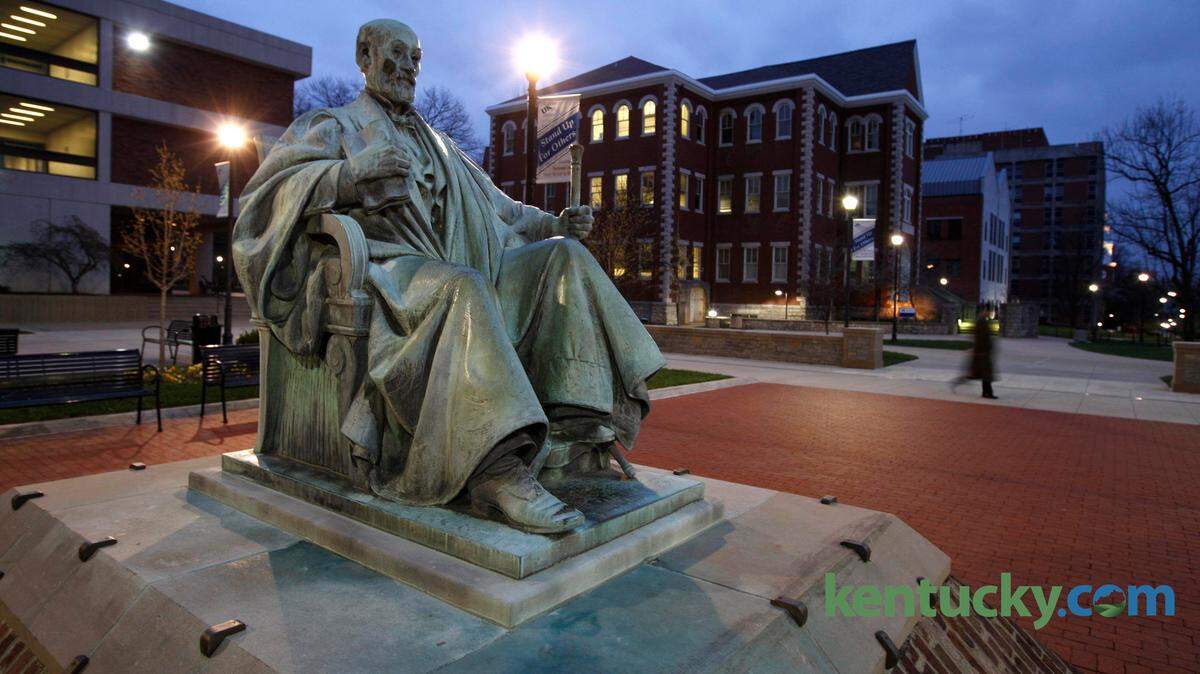
The University of Kentucky stretches over 800 acres of central Lexington, its buildings, its people and its programs touching nearly every aspect of the city and much of the commonwealth beyond.
Yet when UK dean of libraries Terry Birdwhistell thinks about UK's founding 150 years ago, he sees a precarious course, one that depended on luck, accidents and some visionary advocates.
"UK's founding and its evolution into a modern, internationally recognized research university and medical center was far from inevitable," Birdwhistell said. "Generations of Kentuckians, from 1865 to the present, worked tirelessly to build this remarkable university, and it is impossible to imagine this commonwealth without the University of Kentucky."
As UK embarks upon a year of sesquicentennial activities, Birdwhistell and others start with the Morrill Act of 1862, which first created "land grant" universities, and people such as John Bowman, who pushed the state legislature to take advantage of the federal largesse. The Morrill Act excluded Confederate states, and luckily, despite Kentucky's strong Southern sympathies, it remained part of the Union.
Bowman had started a school known as Kentucky University in Harrodsburg in 1858, which he later moved to Lexington in a merger with Transylvania University in Lexington. Kentucky University was affiliated with the Disciples of Christ Church.
The Morrill Act specifically added agriculture, mechanical and military schools. By 1865, the legislature established Kentucky University on what we now know as the Transylvania campus with its new Agriculture and Mechanical College. A year later, Bowman bought the Ashland Estate and nearby Woodlands Farm (today's Woodland Park) for the A&M campus, where it operated for 12 years.
"He (Bowman) was a very energetic and visionary person," said UK higher education historian John Thelin, "but I think his vision required a lot of collaboration with various political factions or it couldn't have come off."
By 1878, a rift between state lawmakers and the Disciples of Christ Church led to another split. Transylvania University was re-established as a private school on its downtown campus. Other cities, including Bowling Green, pushed to become the home of state-owned Kentucky University. But Lexington and Fayette County officials were determined to keep the school here and offered the city's old fairgrounds as a new campus for what became the State University of Kentucky.
By 1916, the University of Kentucky was officially renamed and established as the state's land-grant flagship university.
UK grew and grew, in buildings, programs, students and research. It now has more than 30,000 undergraduate and graduate students. Thanks to the agriculture extension service, UK reaches across the state, and true to its founding, agriculture and engineering remain some of its strongest programs. Today, it's one of only eight state universities with a full range of liberal arts, professional, agricultural and medical colleges on one campus.
Oh, and a pretty good basketball team.
Historian and UK alumnus James Klotter said some themes have remained constant: Athletics have always overshadowed academics, and it has always been underfunded by the state.
Klotter's research revealed that in 1904, the University of Wisconsin, one of the most successful land grant universities, received $471,000 in state funding. UK received $36,000.
A few years later, the University of Illinois received $1.1 million, while UK received $130,000. Today, state funding makes up less than 10 percent of UK's total budget. That might help explain why UK has never reached the national rankings to which it has always aspired, Klotter said.
"UK has had the strength of the will to achieve in some areas but never across the board," he said.
Today, UK has a devoted alumni following and a president who is determined to link UK's future to its past founding. President Eli Capilouto speaks about what he calls "the Kentucky Promise," the notion of UK's covenant with the people of Kentucky to improve their lives through education, research and service.
"To be sure, our complex, multifaceted work looks different today in many ways than it did in 1865; however, we remain anchored by our mission as Kentucky's flagship and land grant research university," Capilouto said. "Our sense of resolve and responsibility to those we touch and teach is without end and remains our compass — the soul of a University for Kentucky."
He and many others will be speaking about UK's 150 years throughout this year, but particularly during the upcoming Founders Week Activities, which include speeches, receptions, and even a blue tie ball to celebrate.
This story was originally published February 21, 2015 at 4:00 PM with the headline "Celebrating 150 years: University of Kentucky's path to prosperity was 'far from inevitable'."