
After 50 years at UK, professor who wrote much of Kentucky law and investigated UK athletics is retiring
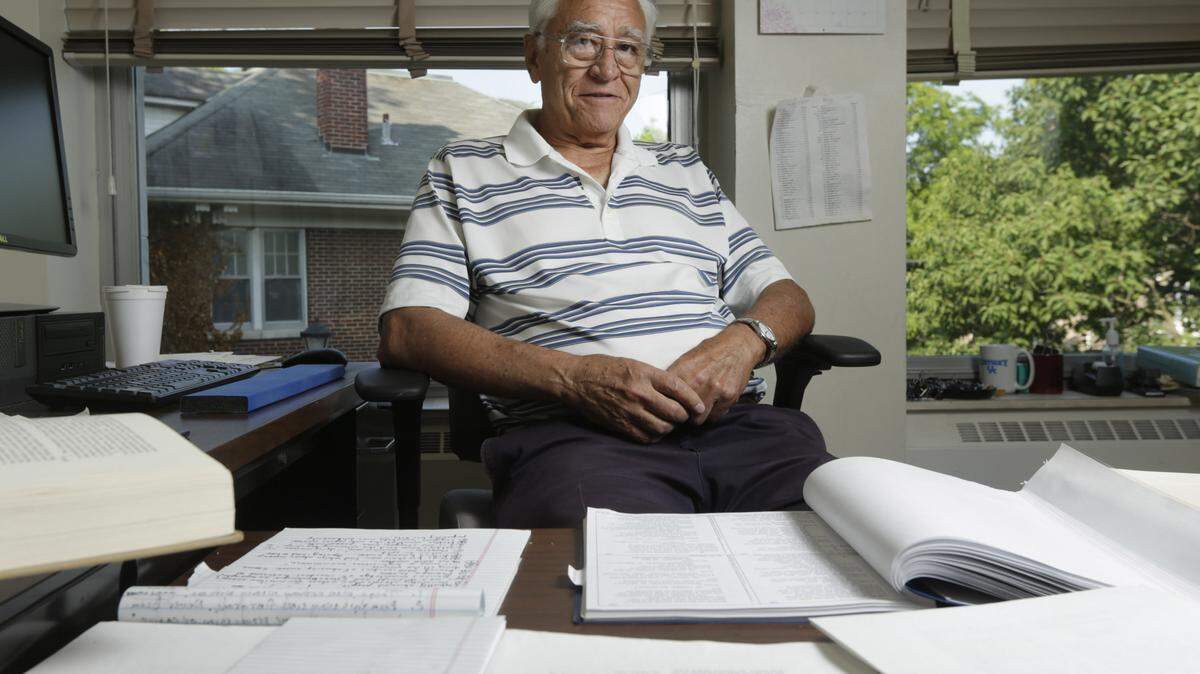
Robert Gene Lawson, who is retiring July 1, wrote much of Kentucky law and taught thousands of the people who practice it.
Lawson spent 50 years as a professor at the University of Kentucky College of Law, and he was dean twice. Among his students were U.S. Senate Majority Leader Mitch McConnell, Gov. Steve Beshear, U.S. Reps. Andy Barr and Ed Whitfield, and most of the Kentucky Supreme Court.
"It's been really interesting watching my students go on in life," Lawson, 76, said Friday, sitting in a cluttered campus office that showed no sign of getting packed up any time soon. "They've done important things and mostly have done them well."
Lawson built an equally large reputation for himself outside the classroom. He authored the state's penal code for criminal offenses and its rules of courtroom evidence. He harangued the General Assembly, with what he considers limited success, for packing the state's jails and prisons with the mentally ill and the addicted. He led investigations into ethics violations at the UK Athletics Department, which didn't win him many friends, and into the nightmarish Beverly Hills Supper Club fire in 1977 that killed 165 people in Northern Kentucky.
"He was Kentucky law," said Allison Connelly, a onetime Lawson student who later joined him on the law school faculty. "He has done so much, when you look at his lifetime of work, to make Kentucky a better place."
The son of a coal miner, Lawson was born in 1938 in a tiny Logan County, W.Va., community almost entirely owned by Island Creek Coal Co. His father urged him to escape the coal camp through an education. He worked his way through tuition-free Berea College and then earned a law degree at UK in 1963.
After two years of practicing law, which he enjoyed, Lawson accepted an invitation in 1965 to teach at UK.
"I never thought I'd stay here," he said. "I thought I'd try teaching for a little bit, see what it was like, and get back into my law practice. But it was a wonderful experience from day one — for one thing: being around all of these bright young people."
Lawson's specialty is Kentucky criminal law and evidence law. He wrote the books on those subjects, books that occupy the shelves of law libraries and judicial chambers. In the 1970s, he worked with the legislature to rewrite the state's penal code, which was hugely disorganized at the time.
"We had never reformed our criminal laws in Kentucky, so you had offenses that had been added one by one over a period of, what, 150 years, 180 years, and a lot of inconsistency in how these offenses were treated," he said.
To Lawson's frustration, within a decade of his penal code work, the national "war on drugs" and concern over urban violence led politicians in Kentucky and elsewhere to enact much tougher sentencing laws.
It's one thing to imprison a murderer for decades, but these new laws put even minor criminals behind bars for long stretches, Lawson said. For example: In dozens of Kentucky cases Lawson researched, people were convicted of the felony of "drug trafficking within 1,000 yards of a school" after police caught them with a small personal stash of drugs in their homes or cars several blocks from a school.
"Bob Lawson's philosophy was always, 'You lock up the people who genuinely scare you because they're dangerous, they're violent, and for the other people, you see if you can't rehabilitate them and make them productive members of society,'" said Fayette Family Court Judge Kathy Stein, a former chairwoman of the state House Judiciary Committee.
In 1974, the year Lawson's penal code changes took effect, Kentucky spent $11 million housing about 3,000 inmates at two prisons. This year, the state expects to spend about $500 million to keep about 22,000 inmates in 12 prisons and dozens of county jails that are paid to hold the state's felon spillover.
The General Assembly's effort four years ago to cut the inmate population — at Lawson's urging — has fallen short "because they aimed too low," he said. "They tinkered; they did too little."
Some county jails are so overcrowded that state inmates who are serving five to 10 years must sleep on the floor and seldom leave their cells, he said. There is little education or addiction treatment provided, so felons are no better off when they're finally released, and in many cases, they're probably harder than ever, he said.
"We got mad at the people who were committing criminal offenses, and we veered away from a philosophy of trying to correct them, which originally had been the thrust of our justice system," Lawson said. "We jacked up the penalties on everything. As a result, we've created this huge problem of trying to pay for all of this. We're just making things worse for ourselves than they were."
One of Lawson's other crusades over the years was trying to be a watchdog of UK's lucrative and popular sports programs. At the request of various UK presidents, he led investigations into possible ethics violations, including cases that brought about the departures of basketball coach Eddie Sutton in 1989 and athletics director Larry Ivy in 2002.
In 2002, as a member of the UK Athletics Administration's board of directors, Lawson cast the sole dissenting vote against hiring Mitch Barnhart as athletics director. Lawson said he didn't object to Barnhart, but the $375,000-a-year salary was "ridiculous" compared to the more modest sums paid to other UK faculty and staff. (Barnhart remains in the job and now makes $600,000 a year.)
Over the past 50 years, the UK Athletics Department evolved into its own universe with its own rules, Lawson said.
"They have become an independent entity, separate from the rest of the university, which is a problem," he said. "Their budget is their budget. The athletics department regards the money that comes in for athletics as their money, not the university's money.
"And I guess I have felt, watching it through the years, that they sort of lost what I would consider to be a reasonable connection of these students to the university as compared to athletics. Let me just give you an example. When I first came here, the basketball season was 20 games. It's now 40. I have my doubts about how they can be a legitimate college student when they've got that problem."
Lawson said he also regrets the explosion in tuition costs at UK and other state universities around the nation, largely because of shrinking public support from state governments. The next UK budget will get just 8 percent of its revenue from state appropriations, the smallest share ever.
"I think everyone who is 50 years old and older — including me — ought to be ashamed of themselves for what we're doing to our young people, making an education all but unaffordable," he said.
"When Mitch McConnell and Steve Beshear were in my classroom, I doubt they paid much more than $100 a semester for their tuition. They went to school almost without any cost, substantially free," Lawson said. "A resident law student next year will pay between $21,000 and $22,000 in tuition. You can't work your way through school at that level. I have students graduating with $100,000 or more in loan debts that will affect them for the rest of their lives. Shame on us."
This story was originally published June 15, 2015 at 2:14 PM with the headline "After 50 years at UK, professor who wrote much of Kentucky law and investigated UK athletics is retiring."