
5-foot oddity on Cape Cod beach ignites debate: What was it and what killed it?
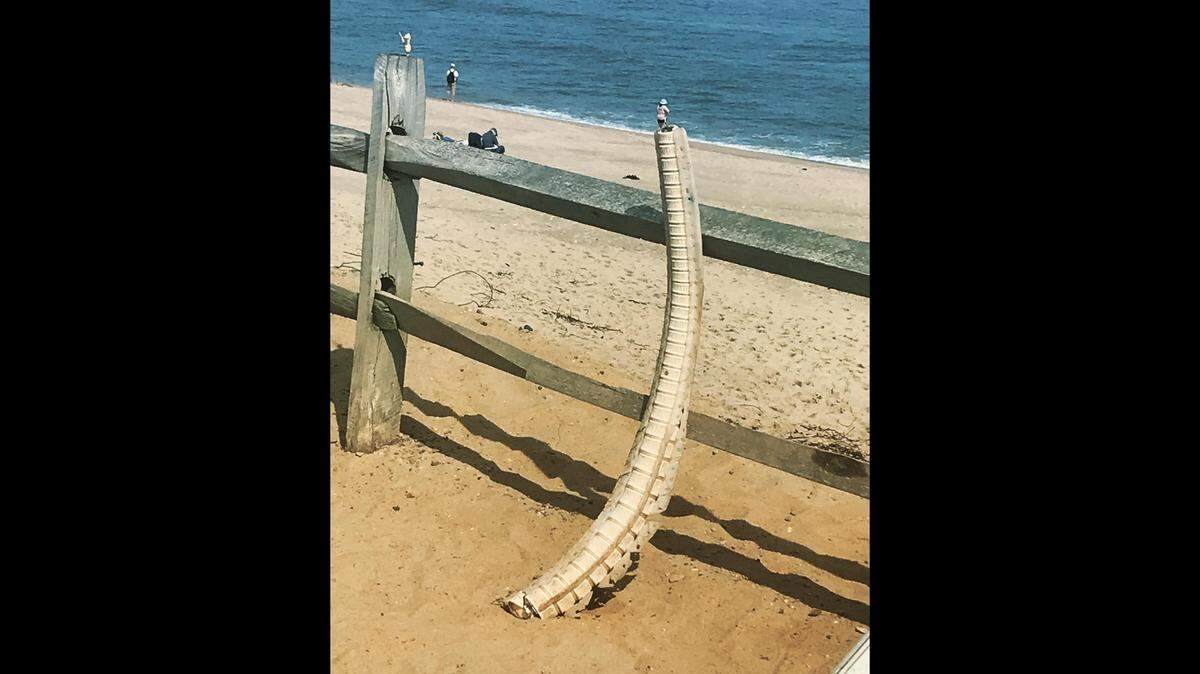
Something resembling a fossilized python turned up Thursday on a Cape Cod beach, mystifying lifeguards and prompting some uncomfortable questions.
Photos shared by Wellfleet Lifeguards on Facebook show the tube-like object was taller than a fence post, porous and ribbed.
It was found at Newcomb Hollow and the lifeguards have a theory that it was buried in the sand “for quite some time” and uncovered last week by storm surge.
They also have an idea as to what it might be, and that’s equally unnerving.
“Yesterday, our guards made an amazing find during their morning beach sweep: a full spine of a marine animal,” the lifeguards wrote.
“Upon further investigation ... and consultation with a few friends of ours (aka marine scientists) who know a thing or two about sharks, it’s likely this is the spinal column of a white shark, and a pretty large one at that.”
The idea some beachgoers were spreading their towels over a shark’s spine is unsettling. But the more pressing question is: What killed a really big great white shark and picked its spine clean like corn on the cob?
“Killed by Orca?” Mike Mahler asked on Facebook.
“Just the thought that something out there could kill a great white of this size makes me cringe!” Carriann Bennett Houde wrote.
“Are you going to need a bigger beach?” Gary Davis wrote.
Suzy Blake of the Wellfleet Lifeguards said the spine is 5 feet long and 3.5 inches in diameter, and the group is “working with local scientists and shark experts to give them any data or samples that they need” for research. After that, it will likely go home with the lifeguard who found it, she told McClatchy News.
“Sharks are occasionally beached,” Blake said. “We’ve had a few beach themselves in years past. So it’s possible this is from a previously beached shark that was then buried, skeleton preserved, and then it was uncovered years later.”
The Atlantic White Shark Conservancy shared the discovery on its Facebook page, noting: “Even with the presence of white sharks along the Cape Cod coastline, it is still a rare find to see a full vertebrate washed up on the beach.”
The conservancy did not offer ideas of how the shark might have died. But it did help settle an argument that has raged since photos of the spine were posted: Many people insisted it could not have been a shark because sharks don’t have bones.
Yes, that’s true, the conservancy said, but a shark’s spine is made of cartilage.
“Although primarily cartilage, shark backbones have high amounts of calcium, which allows them to preserve well,” Greg Skomal of the Massachusetts Division of Marine Fisheries told For The Win Outdoors.
This story was originally published September 28, 2020 at 7:04 PM with the headline "5-foot oddity on Cape Cod beach ignites debate: What was it and what killed it?."