‘Gigantic’ prehistoric creature discovered in Russian quarry is a new species
Prehistoric creatures came in all shapes and sizes, from the towering dinosaurs to the small mammals on the forest floor.
Many of these animals were preserved in rock formations upon their death, exposed only when their sediment layer is exposed to the surface once again.
This makes quarries the perfect place to find some of these ancient beings — and discover new species.
The Kosyakino quarry, located near Stavropol, Russia, became well known for its assemblage of ancient vertebrates after its discovery in 1938, according to a study published Sept. 14 in the peer-reviewed journal Doklady Biological Sciences.
The fossilized remains of birds, reptiles and amphibians have been chipped from the rock formation, which was closed as a quarry and instead kept as a natural monument in 1961, study author Alexey V. Lopatin wrote.
Animals found here lived during the Miocene, or a geological period around 5.5 to 6 million years ago, according to the study.
In 1938, the “remains of a large bear-like carnivore” were excavated and identified as a “hyena bear,” Lopatin wrote.
The specimen was kept in an academic collection for nearly a century before Lopatin took another look and noticed the jawbone had some interesting features.
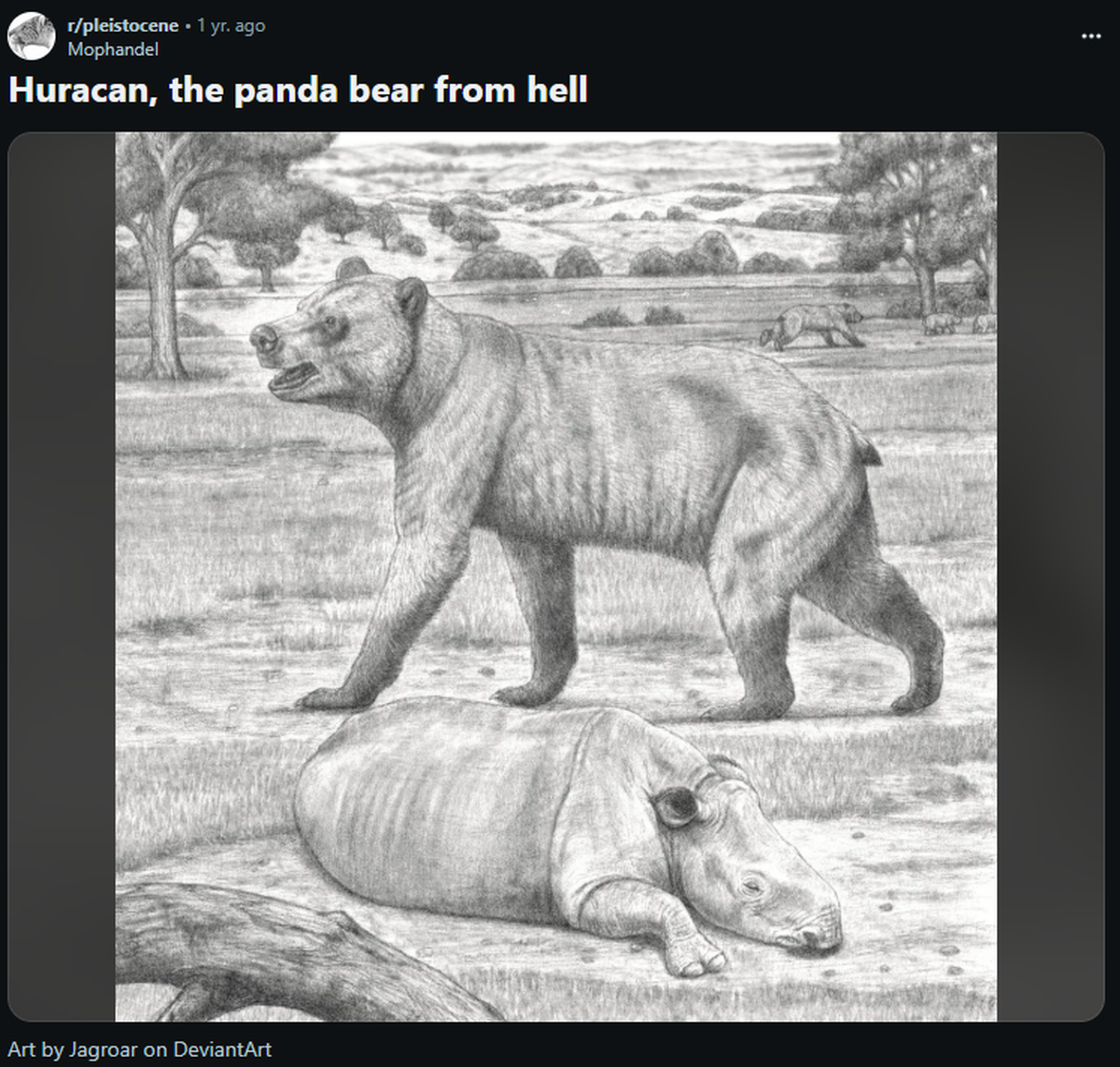
The fossil belonged to a new species — Huracan borissiaki, or a “gigantic bear.”
The remains consisted of a “fragmented mandible,” or jawbone, according to the study. It was “deep and robust,” and the teeth were “widely spaced, large and robust.”
The carnassial teeth, found in carnivores and used for tearing apart prey, were described as “large” and “massive,” sticking high from the jawbone, Lopatin wrote.
The new species was named Huracan borissiak to honor Russian paleontologist A.A. Borissiak, according to the study.
“In terms of the size of the mandible and lower teeth, the Kosyakino gigantic bear corresponds to average values of the parameters of the largest species of the genus Huracan, H. coffeyi, surpassing in this respect H. schneideri, as well as all species of Agriotherium and Indarctos,” Lopatin wrote.
The Huracan genus was first described in 2023 and is considered a larger, carnivorous ancestor of the giant panda, McClatchy News previously reported.

H. coffeyi was noted at the time for its particularly large size, and researchers said it was “probably the largest among all known bears, living and extinct.”
The new species was about the same size, Lopatin wrote, meaning it was one of the largest bears to ever exist.
The earliest known Huracan bear dates to the Late Miocene, or about 7 million years ago, and was found in China, according to the study. The other species have been found across the northern hemisphere.
“However, while Huracan bears persisted in North America until the Middle Pliocene, and in East Asia until the Early Pleistocene, they disappeared from Europe soon after their arrival in the terminal Miocene,” Lopatin wrote. “Apparently, (the new species), which inhabited the territory of the Ciscaucasia at the end of the Miocene (about 6-5.5 million years ago), was another representative of Huracan, that dispersed from Asia to Europe.”
Stavropol is in southwestern Russia, north of the border with Georgia and just north of the Caucasus Mountains.
This story was originally published September 19, 2025 at 12:40 PM with the headline "‘Gigantic’ prehistoric creature discovered in Russian quarry is a new species."