Matt Bevin says he’s out-hustling other states for jobs. What do the numbers show?
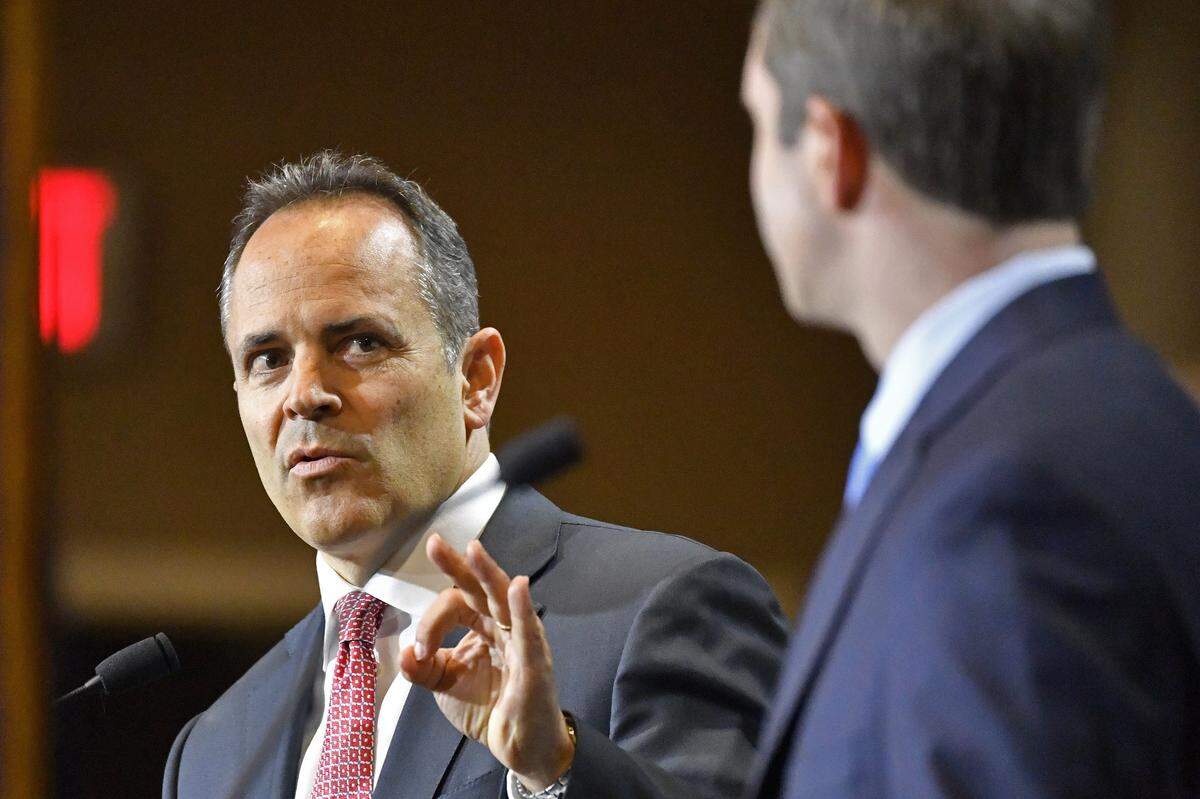
At the Kentucky League of Cities conference last month, Gov. Matt Bevin told a story about the former governor of Florida and the governor of Texas. The two men, at the time in charge of the fourth and second largest economies in the United States, were one-upping each other about the number of jobs they were adding in their states. As they went back and forth, Bevin said he butted in with an analogy.
“You guys are the two big dogs, you’re at the table, the roast beef is piled high, you’re chowing down,” Bevin said he told them. “You’re eating it so much that scraps are flying off the table, you don’t even care, you have all the roast beef. And I said but you know what? One day, you’re going to look down at the end of the table and there’s going to be another big dog sitting there, waiting to dig into the roast beef.”
Bevin then addressed the assembled crowd of city leaders.
“Right now, we’re a little dog,” Bevin said. “We’re under the table, we’re eating all the scraps, but you just wait. We’re going to be sitting there at the table.”
As Bevin battles for reelection against Democrat Andy Beshear, the Republican governor has painted his three and a half years in office as a crusade to revitalize Kentucky’s economy. In speeches across the country, he talks about his desire to make Kentucky the engineering and manufacturing hub of America. His administration joined with the Republican-led legislature to pass bills that weakened unions, provided economic development incentives to lure companies and began restructuring the tax code to appeal to businesses. Bevin says he’s out-hustling every other governor in the country in order to break records in capital investment in the state and lure new companies.
And the economy looks pretty good. During Bevin’s tenure, Kentucky has added jobs, the state’s median household income has grown faster than surrounding states and the unemployment rate has dropped to record lows, mimicking national trends.
Still, the state lags. Job growth has been anemic when compared to border states, the percentage of people participating in the work force is below all surrounding states but West Virginia, and the average wage ranks 45th in the nation. In addition, most of the economic growth has occurred in larger cities, leaving many rural communities to wither.
There’s also this often overlooked fact: Most of those numbers — good and bad — don’t have much to do with the governor.
“I believe that voters and the public tend to exaggerate how much impact the governor, or president for that matter, have on the economy,” said Timothy Bartik, a senior economist at the Upjohn Institute for employment research.
It will likely take years before we see the effects, if any, that Bevin and the GOP-led legislature have had on the economy. But it is an election year, so every good economic development announcement gets splashed onto a press release by Republicans while all shortcomings get painted with a target for Democrats.
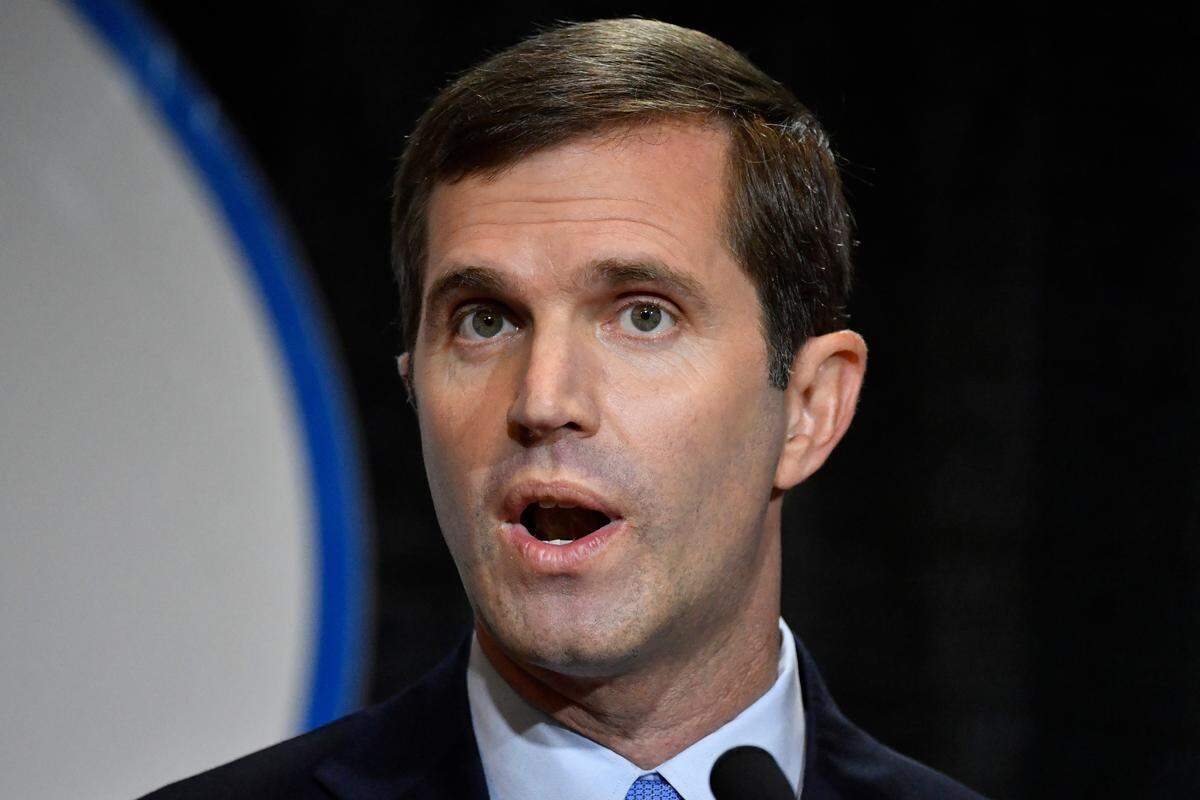
For example, when the moderator of a debate earlier this month in Paducah between Bevin and Beshear mentioned that Briggs and Stratton, a company that makes small engines, was leaving Kentucky and taking 600 jobs with them, Beshear pounced.
“He’s running commercials and running around the state saying that everything is great in the economy and the question even said this area has significant loss,” Beshear said.
At the Kentucky League of Cities conference in Covington, Bevin acknowledged that Kentucky must do more.
“We are outperforming those around us,” Bevin said. “But I will tell you what, it’s not good enough. We need to not just put the seeds in the ground, we need to cultivate, fertilize, water, wait, these things will come in time, but I’m telling you Kentucky for the first time in a long time is leading this nation on a lot of fronts that are good.”
The numbers
Bevin’s best selling point on the campaign trail is the economy. He says there are now more people working in Kentucky than ever before. In terms of raw numbers, that’s true.
The number of non-farm jobs in Kentucky grew by 49,600 from December 2015 to August 2019, reaching 1,951,800 jobs, according to the Bureau of Labor Statistics. Still, population growth means a smaller percentage of Kentuckians are working today (59.1%) than in January 2007 (62.7%), just before the Great Recession, according to the Federal Reserve.
Kentucky’s job growth also isn’t keeping pace with surrounding states.
The 2.61% increase in jobs during Bevin’s tenure was better than only two of Kentucky’s border states: West Virginia and Ohio. Kentucky’s growth was dwarfed by two states Bevin often uses as a comparison: Tennessee (6.3%) and Indiana (3.43%). Nationally, the number of jobs increased by 5.91%.
Beshear has pushed back on Bevin’s job numbers by saying wages are growing too slowly in Kentucky, a critique that has been made at the national level in a top heavy economy — richer people have seen faster growth.
Despite those claims, Kentucky’s median household income (which measures the incomes of people in a household over the age of 15) has grown during Bevin’s tenure at a rate faster than surrounding states. When the 2015 median household wage is adjusted for inflation to 2018 dollars, the median household wage in Kentucky has increased 4.9%, from $47,903 in 2015 to $50,247 in 2018. This is the largest increase of any surrounding state and the 19th largest increase in the nation.
At the same time, Kentucky’s average wage in 2018 was still the 45th lowest in the nation, including Washington D.C. The state also had a higher number of people in poverty in 2018 (16.9%) than every surrounding state except West Virginia, even though the poverty rate has decreased 1.4 percentage points under Bevin.
The mixed numbers reflect a disjointed economic recovery that has disproportionately benefited urban areas. About 82% of the new jobs in Kentucky between June 2017 and June 2018 were in the Lexington and Louisville metro areas, according to a talk Ted Abernathy, an economic development policy adviser, gave to the Kentucky Chamber of Commerce in 2018.
That matches national trends. Urban counties have seen more job growth as rural counties have struggled since 2013, according to the Brookings Institution.
Former Gov. Paul Patton, a Democrat who lives in Pikeville, said Bevin hasn’t delivered for Eastern Kentucky. In 2017, nine of the 30 poorest counties in the country were located in Appalachian Kentucky. Patton said the coal industry’s decline and a lack of available flat land for new industries is largely to blame.
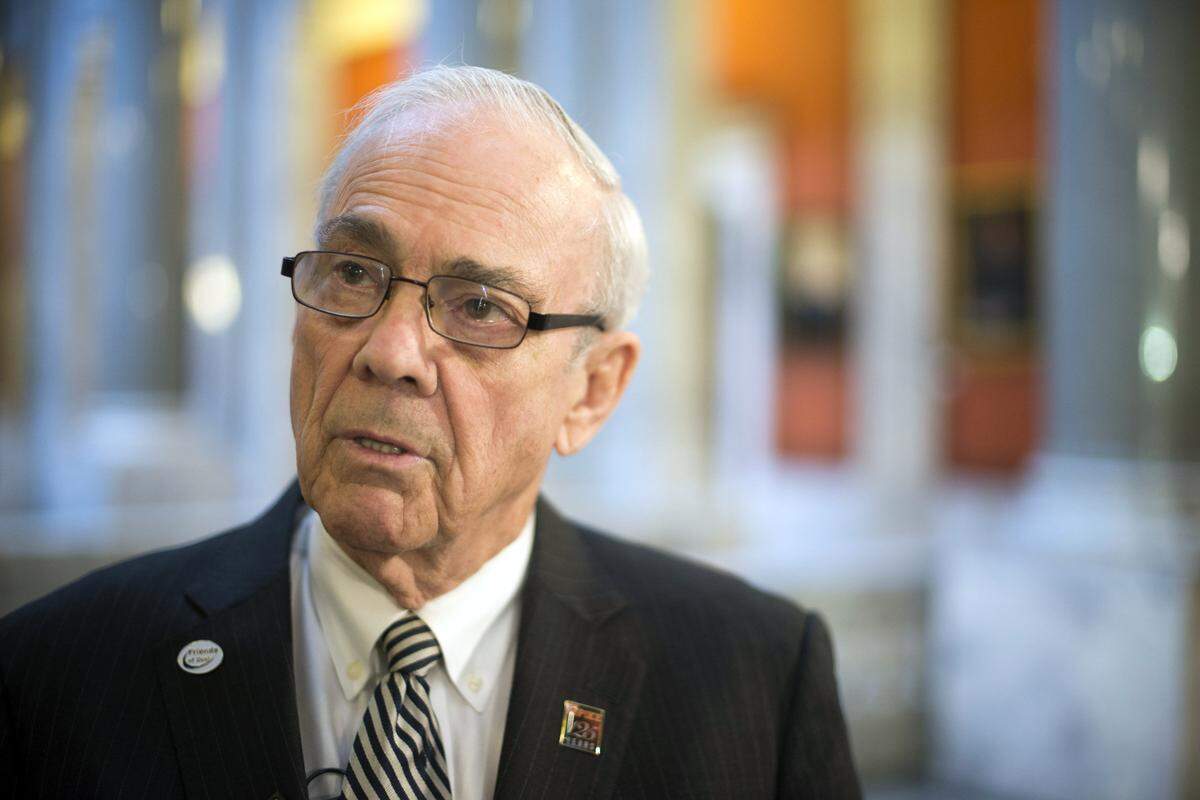
“He’s exaggerated his impact on economic development,” Patton said. “He’s claiming some numbers, but certainly in Eastern Kentucky they haven’t materialized.”
Bevin often talks about how Kentucky’s unemployment rate hit record lows during his administration — 3.5% in November 2018, and it’s currently 4.3%. The unemployment rate, though, does not count people who have given up looking for work.
Kentucky’s labor force participation rate has improved by 2.25% under Bevin, but the August 2019 rate was still below the national rate and all surrounding states except West Virginia.
“Labor force participation rate is an important indicator because it tells us how we compare to other states,” said Michael Clark, the associate director of the center for business and economic research at the University of Kentucky. “It could be related to education, disability, training... a lot of different things can play into how we are different from the country.”
Bevin has acknowledged that Kentucky’s economy still doesn’t compare well to Indiana and Tennessee, but puts the blame on past Democratic governors.
“We now have 4.5 million people. Both those states are 6.5 to 7 million people each,” Bevin said. “How is that? Better policies. Not chasing after things that glitter but are not gold. Not chasing after the false promise, not kicking of the can. They’ve done enough of that themselves, they’ve done less of it than us, now they’re 10-15 years ahead of us.”
Bevin’s impact
With Bevin in the governor’s office, the House of Representative flipped from a Democratic majority to a Republican majority in 2016 for the first time in nearly 100 years. This laid the groundwork for a bevy of conservative legislation as Kentucky Republicans rushed to enact policies to match other conservative-controlled states.
He credits those changes for opening the floodgates of economic development, touting that his administration has attracted companies that have pledged to create more than 57,000 jobs and invest more than $20 billion.
Economists, though, are skeptical of claims that the GOP agenda had an immediate impact on job growth.
That is driven by the national economy, said Michael Clark, associate director of the Center for Business and Economic Research at the University of Kentucky.
“A large portion is due to national and global trends,” he said. “If they go up, we go up as well. If they go into a recession, then we would as well.”
Many economists also don’t think highly of the tax breaks Kentucky and other states lavish on companies looking to relocate or expand.
For example, Bevin teamed up with lawmakers to invest $15 million of the state’s money into Braidy Industries, a proposed aluminum mill in Ashland. The investment passed the legislature in 2017, but the company still doesn’t have enough investors to deliver on their promise.
Bartik, the economist who focuses on employment research, said most incentives to lure companies to a state aren’t worth the cost. He said an incentive policy at most induces about 25% of the jobs in an economy and that often those companies, or another company, would locate to the place regardless of the incentive.
“In general, when you do a serious fiscal analysis of incentives, they do not pay for themselves,” Bartik said.
In 2018, Kentucky forfeited at least $181.7 million in tax revenue through its economic development incentive programs, according to Good Jobs First, an advocacy group that tracks corporate subsidies.
Even the state’s overall tax structure, something Bevin has said he’d like to see shifted toward a higher sales tax and lower income tax, doesn’t impact a company’s location decision as much as the area’s overall quality of life, including access to quality education and entertainment options, according to Bartik.
“In the long term, what’s going to affect the economy is industry mix, what’s happening at the national level and past policy,” Bartik said.
Education policy is viewed as being particularly important over time.
Bevin has talked frequently about the need to build a reliable workforce in the midst of an opioid epidemic that has left some employers scrambling for dependable workers. In particular, he’s emphasized job-specific skills training as an alternative to four-year college degrees.
In 2017, he redirected money away from a program intended to make community college free for Kentuckians, instead creating a scholarship for students seeking certificates in health care, advanced manufacturing, construction, transportation and logistics, and information technology. He’s also moved colleges and universities toward a performance-based funding model, which emphasizes the number of students graduating with degrees in science, technology, engineering and math.
By pushing the focus to those areas, Bevin is hoping to develop a workforce available to industries that are currently in search of employees.
“It’s about rethinking the way in which we meet the workforce where it is,” Bevin said. “We keep lying to people about how a four-year degree is going to be the ticket to all your desires in life, because increasingly that isn’t necessarily true.”
But some of Bevin’s changes have been criticized sharply by the education community, exacerbated by the fact that Kentucky cut funding for higher education by 26.4% between 2008 and 2017, according to the Center for Budget and Policy Priorities, a liberal-leaning think tank in Washington D.C. That funding drop is one of the largest in the country and is unlikely to get better as the state faces a tight budget.
Beshear has said he hopes to provide more funding for higher education and further limit how much universities could raise tuition. He said he doesn’t agree with the governor that funding should be tied to training people specifically for the industries that currently need workers.
“Neither of us has room to make that argument,” Beshear said. “He was an East Asian studies major and I was a political science and anthropology double major and one of the two of us is going to be the next governor. We have got to understand that higher education is about developing your mind and your potential. It’s learning how to think and learning how to problem solve.”
This story was originally published October 29, 2019 at 9:35 AM.