‘Very difficult situation.’ Beshear promised teacher pay raises, but can he deliver?
During his gubernatorial campaign, Andy Beshear promised to give every Kentucky public school teacher a $2,000 pay raise once he was elected. Asked if that was realistic, Beshear confidently told reporters, “Watch me.”
Now, preparing to take office Tuesday, the new Democratic governor must face some dismal facts. State budget officials expect Kentucky to collect $422 million in additional revenue over the next two years, falling far short of its estimated $1.8 billion in new spending obligations, such as pension contributions, state prisoners, Medicaid and public employee and retiree health insurance.
Fiscally speaking, Beshear is getting one bucket of paint to cover the interior of Rupp Arena.
“It’s a very difficult situation, there’s no question,” said Crit Luallen, the former lieutenant governor and state auditor who is preparing a comprehensive budget report for Beshear as a leader on his transition team.
“I don’t envy him the decisions he’s going to have to make,” Luallen said. “He’ll have to analyze all of these numbers and determine what his best options are for either cutting costs or raising revenue or both. And he’ll have to find common ground with a Republican legislature as he approaches this.”
GOP lawmakers say they aren’t inclined to deliver Beshear a major source of new revenue like casino gambling to relieve the pressure, although they might be open to one or two small adjustments, such as another tobacco tax hike or a tax on e-cigarettes. In 2018, the legislature approved a 50-cent tax increase on every pack of cigarettes that has yielded about $140 million in fresh income a year.
However, that gain was largely negated by a batch of tax relief bills the legislature passed last winter for banks, corporations and others. Overall, Kentucky forfeits about $8 billion a year in potential revenue under its complex web of tax breaks.
Budgets long have been a problem for Kentucky, a poor state that expects more from government than it wants to contribute.
A recent report from Moody’s Analytics warned that Kentucky — unlike most states — has too little money saved in a “rainy day” reserve fund that it will need to weather the inevitable next economic recession. State leaders keep raiding that fund in order to balance the budget, as they do other critical funds, including one meant to provide state employees with health insurance.
Eroding state government
State government should learn how to stick to a budget just as individual Kentuckians do, said Kentucky House Appropriations and Revenue Committee Chairman Steven Rudy, R-Paducah.

“There are always going to be people telling us we need to have more money. And in the minds of the taxpayer, the question is, ‘In what areas are we paying taxes now that we think we should be paying more?’” Rudy said. “We have an $11 billion General Fund for 4.3 million Kentuckians. If we can’t live within that, then that’s something we need to be talking about.”
Others say waves of budget cuts over the last 12 years have eroded the ability of state government to serve citizens. The number of employees in the executive branch has plunged 30 percent since 2007, from 47,917 to 33,696, and for many of those remaining, wages are stagnant and benefits like health insurance and retirement packages are less attractive than they once were.
In recent months, lawmakers in Frankfort have heard testimony about state social workers quitting faster than they can be replaced, endangering families. One district office at the Kentucky Transportation Cabinet has lost nine engineers in the last five years, and as a result, an engineer-in-training with only eight months of experience has been left to run a $60 million project, lawmakers were told.
“You see the impact of this when you look at how badly we’ve bungled our response to compliance with the federal Real ID Act on driver’s licenses,” said David Smith, executive director of the Kentucky Association of State Employees.
“You see social workers who have so many cases, they can’t begin to investigate all of the allegations of harm to kids that they’re assigned,” Smith said. “You see how many parts of Kentucky where we can’t provide people with clean drinking water. These are real, everyday impacts. But when we try to make the case for additional revenue, it’s like we’re talking to a wall.”
Pay raises possible?
A deadline is fast approaching. By law, Beshear must submit a two-year, $23 billion state budget proposal to the General Assembly no later than Jan. 28. Last month, state agencies gave fat binders containing their funding requests to Beshear’s transition team.
The requests are ambitious.
For example, the Kentucky Department of Education is asking for more than $460 million a year in additional funding, for textbooks (which are not covered by the current state budget); for full-day kindergarten (also not presently funded); for more per-pupil spending in classrooms across the state (the current spending rate has been declining on an inflation-adjusted basis); and for more assistance with transportation and construction costs for local school districts, among other items.
Lawmakers also will feel pressure to fund their School Safety and Resiliency Act, passed last winter as Senate Bill 1, although without any money attached, in response to campus shootings. The state budget office lists it as a spending obligation. The Kentucky School Boards Association estimates the costs at about $18 million to improve physical safety features at schools and $121 million a year to hire the required counselors and safety officers.
Apart from all of that, Beshear pledged as a candidate to raise every teacher’s pay by $2,000. He said this was a gesture of respect for educators insulted and belittled for four years by outgoing Gov. Matt Bevin, a Republican whom he defeated.
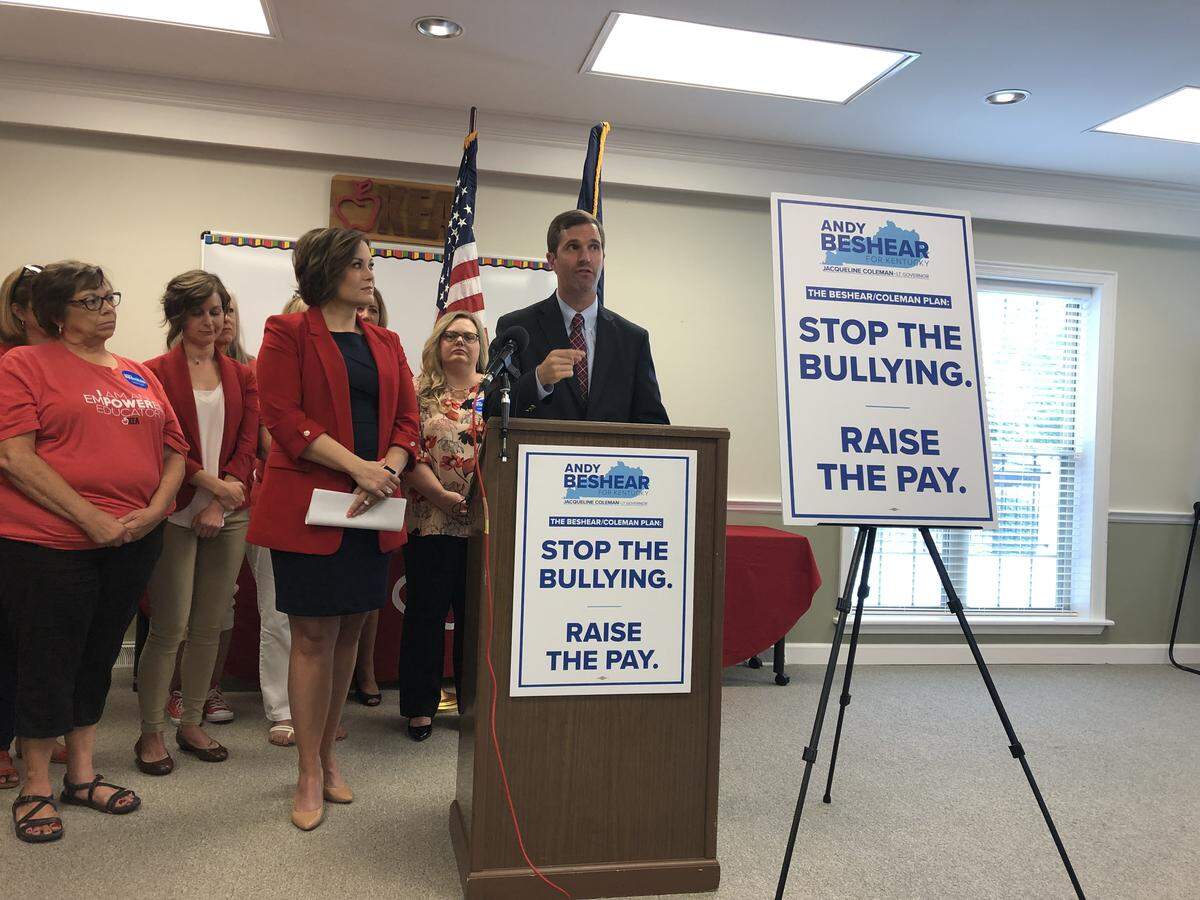
“After all of the bullying, this boost will immediately help our economy, especially in rural Kentucky where public education is typically the largest single employer,” Beshear said in September, surrounded by Kentucky Education Association members.
But finding the cash necessary for teacher pay raises will be hard with so many competing hands sticking out. Beshear estimates the cost of those pay raises at $84 million a year. The state budget office puts it at $97 million, including pay-related benefits.
At the same time, some state government employees have gone a decade without a salary increase. They want raises, too. A proposed cost-of-living adjustment for state workers would boost their paychecks by 2 percent a year at an estimated cost of about $25 million.
Unbalanced budget
Kentucky has a structurally unbalanced budget. It collects less money than it spends. Over the long run, that habit helped it rack up a $30 billion pension debt for state workers and teachers that’s now squeezing everything else.
This fiscal year, which ends June 30, is projected to have a $118 million funding shortfall underway. So Beshear faces the likelihood of making more cuts to government in his first few months.
Looking ahead, the state only expects about $200 million annually in new income during fiscal years 2021 and 2022, which is not quite half the revenue growth rate that Kentucky has seen on average since 2010.
In a memo this week, the state budget office identified at least $1.8 billion — and quite possibly more — in new spending obligations for Kentucky over the next two fiscal years, such as larger state contributions that will be required for the public pension systems as well as the Medicaid program that provides health insurance for 1.3 million low-income Kentuckians.
Those obligations seem to be legally non-negotiable. Throw in new spending that has only been proposed as desirable, such as teacher pay raises and greater school and university funding, and that adds an additional $1 billion in costs, the state budget office said.
“Obviously, not all of those things are going to get done, are they?” said Pam Thomas, a former state legislative budget aide who now studies state spending and taxation for the Kentucky Center for Economic Policy in Berea.
“You look at these numbers and you quickly realize that we don’t have enough revenue to cover all of the things we need to keep going in a continuation budget, much less to try to add any of the new services and projects that people want,” Thomas said.
Thomas said Kentucky needs to collect more revenue from different sources, such as the thousands of “instant racing” gambling machines being installed at horse racetracks around the state. From 2018 to 2019, the amount bet on the machines increased by 80 percent, or just over $900 million, she said.
Kentucky taxes this newly established form of gambling at a low rate compared to how it taxes live horse racing or how other states tax slot machines, she said. This is just one of many examples of how Kentucky squanders potential revenue, she said.
“There are really pressing needs everywhere,” Thomas said. “Our state agencies have been limping along for years, trying to serve the people on less and less, but I think they are reaching the end of their ability to keep doing that.”
New expenses
Some of Kentucky’s additional state spending obligations that are estimated for fiscal years 2021-22:
Medicaid: $603 million
Prisons: $63 million
Pensions: $169 million
Retired teachers health insurance: $167 million
Kentucky Wired debt service: $14 million
Kentucky Employees’ Health Insurance Plan: $650 million
School Safety and Resiliency Act (Senate Bill 1): $18 million initially, $121 million annually
Sources: State budget office, Kentucky School Boards Association
This story was originally published December 6, 2019 at 2:57 PM.