Kentucky is burning through its unemployment funds. What happens if they run out?
Kentucky’s unemployment insurance trust fund, which started the year as one of the nation’s least solvent, is burning through many tens of millions of dollars as a record number of people turn to it for help during the COVID-19 pandemic. The trust fund’s balance plunged by nearly 25 percent just in the two-week period between March 31 and April 16.
If the fund runs dry, Kentucky will have to borrow from the federal government, as it did in the 2008-09 recession, when it took out $961 million in loans.
“Clearly, the federal government needs to be doing more to help the states. Congress needs to step up here because we are going to be seeing huge loans across most or all of the states to keep the unemployment programs going, and we’re not going to want a cut in benefits down the road in order to repay them,” said Jason Bailey, executive director of the Kentucky Center for Economic Policy.
The Kentucky Education and Workforce Development Cabinet, which runs the trust fund, declined to answer several questions from the Herald-Leader on Friday about the trust fund’s financial condition.
Speaking generally in a written statement, cabinet spokesman JT Henderson said federal money allocated by Congress as part of the coronavirus relief package will help relieve pressure on the trust fund.
“Our number one priority during these unprecedented times remains ensuring every eligible Kentuckian receives the benefits they deserve,” Henderson wrote. “Priority 1A for the Cabinet of Education and Workforce Development is the health of the unemployment insurance trust fund. The trust fund is healthy and, as always, we continue to monitor it closely.”
Roughly one-fourth of Kentucky’s civilian workforce has filed for unemployment since March, when the arrival of the novel coronavirus pandemic led state leaders to order most businesses and government offices closed, throwing nearly 500,000 people out of work.
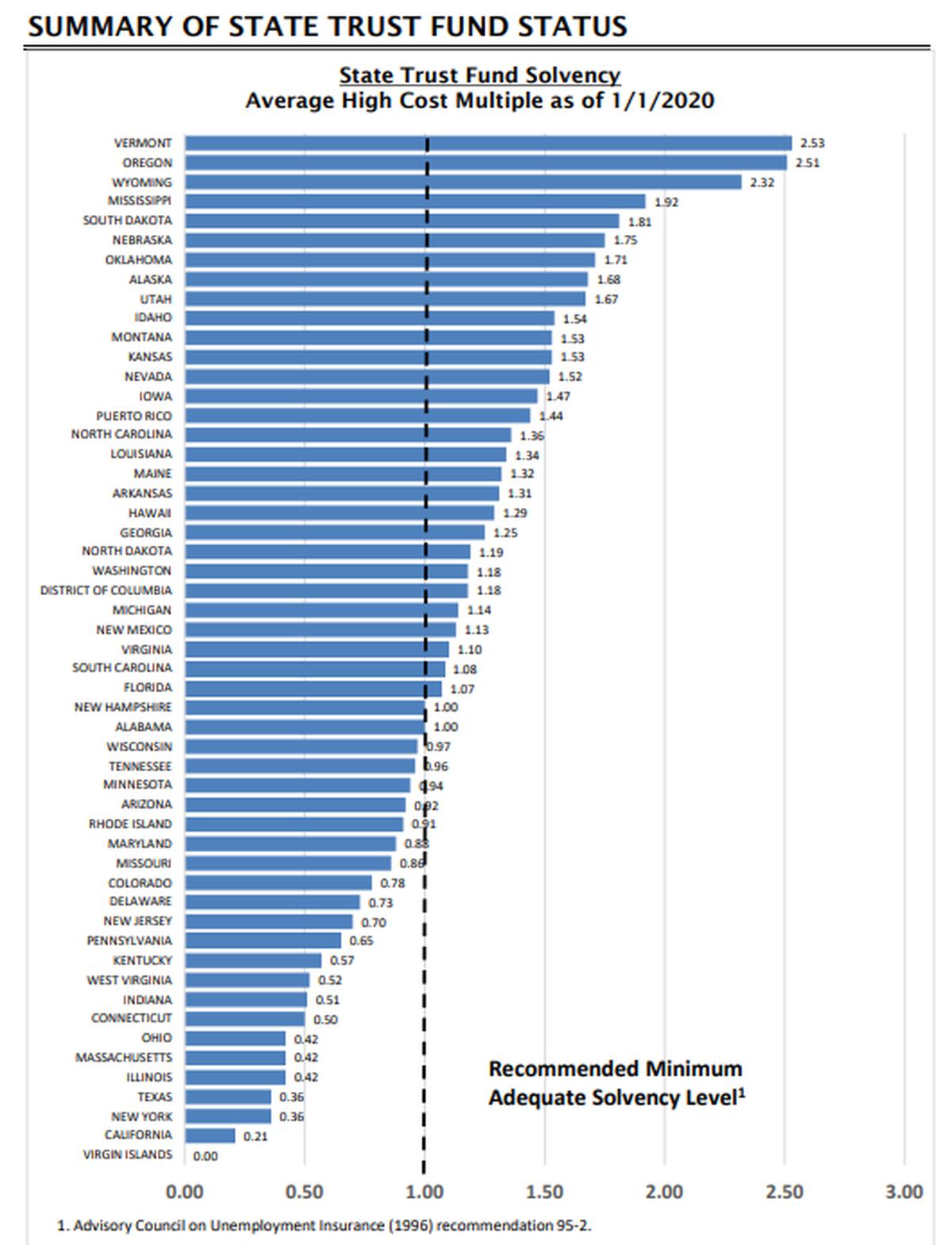
Kentucky began 2020 with $618 million in its unemployment insurance trust fund, ranking it among the 10 worst-funded states, according to a report issued in February by the U.S. Department of Labor. Altogether, 21 states and the Virgin Islands fell below the recommended adequate minimum solvency level, including Kentucky, the report stated.
As hundreds of thousands of Kentuckians have filed for jobless benefits during the pandemic, the trust fund quickly is draining, hitting $557 million on March 31 and $426 million on April 16. And that’s even with the U.S. Labor Department assisting with expanded benefits, such as coverage for part-time and self-employed workers who ordinarily would not be eligible for unemployment insurance.
The unemployment insurance trust fund is supported by a tax on Kentucky employers. In 2018, the most recent year for which data is publicly available, roughly 94,000 of the state’s employers contributed a total of $381 million.
The General Assembly has argued in recent years over ways to shore up the trust fund, with business groups backing less generous jobless benefits while labor unions and other groups argued that too many unemployed Kentuckians already did not qualify for much, if any, aid.
State Rep. Russell Webber, R-Shepherdsville, sponsored an unemployment insurance bill in 2019 that did not pass. On Friday, Webber said his bill would have given applicants larger benefits up front while shortening the payments period, allowing more money to build up in the trust fund.
“It made sense at the time because most people were not on unemployment insurance for the entire benefit period, said Webber, chairman of the House Economic Development and Workforce Investment Committee. “Of course, the circumstances are different today, and the fund could run out of money if the federal government does not intervene.”
If its trust fund is depleted, Kentucky will have to repeat what it did during the 2008-09 recession — when the state’s unemployment rate hit 10.9 percent, less than half what it is today — and borrow money from the federal government.
For the last recession, Kentucky didn’t finish repaying the federal loan package that totaled $972 million until 2015. That debt led state leaders to cut jobless benefits and raise the unemployment tax on employers for the next six years.
“That’s my concern this time,” said Bailey, of the Kentucky Center for Economic Policy. “I’m not worried about spending down the trust fund. That’s what it’s there for. We have it to get us through recessions like this one. My concern is, what happens down the road once we’ve taken out these loans? How do we go about paying them back?”
The current round of jobless benefits is scheduled to last for 26 weeks, covering Kentuckians into September. However, even if the state’s economy is allowed to slowly revive this summer, some employers — including some restaurants, bars and retail stores — likely have suffered irrevocable damage during the shutdown and will not reopen, Bailey said.
“Some places might be gone for good,” Bailey said. “We don’t know what kind of economy we’re going to have later this year and next year. We need to be prepared for sub-optimal employment for some time to come even after things open back up, so I would not be in favor of anything that involves a reduction in benefits down the road.”