Kentucky still loves Trump. What that means for McGrath’s chances against McConnell.
On a Sunday in July, in the middle of the COVID-19 pandemic, most of the stores in downtown Cadiz were closed. The painted pigs, spread along Main Street, weren’t blocked by any parked cars.
But there was at least one place people could shop — a pop-up tent full of shirts and hats and signs supporting President Donald Trump, the same flags you could find flying on some of the boats on Lake Barkley, the same hats and shirts worn by some of the people who spent their day fishing at Lake Barkley State Resort Park.
Scott Lasley, a political science professor at Western Kentucky University and the former chairman of the Warren County Republican Party, said he’s noticed these pop-up stands in Warren County, too.
“They weren’t here in 2016,” Lasley said, when Trump won Kentucky by 30 percentage points, one of his largest margins in the country.
Four years later, Trump’s presidency has been marked by contentious Supreme Court nominations, alt-right rallies, a trade war, a humanitarian crisis at the border, impeachment, potential war with Iran, a global pandemic and a reckoning over racism in America.
While his tumultuous tenure in the White House has caused Trump’s approval ratings to slip nationally, a 2020 Trump victory in Kentucky has never really been in question. He leads former Vice President Joe Biden in polling in Kentucky anywhere from between 10 percentage points to 24 percentage points.
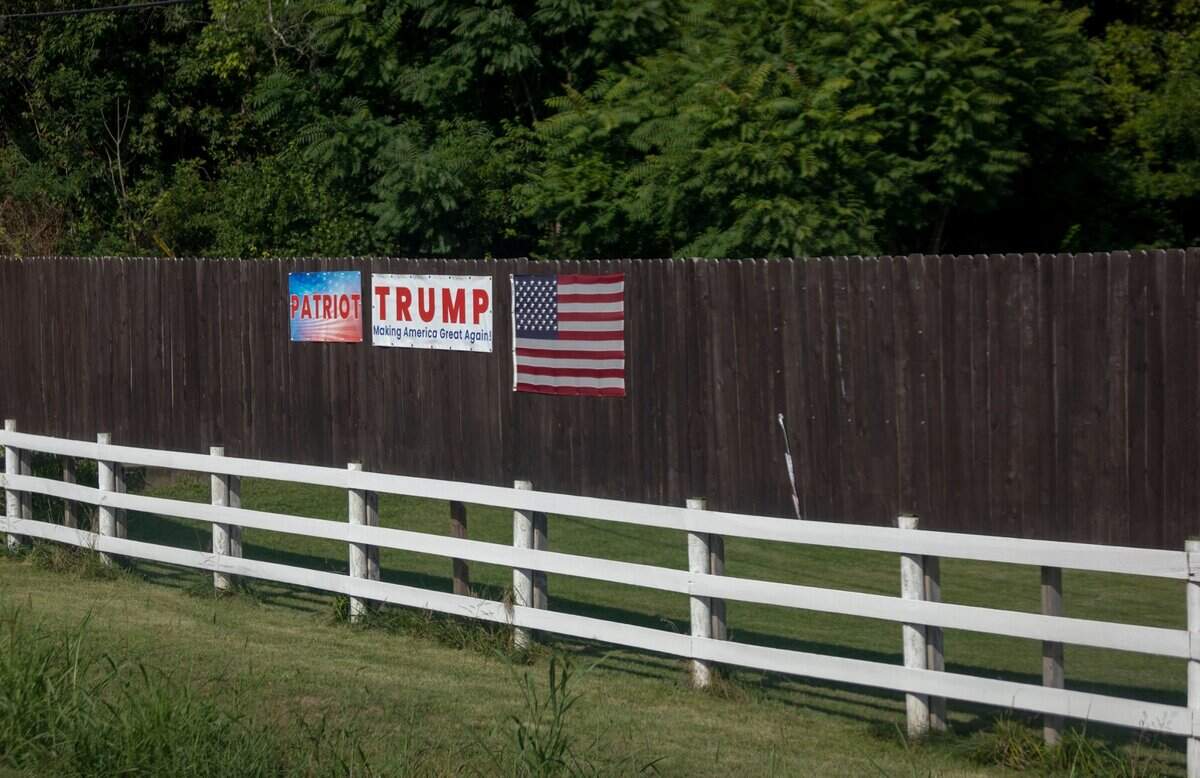
“I think it’s just our demographics, I think it’s the way we are,” said Phyllis Sparks, a magistrate in Boone County, who said all the allegations against Trump have proven to be a hoax or fraud. “We stick with our Republicans. I think other parts of the country tend to be more moderate and wavering.”
Support for Trump — a popularity that stretches beyond bumper stickers on the back of a pickup truck and into personal identity in a rapidly changing world — is one of the biggest obstacles for former Marine Corps Pilot Amy McGrath as she attempts to unseat U.S. Senate Majority Leader Mitch McConnell.
Every Democratic politico in Kentucky talks about McConnell’s unpopularity in Kentucky — as Senate Majority Leader he’s a magnet for both publicity and blame — but in an election year where Trump is at the top of the ticket it might not matter how much or little Republicans like McConnell.
“Any Republican running would want to latch on to the president’s coattails,” Sparks said. “It’s the smart thing to do.”
Onboard the Trump Train
Ernest Lawrence, the Republican Party Chairman in Trigg County, has a relatively straightforward take on all the talk about Trump.
“I would say leave Trump alone,” Lawrence said. “He’s done a good job.”
It’s a sentiment shared by many Kentucky Republicans. As Kentucky has shifted to the right — a shift accelerated in part by Trump’s election in 2016, which helped flip the Kentucky House of Representatives — the polarization between the two political parties has helped solidify Trump’s support, especially in rural Kentucky.
“There is a view that the Democratic Party has left behind this part of the country,” said Tres Watson, a Republican political consultant. “People simply don’t like Democrats in many parts of the state.”
That feeling may persist more in rural Kentucky — the places where people have felt left behind as the coal industry has declined and manufacturing plants have moved out of state.
David Jones, chairman of the Graves County Republican Party, said he’s been thinking about the protests that have swept through the country, even coming to nearby Murray. He said learning that a Black woman he works with fears for the men in her life when they’re driving home has stayed with him. He said he’s always considered himself southern, not confederate.
But he also said the issues at the heart of the Black Lives Matter movement “stem from large God-less cities.”
“When you take God out of the picture, people can be racists,” Jones said. “Out where I live, we don’t have those problems.”
Jones is a Christian, part of a demographic that Trump has courted, the way Republicans have made conservative cultural issues a bedrock of their party for decades. He said Trump has kept his campaign promise to stand up for Christians.
“I don’t agree with how Trump has always lived his life and everything else,” Jones said. “But we’re not hiring a preacher. We’re hiring a plumber to clean the sewer out.”
McGrath has attempted to seize on that concept: the sewer. Her campaign has portrayed McConnell as a man whose life ambition has always been serving in the Senate and accumulating political power, the epitome of the Washington D.C. establishment, the swamp, the very institutions voters were putting on notice when they elected Trump in the first place.
“I get it,” McGrath said in an interview with the Herald-Leader shortly after she announced her bid for Senate. “They’re tired of the dysfunction, they’re tired of nothing getting done, they’re tired of the D.C. elite, they’re tired of the partisanship and they thought that and still many of them still think Donald Trump is there trying to shake things up, trying to drain the swamp. And they’re giving him the benefit of the doubt.”
More than a year later, McGrath has struggled to create separation between McConnell and Trump. Democrats point to Trump’s slipping poll numbers in the suburbs, but Kentucky is a more rural state.
“I think you guys are overplaying the degree that everyone who shows up for Trump is going to pull the lever for McConnell,” said Marisa McNee, the communications director for the Kentucky Democratic Party. “The idea that there’s no such thing as a Trump/McGrath voter is crazy.”
McGrath has not had a lead in any of her campaign’s internal polls since she entered the race.
The more popular Trump is, however, the more difficult it is for McGrath to flip votes. When asked why Trump appears to be slipping more in other states than Kentucky, Sparks, the Boone County magistrate, blamed the news.
“We’re probably seeing some Trump fatigue,” Sparks said. “He is a very polarizing individual and because of the challenges he’s faced over the past four years, they have grown tired of how he’s represented in the media.”
Sparks said her defense against Trump fatigue has been to stop watching the news. On her lunch break, she was listening to Rush Limbaugh.
An aid to McConnell
In 1990, while McConnell was running for re-election against Democrat Harvey Sloane, he received a $1,000 campaign donation from then New York developer Donald Trump. Trump, who was dogged by debt at the time, had recently dropped off of Forbes Magazine’s annual list of America’s 400 richest people.
“While I thank you for your contribution, I have noticed several stories in the last few weeks about your financial difficulties. Having been through difficult financial times myself, I know how hard it can be on a person,” McConnell wrote in a letter to Trump with the refund. “Although I am certain you will recover, I have decided to return your contribution of $1,000, because it appears you may need the money more than I do right now.”
McConnell was right, Trump recovered. Now, McConnell’s reelection chances hinge on much more than a campaign donation from Trump.
In a recent poll conducted by Quinnipiac University, McConnell had a negative approval rating, with 48 percent of voters saying they disapproved of him.
“We’re still with Mitch. He’s done a good job, I guess,” Lawrence, the Trigg County Republican Party Chairman, said. “Mitch has been alright.”
McConnell, who was first elected in 1984 on the coattails of Ronald Reagan, has long been considered unpopular in Kentucky. Staid and dry, he’s never been much of a retail politician, one who slaps backs and kisses babies. Yet he has repeatedly won reelection.
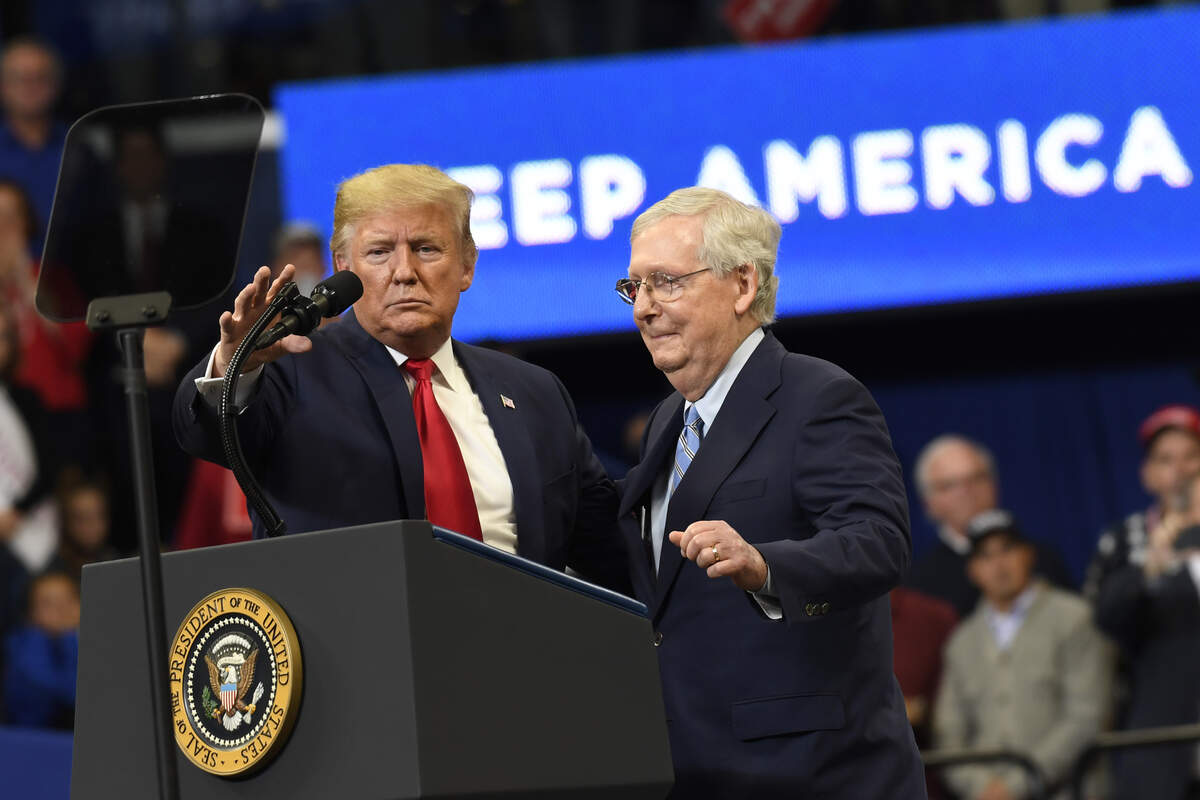
In 2016, when former House Speaker Paul Ryan and other Republican leaders often condemned Trump, McConnell went mostly silent.
After the election, McConnell quickly aligned himself with the president, shepherding U.S. Supreme Court Justice Brett Kavanugh through a contentious nomination, beating back Trump’s impeachment by the House of Representatives and reshaping the judicial system through the appointment of conservative judges.
It has bought him good will among some Kentucky Republicans. Sparks said McConnell has been “the leader we needed to protect our president and our republic.”
“The biggest chunk of that is the courts,” Lasley said. “He bought himself so much leeway with the courts and that has allowed him to be seen as enough of an ally. Even the folks who in the past have been critical have been able to move past it because of the courts.”
Still, Trump does not remain popular through all of Kentucky. Since 2016, Democratic margins in Lexington and Louisville have grown and Democrats have been eyeing Northern Kentucky as a place for potential Democratic gains after Gov. Andy Beshear won Campbell County and Kenton County. (Sparks said this won’t be replicated by McGrath because former Gov. Matt Bevin was a much weaker candidate than McConnell).
McGrath’s campaign has put a lot of focus on those suburbs, hoping they can follow Beshear’s path, which relied on large margins in the state’s biggest cities and the suburbs that surround them, along with some support in Eastern Kentucky.
“There are plenty of people who voted for Trump in 2016 that voted for Beshear in 2019,” McNee said.
Watson said McConnell’s campaign is trying to capitalize on enthusiasm for Trump while shoring up support in places where the president’s popularity has slipped.
“In the suburban places where Trump has lost support, he has to remind them of why they voted for him six years ago,” Watson said.
This story was originally published August 21, 2020 at 10:27 AM.