America is in a racial reckoning. What does that mean for McGrath and McConnell?
It was quiet in downtown Louisville last Wednesday evening. A father and son walked out of the Old Spaghetti Factory with takeout in hand. A few people gathered at tables outside the bars of Fourth Street Live!
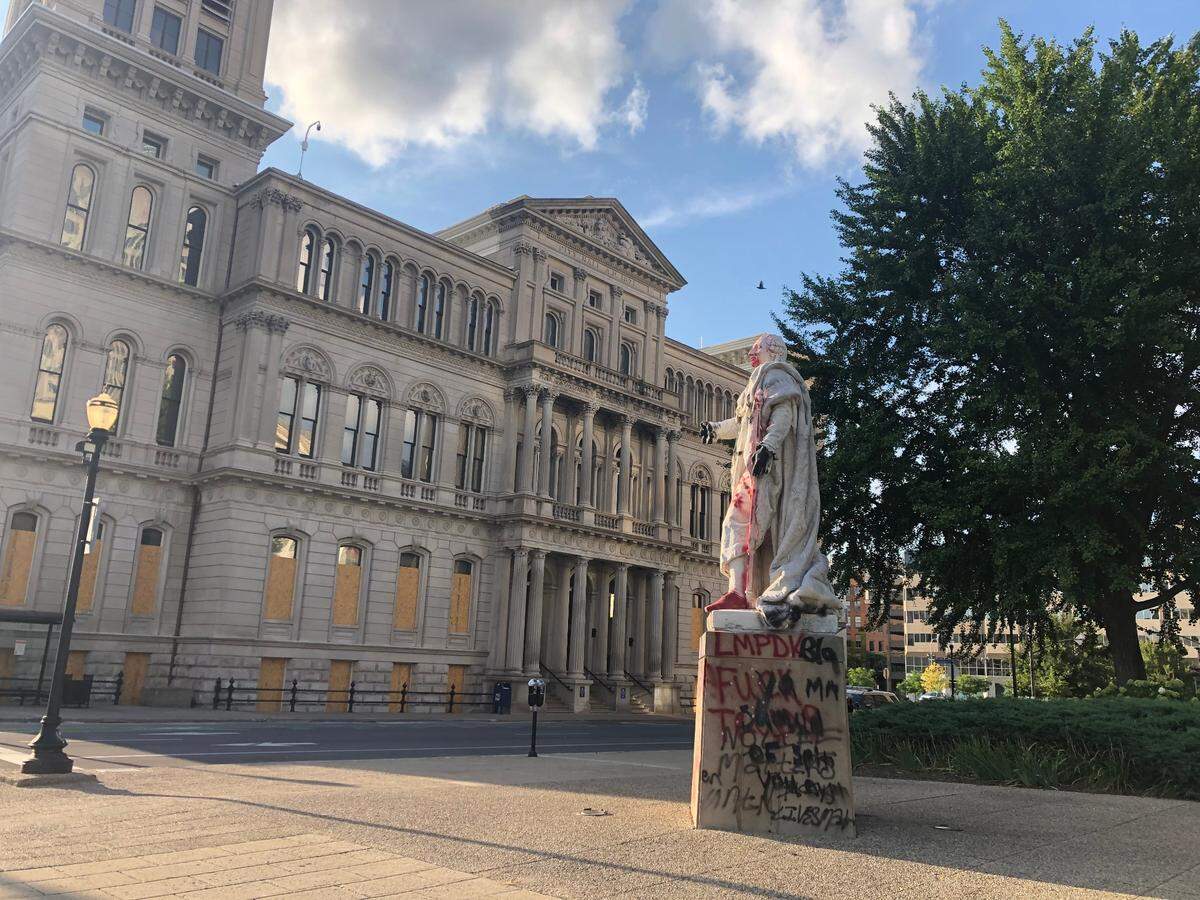
At Jefferson Square Park, now called Injustice Square Park by the demonstrators who spend time there, people milled about. Signs that are spread out in front of the memorial to Breonna Taylor during the day were grouped up under a blue tarp. The windows on the first floor of city hall, the county clerk’s office, the courthouse and the police department were covered with plywood.
Tyra Walker, 49, of Louisville, has been at the protests every night since they first started at the end of May. As she’s talking to a reporter, people come up to give her hugs.
“This is our constitutional right,” Walker said. “We have a right to a peaceful protest and that’s what we’re going to do. And we’re going to let our voices be heard and we’re going to get justice for Breonna Taylor and David McAtee.”
Kentucky — and the entire country — is in the midst of a reckoning on race. For four months, there have been protests over the treatment of Black Americans at the hands of law enforcement. In Kentucky, they have focused particularly on the death of Taylor, a 26-year-old emergency room technician who was shot and killed by police while they executed a no-knock warrant. Those protests have spread throughout the state over the summer, from Louisville and Lexington to Calloway County and Hazard.
The response has been polarized. To some, the protests represent an outpouring of grief and years of anger over the deaths of Black Americans at the hands of law enforcement. They demand immediate reform. Any violence that results is an unfortunate side effect.
To others, the resulting conflict and violence is the focus, a sign of destruction in American cities that detracts from the message of protesters and proves the need for police officers.
Those protests — and the partisan reaction to them — have the potential to shape the outcome of November’s election in Kentucky, where Democratic nominee Amy McGrath needs the support of white suburban voters in order to have any chance of unseating U.S. Senate Majority Leader Mitch McConnell.
McConnell’s campaign is focused on the violence, a feature of the traditional “law and order” campaign.
His ads do not feature peaceful protests. They do not talk about Taylor or George Floyd, who was killed by police in Minneapolis, or, most recently, Jacob Blake, who was shot seven times by a police officer in Kenosha, Wisconsin. Instead, they highlight riots in Portland, Oregon, where demonstrators have set fires and vandalized federal buildings.
“I mean this is politics,” said Billy Piper, a former McConnell chief of staff who now runs Fierce Government Relations in Washington, D.C. “You’re not going to get nuance in a 30 second ad. But I do think what’s going on in a lot of these cities has a lot of people scared.”
This is not a new campaign tactic. Since at least the 1960s, politicians have attempted to position themselves as law and order candidates. Targeted at conservatives and white voters in the suburbs where President Donald Trump has been slipping, the ads make a play toward fear at a fraught moment in American history.
“I think it might work in some states, but it seems like a strategy that was built for a certain period of time and I don’t know that it will be as effective in 2020,” said Christopher Stout, a political science professor at Oregon State University. “I think it’s basically betting on the past.”
The past
Dan Carter, an emeritus history professor at the University of South Carolina, saw McConnell’s ad highlighting violence at protests in Oregon and immediately drew a comparison to the 1968 presidential election.
Not to the “law and order” campaign of former President Richard Nixon, but to former Alabama Gov. George Wallace, who ran as a third party candidate that year.
“[The Wallace] ad tried very specifically to link the violence, anarchism, the threat to your personal safety, to both political parties but particularly to the Democratic Party,” said Carter, who wrote a biography about Wallace. “In that sense, the McConnell attempt to suggest that the Democratic Party is the party of violence and defunding police and leaving you unsafe in your homes, that to me is a direct connection to [Wallace].”
The reason we see this type of rhetoric in campaigns is relatively simple: it appears to work.
In 1968, the Nixon campaign highly emphasized law enforcement, pledging to “restore order” to American cities in a year roiled by assassinations, protests and riots over race relations and the war in Vietnam.
In 1988, polls showed Vice President George H.W. Bush trailing then Massachusetts Gov. Michael Dukakis heading into the party conventions in the summer. Bush launched an aggressive campaign of attack ads — including the infamous Willie Horton ad about a man who committed armed robbery and rape while on a weekend furlough from prison — and defeated Dukakis in November.
“People know that worked in 1968, that worked in 1972, it worked in 1988 with the Willie Horton ad,” Stout said. “And so people are saying ‘hey that type of advertisement is effective, I’m obviously going to do the same thing.’ But I think the main downside for that is we’re not in 1968, we’re not in 1988, we’re not even in 2000 — 2020 is a whole new year.”
While the ads may help motivate the conservative base of the Republican Party, they appear to be more geared toward white suburban voters and winning back the people who helped Democrats win control of the U.S. House of Representatives in 2018.
They also reflect Trump’s message, further cemented by the Republican National Convention where speakers, including McConnell, painted a dire image of the state of the country.
Trump won Kentucky by 30 percentage points in 2016. By playing up violence in other states — without mentioning the protests in Louisville — McConnell is attempting to both energize his base while playing on concerns of the suburban white voters who may have soured on the president.
“He’s trying to stoke divisions between Kentuckians who may not be connected to each other on a regular basis,” said state Rep. Attica Scott, D-Louisville, who has participated in the protests.
Still, the message builds upon a general feeling of concern. In downtown Louisville, where businesses and major government buildings are boarded up, a combination of the pandemic and unease over protests has built a perception among some that it’s unsafe to go downtown.
“It’s just the narrative. It’s the narrative,” said Shamari Parrish, 21, of Louisville. “White people act like they’re so scared of Black people and this, this and that. They need to think of Breonna Taylor who was asleep. And she got killed in the middle of the night in her sleep. By white people.”
That narrative carries electoral implications. Stout said he is skeptical it will work because public opinion has changed and voters, especially suburban women, have become more liberal on racial issues. Meanwhile, conservative Democratic swing voters of years past have left the Democratic Party.
“It’s a strategy that was built for a period of time where there were more swing voters, but doesn’t really work in a more polarized America,” Stout said.
Piper said he doesn’t think McConnell is trying to shut down one side of the discussion by focusing on the violence, pointing out McConnell has a record of supporting the First Amendment.
“Rallies are great, violence is not,” Piper said.
When asked why his message has focused on the more violent elements of the protests, McConnell said he had “limited tolerance” of vandalism, violence and looting and criticized the liberal talking point of defunding the police by putting resources into other social services.
“I have no patience whatsoever and no tolerance whatsoever for rioting, looting and violence,” McConnell said. “And I think it’s completely inappropriate to demonize all police departments because most of the police across America are trying to protect us all, they’re engaged in an enormously difficult job.”
Democratic disappointment
McGrath has pushed back on McConnell’s claims that she won’t denounce violence that has broken out after protests. Like most Democratic candidates, McGrath has denounced violence while focusing more on the protesters’ calls for change in policing.
“I fought for this country and wore the uniform so I am someone who believes in the laws of our land,” McGrath said after a voter event last week. “At the same time... nobody should be shot in the back seven times. You know we need change, you know we need to address this issue. So we have to do it and I think we should do it on the federal level on down.”
But the current social reckoning, and the Democratic base’s cries for immediate change, have plagued McGrath’s campaign.
In the Democratic primary, the protests provided an opportunity for her opponent, state Rep. Charles Booker, to capture the national spotlight. Her halting answer during a debate about why she hadn’t attended any of the protests (concerns about her family in light of the COVID-19 pandemic) was used in an attack ad by Booker.
Those criticisms have followed her into the general election.
McGrath’s campaign has focused more on winning over voters who may be dissatisfied with Trump or McConnell than getting out the Democratic base. It’s a strategy based on a grim reality for Democrats in Kentucky, where there are still slightly more registered Democrats than registered Republicans but voter patterns have shown an increasingly conservative bent in federal elections.
It’s also a strategy that has alienated her progressive base.
McGrath has spent time over the summer attempting to reach out to Black voters and has begun hiring more Black campaign staffers, including Denise Gray, who ran for the state Senate in Lexington in 2018.
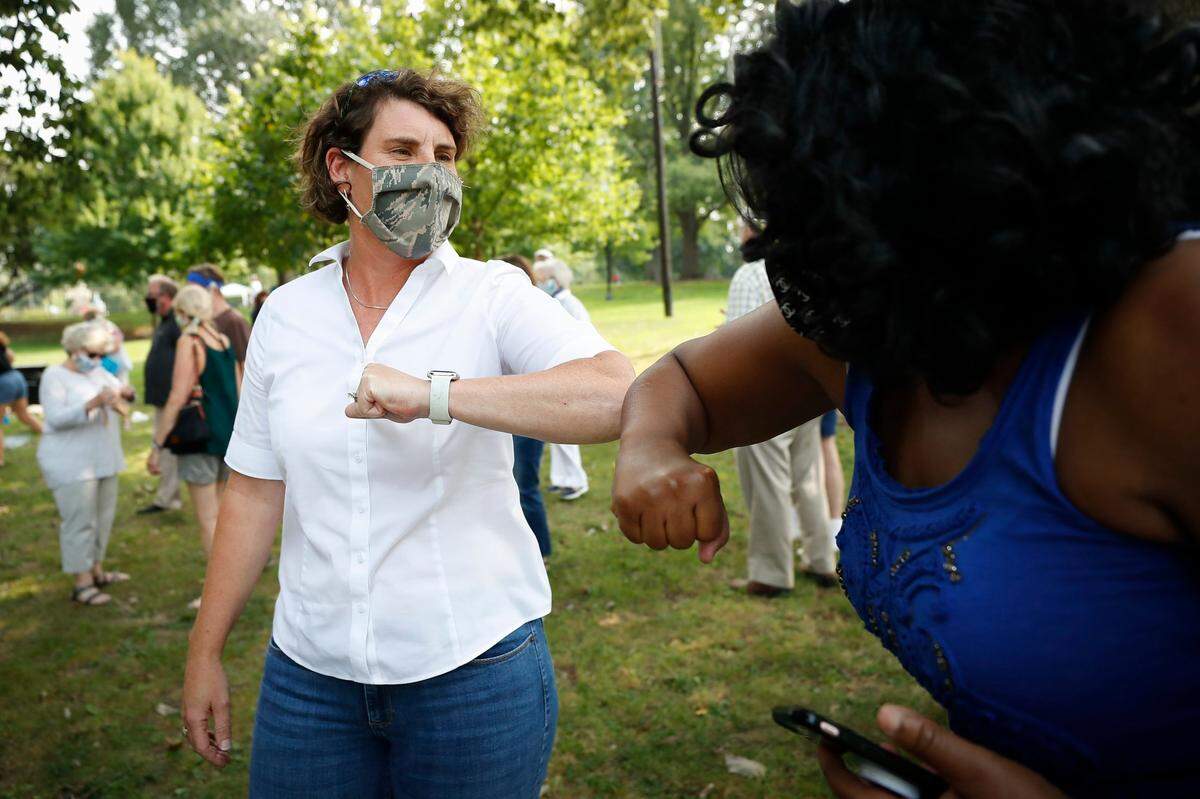
Her campaign has launched a voter registration drive to increase turnout among college students, African Americans and the 140,000 Kentuckians who had their voting rights restored by Gov. Andy Beshear after he took office. She’s criticized Attorney General Daniel Cameron’s investigation into Taylor’s killing.
Although her campaign has been reaching out to progressives, the overall messaging remains focused on moderate voters. In her response to McConnell’s ad about the protests, McGrath highlighted her military record instead of criticizing him for focusing on violence.
In a recent stump speech in Lexington, she included a line about racial and social injustice, focusing on the need for criminal justice reform and police reform. McConnell, too, supports a version of police reform, in his case a bill sponsored by Sen. Tim Scott of South Carolina, which differed on key issues from one proposed by House Democrats.
“I definitely feel like McGrath is not doing enough,” Rep. Attica Scott said. “And that’s because McGrath is also disconnected.”
Walker, who is a teacher at Jefferson County Public Schools, was for Booker in the Democratic primary. She said she felt like McGrath was trying, but that there is a learning curve in understanding the issues that are at the top of the mind for Black voters in Louisville.
She also felt that if Booker had won McConnell wouldn’t be talking negatively about the protests in the first place.
“Now he’s running against Amy McGrath, he thinks he has it in the bag,” Walker said. “The supporters that were supporting Booker, we are turning those supporters around and they will be supporting Amy McGrath this November.”
This story was originally published September 3, 2020 at 11:10 AM.